Get your free personalized podcast brief
We scan new podcasts and send you the top 5 insights daily.
A successful AI strategy isn't about replacing humans but smart integration. Marketing leaders should have their teams audit all workflows and categorize them into three buckets: fully automated by AI (AI-driven), enhanced by AI tools (AI-assisted), or requiring human expertise (human-driven). This creates a practical roadmap for adoption.

Related Insights
Despite hype, true 'autonomous marketing' is not imminent. AI excels at automating the first 80-90% of a workflow, but the final, most complex steps involving anomalies, nuance, and judgment still require a human. This 'last mile' problem ensures AI's role will be augmentation, not replacement.

AI excels at tasks like account scoring and initial insight gathering, providing a massive head start. However, the final strategic layer—interpreting the data and crafting the value proposition—requires human expertise. This "human first, AI fast" approach maximizes efficiency without sacrificing quality.

Implement AI effectively by allocating 10% of your time to human-led strategy (ideation), delegating 80% to AI for repetitive execution (research, list building), and reserving the final 10% for human review and integration. This framework ensures human taste and vision remain central to the process.

A critical error in AI integration is automating existing, often clunky, processes. Instead, companies should use AI as an opportunity to fundamentally rethink and redesign workflows from the ground up to achieve the desired outcome in a more efficient and customer-centric way.

When vetting an agency, ask how they integrate AI. The best answer isn't that they avoid it or use it to simply cut costs. Look for partners who use AI as a tool to augment human analysis, conduct deeper research, and ultimately make more informed strategic decisions.

Most AI tools focus on automation, which often produces more average, noisy content. The superior approach is augmentation—designing AI to enhance a marketer's abilities and produce exceptional, not average, work. This shifts the goal from creating "more" to creating "better."
Marketers mistakenly believe implementing AI means full automation. Instead, design "human-in-the-loop" workflows. Have an AI score a lead and draft an email, but then send that draft to a human for final approval via a Slack message with "approve/reject" buttons. This balances efficiency with critical human oversight.
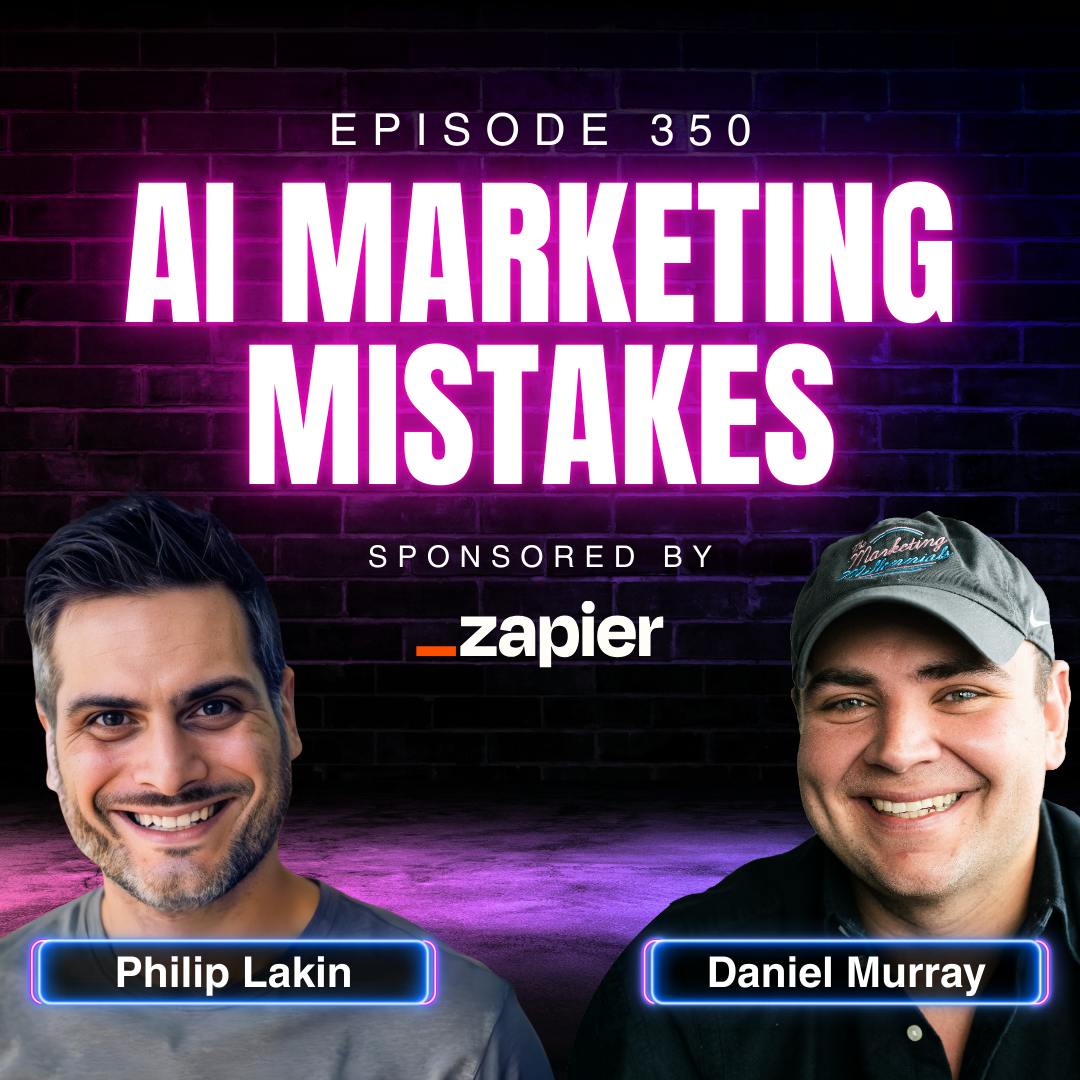
To get mainstream users to adopt AI, you can't ask them to learn a new workflow. The key is to integrate AI capabilities directly into the tools and processes they already use. AI should augment their current job, not feel like a separate, new task they have to perform.

To maximize AI's impact, don't just find isolated use cases for content or demand gen teams. Instead, map a core process like a campaign workflow and apply AI to augment each stage, from strategy and creation to localization and measurement. AI is workflow-native, not function-native.
Adopt a 'more intelligent, more human' framework. For every process made more intelligent through AI automation, strategically reinvest the freed-up human capacity into higher-touch, more personalized customer activities. This creates a balanced system that enhances both efficiency and relationships.
