Get your free personalized podcast brief
We scan new podcasts and send you the top 5 insights daily.
MuseCode's tendency to generate mock data instead of working with real data structures indicates its underlying model is a generation behind competitors like OpenAI and Anthropic. This behavior, common in older models, makes it difficult to use for practical application development without extensive hand-holding.

Related Insights
While competent on benchmarks and initial queries, many open-source models struggle with complex follow-up questions. This is likely because their web-scraped training data contains many simple explanations but lacks examples of nuanced, multi-step problem-solving or edge cases found in the real world.
According to research from Meta cited by Swyx, 50% of AI-generated code that passes the popular Sweebench benchmark is unmergable due to low quality. This highlights a major flaw in current evaluation methods, prompting a shift toward new benchmarks like Frontier Code that prioritize maintainability and human-level quality.

During a live test, multiple competing AI tools demonstrated the exact same failure mode. This indicates the flaw lies not with the individual tools but with the shared underlying language model (e.g., Claude Sonnet), a systemic weakness users might misattribute to a specific product.

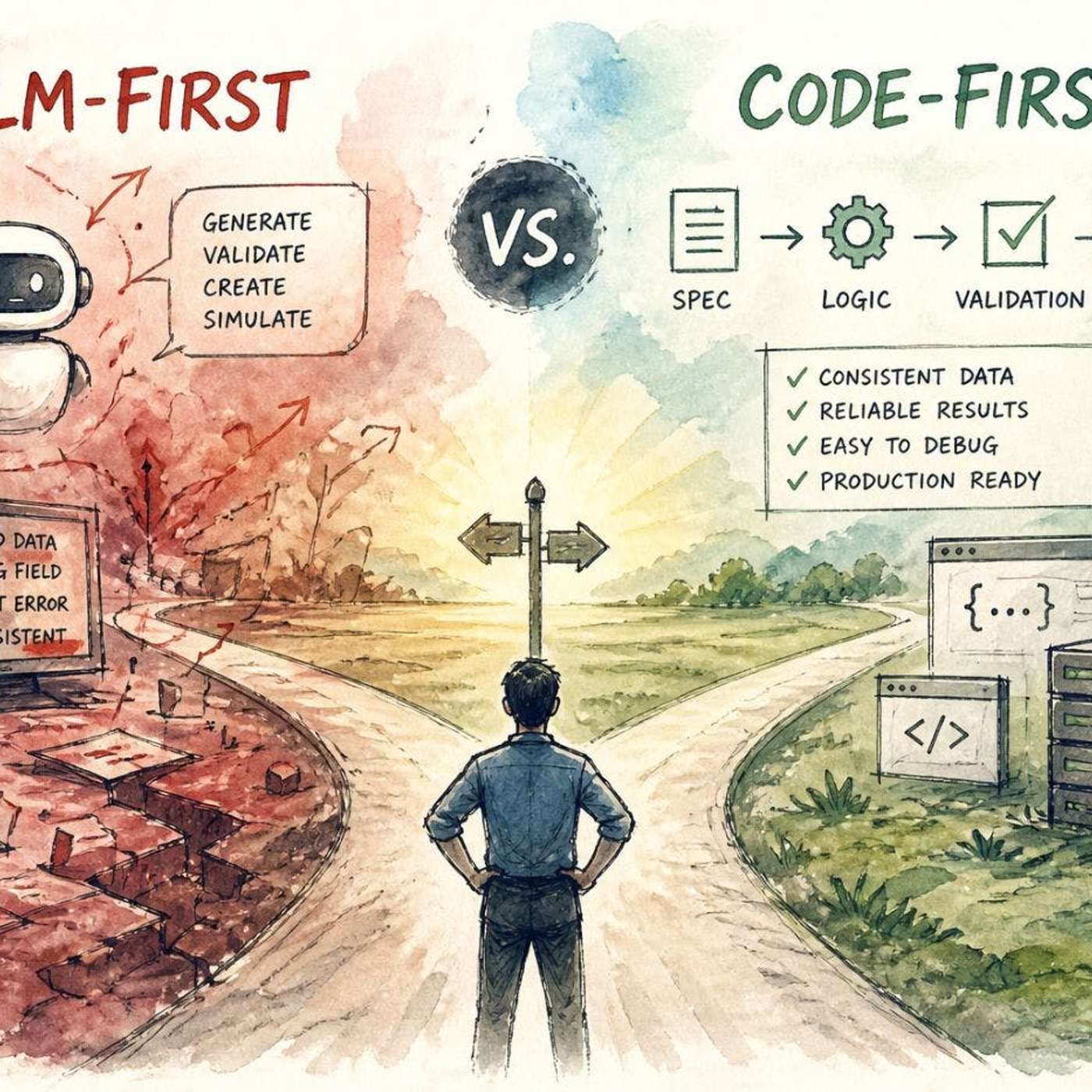
An 'LLM-first' approach, where the model handles core logic, creates impressive demos but lacks production reliability. A 'code-first' approach, using code for structure and LLMs for specific tasks, is less flashy but proves robust and debuggable in real-world applications.
AI platforms using the same base model (e.g., Claude) can produce vastly different results. The key differentiator is the proprietary 'agent' layer built on top, which gives the model specific tools to interact with code (read, write, edit files). A superior agent leads to superior performance.

An AI coding agent's performance is driven more by its "harness"—the system for prompting, tool access, and context management—than the underlying foundation model. This orchestration layer is where products create their unique value and where the most critical engineering work lies.

Meta's Muse Spark model card highlighted its top score in blue, implying overall superiority. Critics called this a "chart crime," as the model underperformed on other key benchmarks. This marketing tactic selectively visualizes data to create a false impression of a model's capabilities relative to competitors.

Anthropic's lead in AI coding is entrenched because developers are comfortable with its models. This user inertia creates a strong competitive moat, making it difficult for competitors like OpenAI or Google to win developers over, even with superior benchmarks.

Meta is developing a high-end AI agent called 'Hatch' priced at $200/month. The project's current reliance on Anthropic's Claude models during the testing phase suggests Meta's own foundational models are not yet ready for this type of advanced, off-platform agentic application, revealing a key strategic dependency.
An experiment revealed that the more architecturally powerful Claude Opus model created a "beautiful" but non-functional code structure. The project's tests passed only because the older, pre-existing code was still being executed, highlighting the risk of AI-driven over-engineering that isn't properly integrated.
