Get your free personalized podcast brief
We scan new podcasts and send you the top 5 insights daily.
The narrative of a direct US-China AI competition is largely an external viewpoint. According to reporting, Chinese AI developers don't orient their innovation around American benchmarks. Instead, they are driven by pragmatic, internal goals and their own vision for what AI should be, rather than simply trying to outcompete Western models.

Related Insights
Contrary to common Western assumptions, China's official AI blueprint focuses on practical applications like scientific discovery and industrial transformation, with no mention of AGI or superintelligence. This suggests a more grounded, cautious approach aimed at boosting the real economy rather than winning a speculative tech race.

China's AI strategy is less focused on achieving AGI and more on the immediate, practical diffusion of AI technology throughout its economy. The government's "AI+" plan emphasizes embedding AI into existing applications like WeChat and high-impact sectors like healthcare, aiming for broad, pragmatic adoption now.

The US AI strategy is dominated by a race to build a foundational "god in a box" Artificial General Intelligence (AGI). In contrast, China's state-directed approach currently prioritizes practical, narrow AI applications in manufacturing, agriculture, and healthcare to drive immediate economic productivity.

Unlike the Western discourse, which is often framed as a race to achieve AGI by a certain date, the Chinese AI community has significantly less discussion of specific AGI timelines or a clear "finish line." The focus is on technological self-sufficiency, practical applications, and commercial success.
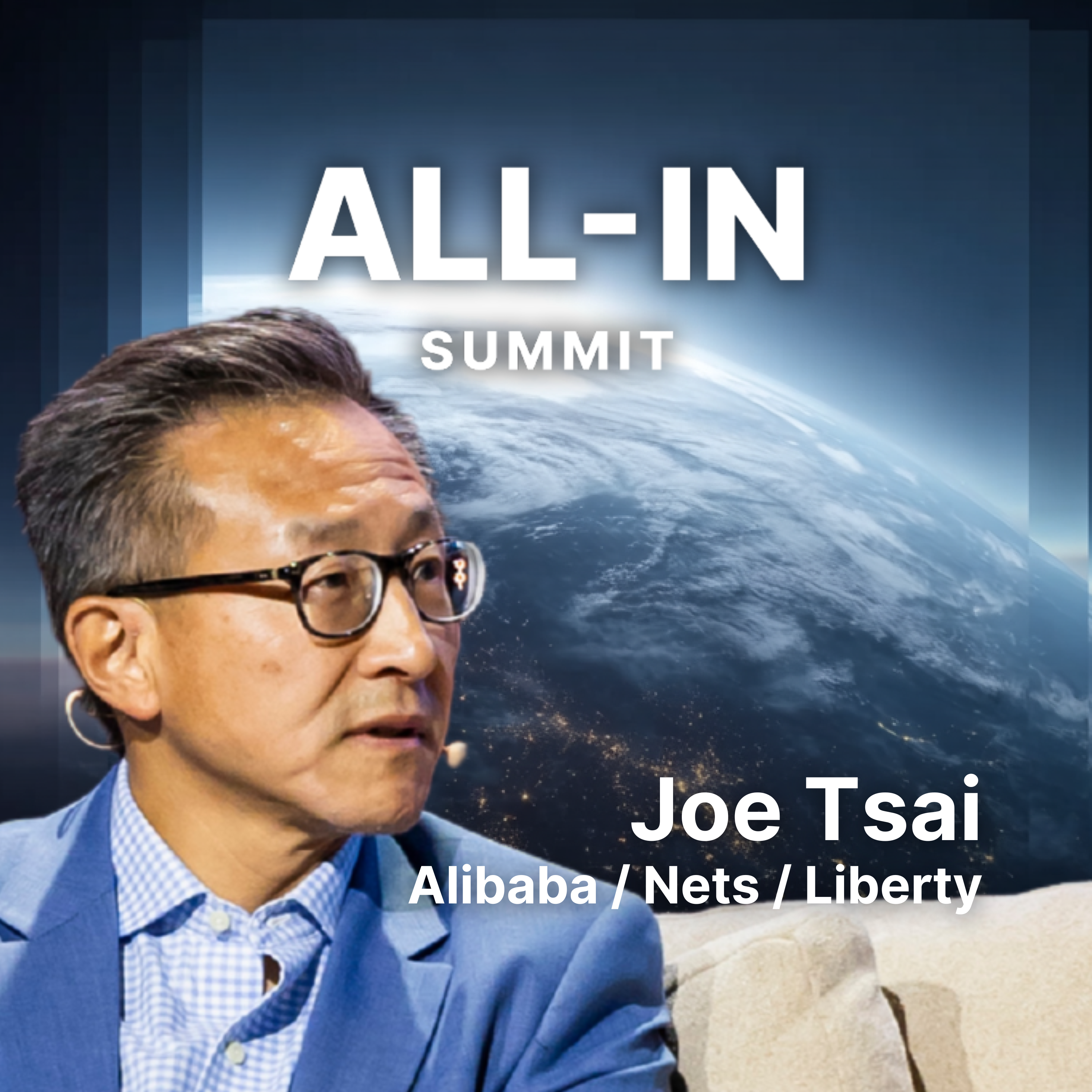
Joe Tsai reframes the US-China 'AI race' as a marathon won by adoption speed, not model size. He notes China’s focus on open source and smaller, specialized models (e.g., for mobile devices) is designed for faster proliferation and practical application. The goal is to diffuse technology throughout the economy quickly, rather than simply building the single most powerful model.
Author Chris Miller posits that China's relatively low AI infrastructure spending isn't a long-term strategic play, but a sign that its leadership isn't as "AGI-pilled" as the U.S. Their preference for domestic chips over superior foreign ones indicates a focus on self-reliance rather than winning the AI race at all costs.

A key strategic difference in the AI race is focus. US tech giants are 'AGI-pilled,' aiming to build a single, god-like general intelligence. In contrast, China's state-driven approach prioritizes deploying narrow AI to boost productivity in manufacturing, agriculture, and healthcare now.

Framing the US-China AI dynamic as a zero-sum race is inaccurate. The reality is a complex 'coopetition' where both sides compete, cooperate on research, and actively co-opt each other's open-weight models to accelerate their own development, creating deep interdependencies.

While the US tech narrative focuses on achieving AGI (superintelligence), China prioritizes practical AI applications (superutility) that address immediate societal problems like labor gaps and healthcare access. This leads to faster, more visible, and widespread adoption among its populace.

While U.S. firms race towards the abstract goal of Artificial General Intelligence (AGI), China is pursuing a more practical strategy. Its focus on applying AI to robotics for industrial automation could yield more immediate, tangible economic transformations and productivity gains on a mind-boggling scale.
