Get your free personalized podcast brief
We scan new podcasts and send you the top 5 insights daily.
Author Chris Miller posits that China's relatively low AI infrastructure spending isn't a long-term strategic play, but a sign that its leadership isn't as "AGI-pilled" as the U.S. Their preference for domestic chips over superior foreign ones indicates a focus on self-reliance rather than winning the AI race at all costs.

Related Insights
Contrary to common Western assumptions, China's official AI blueprint focuses on practical applications like scientific discovery and industrial transformation, with no mention of AGI or superintelligence. This suggests a more grounded, cautious approach aimed at boosting the real economy rather than winning a speculative tech race.

The US AI strategy is dominated by a race to build a foundational "god in a box" Artificial General Intelligence (AGI). In contrast, China's state-directed approach currently prioritizes practical, narrow AI applications in manufacturing, agriculture, and healthcare to drive immediate economic productivity.

Unlike the Western discourse, which is often framed as a race to achieve AGI by a certain date, the Chinese AI community has significantly less discussion of specific AGI timelines or a clear "finish line." The focus is on technological self-sufficiency, practical applications, and commercial success.
Facing semiconductor shortages, China is pursuing a unique AI development path. Instead of competing directly on compute power, its strategy leverages national strengths in vast data sets, a large talent pool, and significant power infrastructure to drive AI progress and a medium-term localization strategy.

The US public and private sectors are overwhelmingly focused on AI, creating a potential strategic myopia. In contrast, China's five-year plan reveals a more diversified portfolio approach, with heavy investment not only in AI but also in green energy, robotics, and other critical technologies.

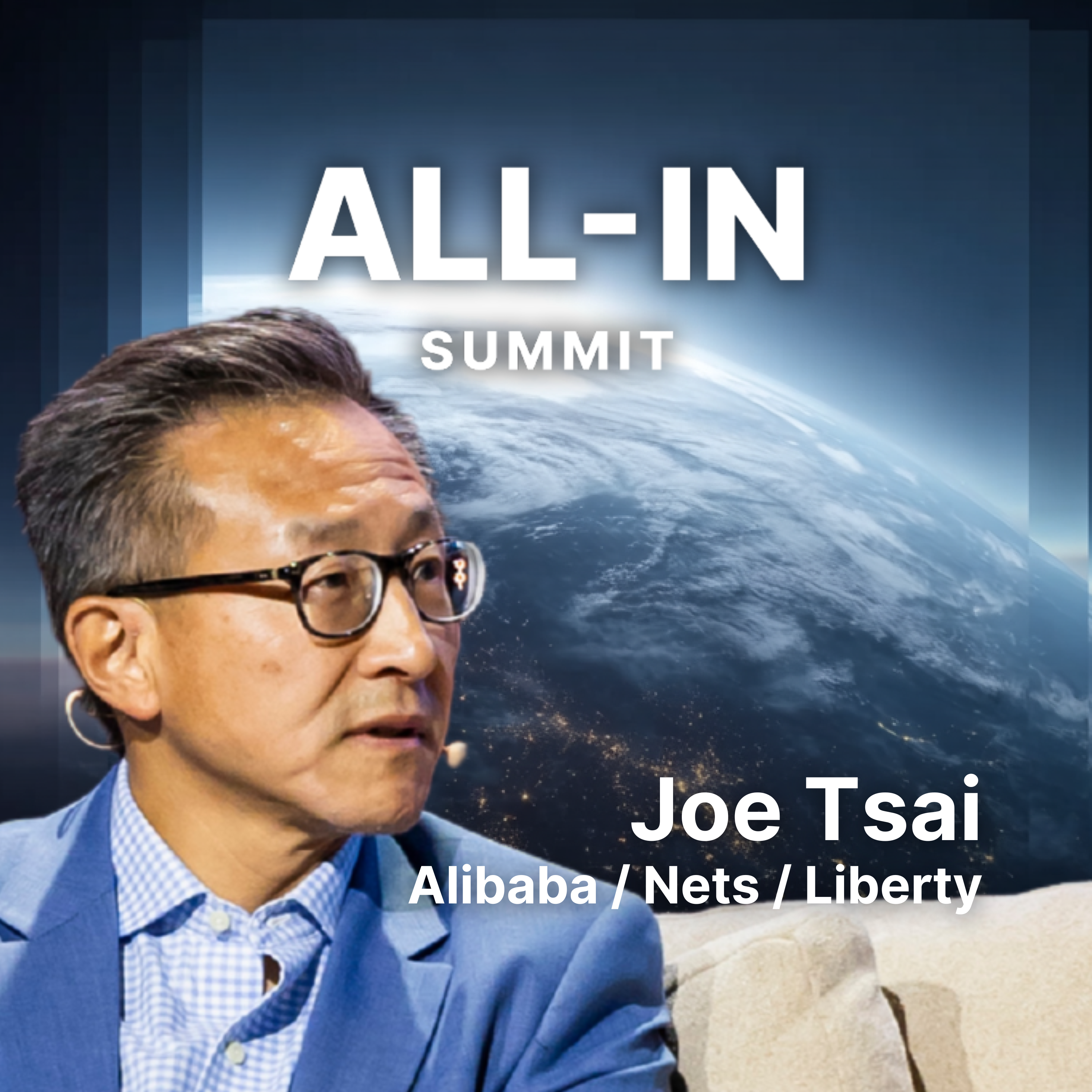
Joe Tsai reframes the US-China 'AI race' as a marathon won by adoption speed, not model size. He notes China’s focus on open source and smaller, specialized models (e.g., for mobile devices) is designed for faster proliferation and practical application. The goal is to diffuse technology throughout the economy quickly, rather than simply building the single most powerful model.
The argument that the U.S. must race to build superintelligence before China is flawed. The Chinese Communist Party's primary goal is control. An uncontrollable AI poses a direct existential threat to their power, making them more likely to heavily regulate or halt its development rather than recklessly pursue it.

A key strategic difference in the AI race is focus. US tech giants are 'AGI-pilled,' aiming to build a single, god-like general intelligence. In contrast, China's state-driven approach prioritizes deploying narrow AI to boost productivity in manufacturing, agriculture, and healthcare now.

The US and China have divergent AI strategies. The US is pouring capital into massive compute clusters to build dominant global platforms like ChatGPT (aggregation theory). China is focusing its capital on building a self-sufficient, domestic semiconductor and AI supply chain to ensure technological independence.
![Dylan Patel - Inside the Trillion-Dollar AI Buildout - [Invest Like the Best, EP.442] thumbnail](https://megaphone.imgix.net/podcasts/799253cc-9de9-11f0-8661-ab7b8e3cb4c1/image/d41d3a6f422989dc957ef10da7ad4551.jpg?ixlib=rails-4.3.1&max-w=3000&max-h=3000&fit=crop&auto=format,compress)
China is compensating for its deficit in cutting-edge semiconductors by pursuing an asymmetric strategy. It focuses on massive 'superclusters' of less advanced domestic chips and creating hyper-efficient, open-source AI models. This approach prioritizes widespread, low-cost adoption over chasing the absolute peak of performance like the US.
