Get your free personalized podcast brief
We scan new podcasts and send you the top 5 insights daily.
The manufacturing process for Brexicel CAR-T in ALL differs from other products like Axicel. It isolates T-cells first to avoid contamination from circulating leukemia blasts. This crucial step prevents the T-cells from becoming over-activated or exhausted before they are even reinfused into the patient, preserving their potency.

Related Insights
While in vivo CAR-T therapies eliminate complex ex vivo manufacturing, they introduce a new critical variable: the patient's own immune system. The therapy's efficacy relies on modifying T-cells within the body, but each patient's immune status is different, especially after prior treatments. This makes optimizing and standardizing the dose a significant challenge compared to engineered cell therapies.
The success of early CAR-T cell therapies was partly luck. Future therapies face a high bar, as an ideal target must meet three criteria: 1) be abundant on cancer cells, 2) be indispensable for the cancer's survival, and 3) be dispensable for the patient's healthy tissues to avoid lethal toxicity.

An investigational in vivo CAR-T therapy uses viral particles infused directly into the patient to convert their T-cells into CAR-T cells. This approach eliminates the complex steps of apheresis, lymphodepletion, and ex vivo manufacturing, effectively creating an off-the-shelf product that becomes an autologous treatment inside the body.
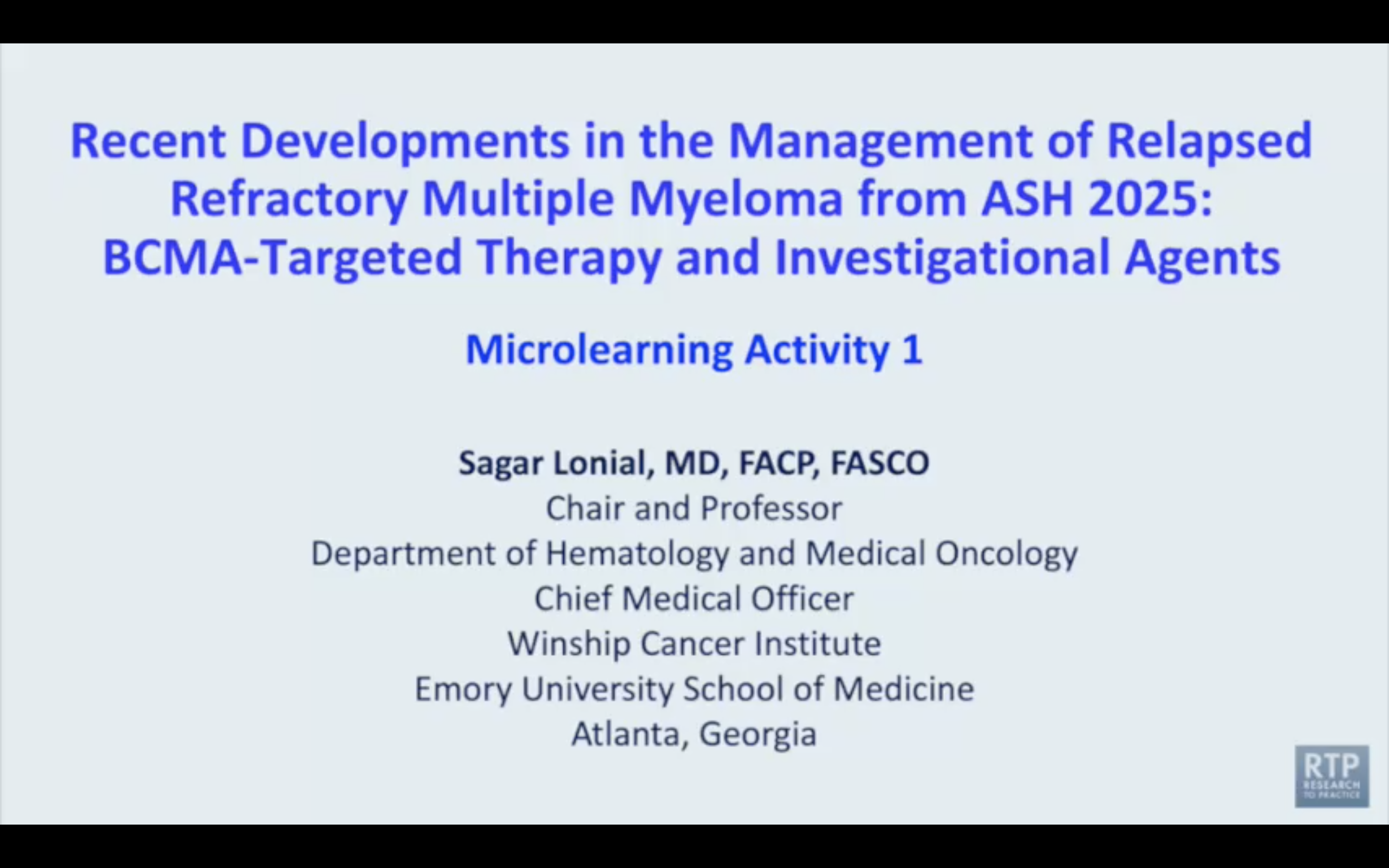
The efficacy of Siltacel stems from a powerful initial expansion that eliminates cancer upfront. The CAR-T cells are often undetectable beyond six months, indicating their curative potential comes from an overwhelming initial response rather than persistent, long-term immune policing of the disease.

Early data from an in vivo CAR-T therapy suggests a paradigm shift is possible. By engineering T-cells directly inside the patient with a simple infusion, this approach could eliminate the need for leukapheresis and external manufacturing, completely disrupting the current cell therapy model.

Unlike older IMiDs where T-cell effects are secondary, CELMoDs have a powerful, independent pro-T-cell mechanism. This dual action is so significant that in the future, CELMoDs will be prescribed not just for their direct anti-myeloma effects, but specifically to enhance the efficacy of T-cell therapies like CAR-T and bispecific antibodies.
While many cell therapies rely on complex genetic engineering with viral vectors, Adaptin Bio manipulates patient T-cells without it. This simpler, non-viral process is a strategic choice to reduce costs, speed up manufacturing, and make the therapy accessible to a broader patient population.
Using a BCMA bispecific antibody first can exhaust a patient's T-cells or cause tumors to lose the BCMA target, rendering a subsequent BCMA-targeted CAR-T therapy ineffective. The optimal sequence is CAR-T first, which preserves T-cell function and BCMA expression, leaving bispecifics as a viable later-line option.
Unlike autologous therapies where one batch treats one patient, a single batch of an allogeneic therapy can treat thousands. This scalability advantage creates a higher regulatory bar. Authorities demand exceptional robustness in the manufacturing process to ensure consistency and safety across a vast patient population, making the quality control challenge fundamentally different and more rigorous.
The success of CAR-T therapy hinges on the quality of the patient's own lymphocytes. Procuring T-cells earlier in the disease course, before they become exhausted from numerous prior therapies, results in a higher proportion of naive T-cells, leading to better CAR-T cell manufacturing and clinical outcomes.