Get your free personalized podcast brief
We scan new podcasts and send you the top 5 insights daily.
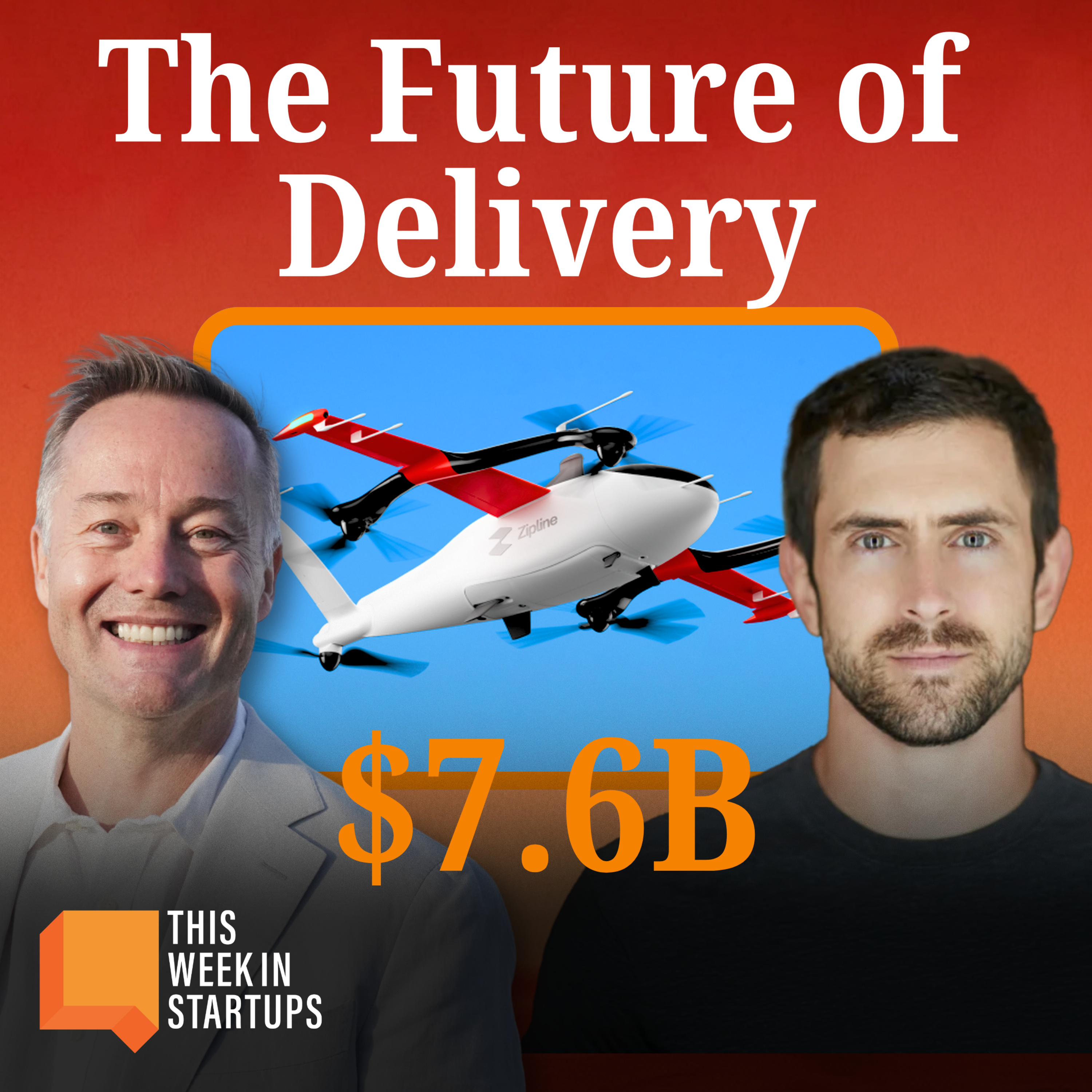
Shifting from a one-pilot-per-drone model, Zipline now employs "Fleet Commanders" who oversee up to 100 aircraft. Inspired by "Ender's Game," this role focuses on strategic system management rather than direct control, representing a significant evolution in human oversight of large-scale autonomous systems.

Related Insights
Skydio's CEO details the drone industry's progression: from raw stick-to-motor commands, to microprocessor-stabilized attitude control, to GPS position hold, and finally to AI-driven computer vision. Each step abstracted low-level flight control, making drones progressively more accessible and autonomous.

Skydio's drones are designed as 'force multipliers' where AI handles complex tasks like navigation, obstacle avoidance, and subject tracking. This frees the human operator to focus on high-level mission objectives, like assessing a situation, rather than the mechanics of flying the drone.

The founders initially focused on building the autonomous aircraft. They soon realized the vehicle was only 15% of the problem's complexity. The real challenge was creating the entire logistics ecosystem around it, from inventory and fulfillment software to new procedures for rural hospitals.

The future of work isn't just using AI as a tool, but managing it. Greg Brockman describes a paradigm where users act as high-level overseers, setting goals for a "fleet of agents" that handle the low-level execution, abstracting away details like clicking buttons or writing specific formulas.

Zipline's CEO reveals the aircraft is a small part of their solution. The real challenge and value lie in the vertically integrated network: ground infrastructure, traffic management, regulatory approval, and customer-facing apps.
The next evolution of work will involve humans acting as orchestrators for "swarms" of specialized AI agents. A manager will direct a team of agents—each trained for a specific function like email marketing or media buying—to collaboratively execute complex projects with high levels of autonomy.

The paradigm for employees shifts from being an individual contributor to being a manager of AI agents. Success is no longer just direct output, but the ability to effectively set up, direct, and manage a team of autonomous agents to achieve goals.

Zipline learned the physical drone is a small fraction of the complexity. The majority lies in building auxiliary software, maintenance systems, inventory management, and integrations with civil aviation and healthcare systems to create a reliable logistics service.
As AI agents begin to run entire business departments like finance or sales, the role of human leadership will pivot. Instead of managing people's day-to-day tasks, leaders will become "directors of the AI," focusing on high-level strategy, sequencing, and handling exceptions.

Skydio's CEO argues the drone industry is transitioning from manually-operated "tools" to a new paradigm of autonomous, internet-connected drones that live in docking stations. This shift treats drones as infrastructure, enabling remote and automated operations that will have an orders-of-magnitude greater impact.