Get your free personalized podcast brief
We scan new podcasts and send you the top 5 insights daily.
Poolside rejected the standard practice of packaging and copying datasets to training clusters. Instead, they stream data just-in-time. This allows training to start immediately, even while data is still materializing, and makes experimenting with data mixes a simple configuration change, dramatically accelerating the research cycle.

Related Insights
The "Bitter Lesson" is not just about using more compute, but leveraging it scalably. Current LLMs are inefficient because they only learn during a discrete training phase, not during deployment where most computation occurs. This reliance on a special, data-intensive training period is not a scalable use of computational resources.

The primary driver of success in large-scale model training is the ability to conduct numerous experiments daily. A robust infrastructure that minimizes cycle time for testing hypotheses provides a greater advantage than focusing solely on developing new algorithms.

Instead of expensive, static pre-training on proprietary data, enterprises prefer RAG. This approach is cheaper, allows for easy updates as data changes, and benefits from continuous improvements in foundation models, making it a more practical and dynamic solution.

Unlike traditional ML where models are repeatedly trained on a fixed dataset, each frontier LLM pre-training run uses more compute than ever before. This makes it a one-shot endeavor where success hinges on accurately predicting final performance from smaller-scale experiments using scaling laws.
Poolside views model building as an industrialized, end-to-end process, optimizing for the speed from a researcher's idea to a trusted experimental result. This engineering-first approach uses thousands of components to streamline everything from data pipelines to training and reinforcement learning, treating models as artifacts of the process.
The value of serverless multi-node training isn't competing with massive pre-training clusters. Its sweet spot is smaller-scale post-training and fine-tuning, where researchers need elasticity to run many small, bursty experiments without managing a dedicated cluster.
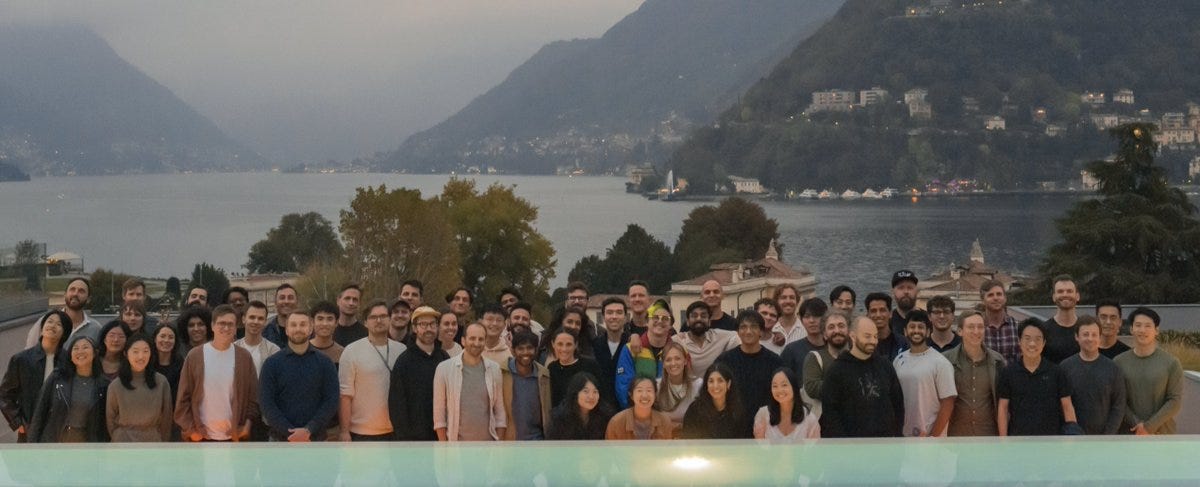
When scaling AI-driven experiments, the key metric is not raw throughput but iteration time. Rapid, sequential learning cycles, even on a smaller scale, compound knowledge more effectively for the AI model than large, slow, and noisy multiplexed experiments.
Static data scraped from the web is becoming less central to AI training. The new frontier is "dynamic data," where models learn through trial-and-error in synthetic environments (like solving math problems), effectively creating their own training material via reinforcement learning.

Traditional ML used "micro-batching" by normalizing inputs to the same size. LLMs break this model due to variable input/output lengths. The core innovation is continuous processing, handling one token at a time across all active requests, which creates complex scheduling and memory challenges solved by techniques like PagedAttention.

Despite its perceived complexity, the core work of building foundation models boils down to two things. Researchers are either improving the data going into the model or finding breakthroughs (in architecture, inference, etc.) that improve compute efficiency. This is a powerful, simplifying framework for a complex field.