Get your free personalized podcast brief
We scan new podcasts and send you the top 5 insights daily.
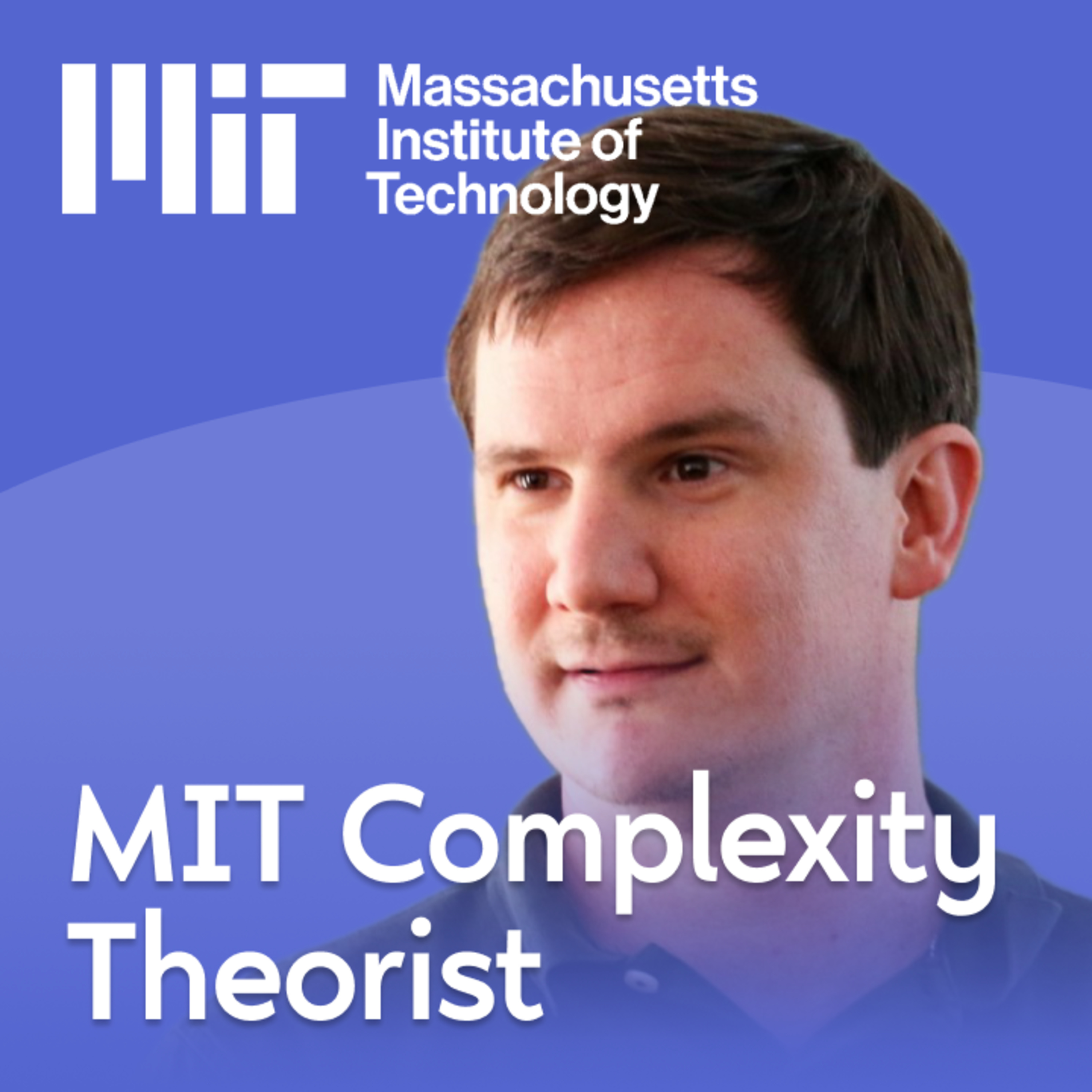
Professor Williams assigns only 80% confidence to P != NP, lower than his peers. His rationale is that our intuition about computational limits is frequently proven wrong by surprising new algorithms. The vast, unexplored space of algorithms makes a definitive conclusion more uncertain than widely believed.
Related Insights
The success of neural networks on problems like Go and protein folding, long considered intractable NP-hard problems, is profound. It suggests our formal understanding of computational hardness, which focuses on worst-case scenarios, may be an incomplete model for how to find useful, approximate solutions in practice.

P represents problems we can solve, while NP represents problems where a solution can be easily verified. If P=NP, any problem with a verifiable solution could be efficiently solved, implying we can know everything we want to know. It's a question about the ultimate limits of discovery.
The "low-hanging fruit" argument for diminishing returns in science is flawed because it assumes a static problem space. Progress is often explosive when entirely new fields, like computer science, emerge from other domains, opening up a fresh landscape of easy problems where rapid breakthroughs are once again possible.

MIT Professor Ryan Williams operates as if the Strong Exponential Time Hypothesis (SETH) is false. This belief forces him to discard standard approaches and explore novel algorithmic ideas. His failed attempts to refute SETH have led to unexpected solutions for other important problems.
The "hardness versus randomness" paradigm reveals a deep connection: if a problem is computationally hard (like P≠NP is believed to be), its unpredictability can be used to construct pseudorandom generators. These generators turn a few true random bits into long sequences that can derandomize any efficient probabilistic algorithm.
The history of AI, such as the 2012 AlexNet breakthrough, demonstrates that scaling compute and data on simpler, older algorithms often yields greater advances than designing intricate new ones. This "bitter lesson" suggests prioritizing scalability over algorithmic complexity for future progress.

Our current computation, based on Turing machines, is limited to "computable functions." However, mathematics shows this set is a smaller, countable infinity compared to the vast, larger infinity of non-computable functions. This implies our current simulations barely scratch the surface of what is mathematically possible.

Humanity's intellectual pursuits, from science to engineering, inherently focus on problems where a potential solution can be verified upon discovery. We wouldn't begin searching for something if we couldn't recognize it once found, which is the definition of an NP problem.
While problems like protein folding are NP-hard in theory, the instances found in nature have structural properties that allow for efficient solutions. Real-world cases of NP-hard problems aren't the adversarial, worst-case scenarios used in complexity proofs, explaining the gap between theory and practice.
For some NP-hard problems, like 3-SAT, a random guess satisfies 7/8ths of clauses. The PCP theorem proves that finding a solution satisfying just an epsilon more (7/8 + ε) is as computationally hard as finding a perfect 100% solution. This places severe limits on approximation algorithms.