/
© 2026 RiffOn. All rights reserved.

Get your free personalized podcast brief

We scan new podcasts and send you the top 5 insights daily.

  1. The Peterman Pod
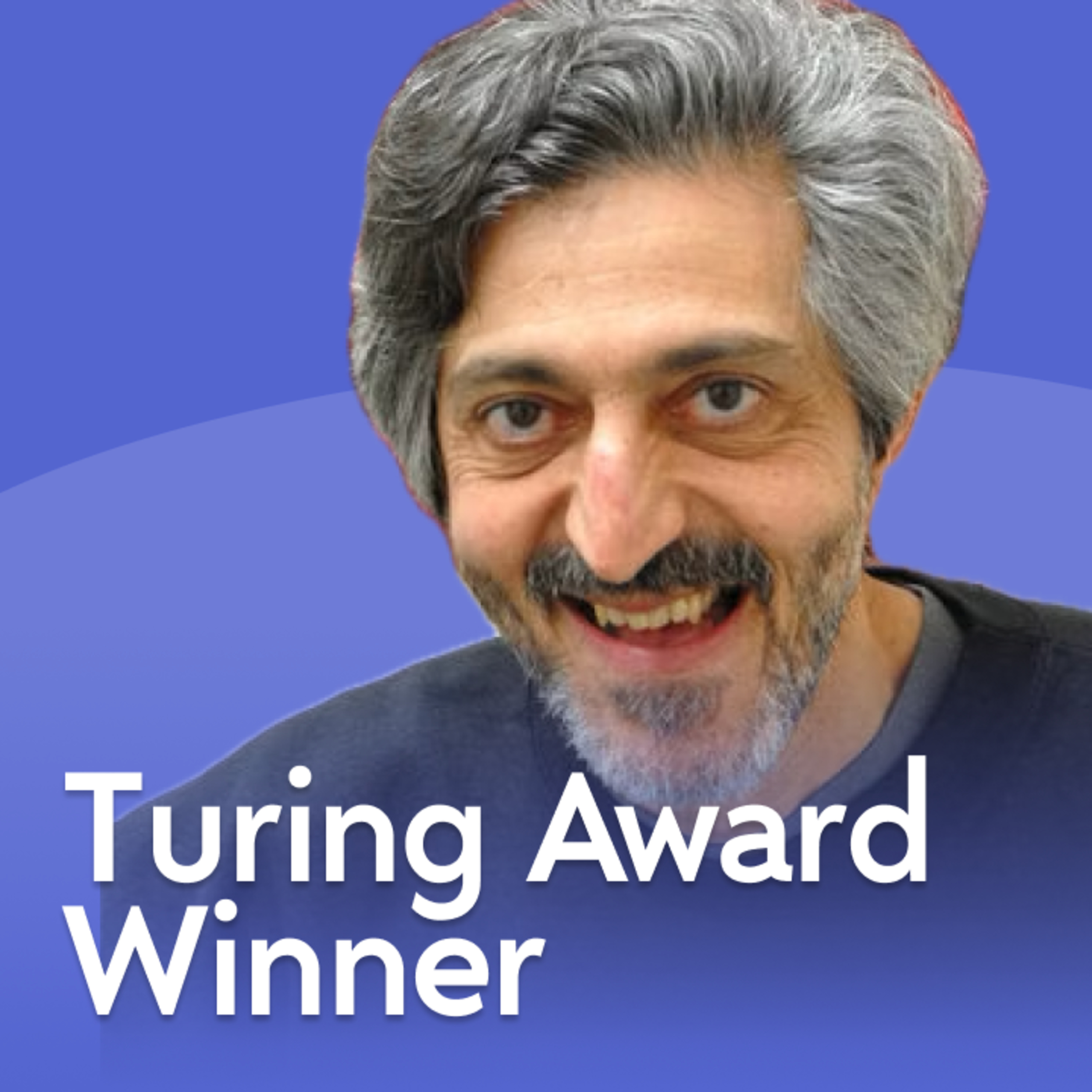
  2. Turing Award Winner: P vs NP, Zero-Knowledge Proofs, Quantum Computation | Avi Wigderson
Turing Award Winner: P vs NP, Zero-Knowledge Proofs, Quantum Computation | Avi Wigderson

Turing Award Winner: P vs NP, Zero-Knowledge Proofs, Quantum Computation | Avi Wigderson

The Peterman Pod · Jun 1, 2026

Turing Award winner Avi Wigderson on P vs NP, the subjectivity of randomness, zero-knowledge proofs, and the future of quantum computation.

Randomness Is Relative; Its Quality Depends Entirely on the Observer's Computational Power

A coin toss is random to a human but predictable to a supercomputer with high-speed cameras. This shows randomness is not an inherent property of an event, but a reflection of an observer's inability to compute the outcome. The less powerful the observer, the more random an event appears.

Turing Award Winner: P vs NP, Zero-Knowledge Proofs, Quantum Computation | Avi Wigderson thumbnail

Turing Award Winner: P vs NP, Zero-Knowledge Proofs, Quantum Computation | Avi Wigderson

The Peterman Pod·14 hours ago

Quantum Proof Systems Can Verify Solutions to Uncomputable Problems Like the Halting Problem

The landmark result MIP*=RE proves that an interactive proof system with multiple, entangled quantum provers can convince a classical verifier of solutions to problems that are fundamentally uncomputable by any classical algorithm. This shatters the classical boundaries of computation and verification.

Turing Award Winner: P vs NP, Zero-Knowledge Proofs, Quantum Computation | Avi Wigderson thumbnail

Turing Award Winner: P vs NP, Zero-Knowledge Proofs, Quantum Computation | Avi Wigderson

The Peterman Pod·14 hours ago

Randomness Is a Computational Resource with Varying Costs and Quality, Not a Physical Property

In algorithm design, randomness isn't free. High-quality random bits (from quantum sources) are expensive, while cheaper sources (thermal noise) have lower quality. This reframes randomness as a resource to be managed and minimized, just like time or space complexity.

Turing Award Winner: P vs NP, Zero-Knowledge Proofs, Quantum Computation | Avi Wigderson thumbnail

Turing Award Winner: P vs NP, Zero-Knowledge Proofs, Quantum Computation | Avi Wigderson

The Peterman Pod·14 hours ago

SAT Solvers Dominate Practical NP Problem Solving Due to Highly Optimized Heuristics

While any NP-complete problem can be reduced to another, SAT solvers are the practical choice because of the immense effort poured into developing heuristics that efficiently handle the structured instances arising in real-world applications. Their advantage lies in engineering, not pure theory.

Turing Award Winner: P vs NP, Zero-Knowledge Proofs, Quantum Computation | Avi Wigderson thumbnail

Turing Award Winner: P vs NP, Zero-Knowledge Proofs, Quantum Computation | Avi Wigderson

The Peterman Pod·14 hours ago

Computationally Hard Problems Form the Bedrock of Powerful Pseudorandom Generators

The "hardness versus randomness" paradigm reveals a deep connection: if a problem is computationally hard (like P≠NP is believed to be), its unpredictability can be used to construct pseudorandom generators. These generators turn a few true random bits into long sequences that can derandomize any efficient probabilistic algorithm.

Turing Award Winner: P vs NP, Zero-Knowledge Proofs, Quantum Computation | Avi Wigderson thumbnail

Turing Award Winner: P vs NP, Zero-Knowledge Proofs, Quantum Computation | Avi Wigderson

The Peterman Pod·14 hours ago

We Only Pursue Problems in NP Because We Must Be Able to Recognize a Solution

Humanity's intellectual pursuits, from science to engineering, inherently focus on problems where a potential solution can be verified upon discovery. We wouldn't begin searching for something if we couldn't recognize it once found, which is the definition of an NP problem.

Turing Award Winner: P vs NP, Zero-Knowledge Proofs, Quantum Computation | Avi Wigderson thumbnail

Turing Award Winner: P vs NP, Zero-Knowledge Proofs, Quantum Computation | Avi Wigderson

The Peterman Pod·14 hours ago

Non-Commutative Algebra Enables Counting Arbitrarily High Using Only Constant Memory

It's possible to solve problems like finding the majority element in a bit string using constant memory, regardless of the string's length. This is achieved by encoding computations as sequences of operations in a non-commutative group, defying the intuition that counting requires logarithmic space to store a counter.

Turing Award Winner: P vs NP, Zero-Knowledge Proofs, Quantum Computation | Avi Wigderson thumbnail

Turing Award Winner: P vs NP, Zero-Knowledge Proofs, Quantum Computation | Avi Wigderson

The Peterman Pod·14 hours ago

Weak, Biased Random Sources Can Be Purified into High-Quality Randomness Using Extractor Algorithms

The theory of randomness extraction provides methods to take a long string of bits from a weak source (e.g., weather data) and distill it into a shorter string of nearly perfect, uniformly random bits. This is crucial for using real-world physical phenomena as a viable source for cryptographic applications.

Turing Award Winner: P vs NP, Zero-Knowledge Proofs, Quantum Computation | Avi Wigderson thumbnail

Turing Award Winner: P vs NP, Zero-Knowledge Proofs, Quantum Computation | Avi Wigderson

The Peterman Pod·14 hours ago

Real-World NP-Hard Problems Are Solvable Because They Possess Hidden Structure

While problems like protein folding are NP-hard in theory, the instances found in nature have structural properties that allow for efficient solutions. Real-world cases of NP-hard problems aren't the adversarial, worst-case scenarios used in complexity proofs, explaining the gap between theory and practice.

Turing Award Winner: P vs NP, Zero-Knowledge Proofs, Quantum Computation | Avi Wigderson thumbnail

Turing Award Winner: P vs NP, Zero-Knowledge Proofs, Quantum Computation | Avi Wigderson

The Peterman Pod·14 hours ago

The PCP Theorem Shows Some NP Problems Are Just as Hard to Approximate as to Solve Exactly

For some NP-hard problems, like 3-SAT, a random guess satisfies 7/8ths of clauses. The PCP theorem proves that finding a solution satisfying just an epsilon more (7/8 + ε) is as computationally hard as finding a perfect 100% solution. This places severe limits on approximation algorithms.

Turing Award Winner: P vs NP, Zero-Knowledge Proofs, Quantum Computation | Avi Wigderson thumbnail

Turing Award Winner: P vs NP, Zero-Knowledge Proofs, Quantum Computation | Avi Wigderson

The Peterman Pod·14 hours ago

The P vs NP Problem Is Fundamentally a Question About the Limits of Human Knowledge

P represents problems we can solve, while NP represents problems where a solution can be easily verified. If P=NP, any problem with a verifiable solution could be efficiently solved, implying we can know everything we want to know. It's a question about the ultimate limits of discovery.

Turing Award Winner: P vs NP, Zero-Knowledge Proofs, Quantum Computation | Avi Wigderson thumbnail

Turing Award Winner: P vs NP, Zero-Knowledge Proofs, Quantum Computation | Avi Wigderson

The Peterman Pod·14 hours ago

Any Mathematical Proof Can Be Converted into a Zero-Knowledge Proof Through NP-Completeness

Zero-knowledge proofs are universal for any problem in NP (any problem with a verifiable proof). The method involves reducing the original problem to an NP-complete problem like graph 3-coloring. By proving knowledge of the graph coloring without revealing it, one indirectly proves the original theorem without revealing its substance.

Turing Award Winner: P vs NP, Zero-Knowledge Proofs, Quantum Computation | Avi Wigderson thumbnail

Turing Award Winner: P vs NP, Zero-Knowledge Proofs, Quantum Computation | Avi Wigderson

The Peterman Pod·14 hours ago