Get your free personalized podcast brief
We scan new podcasts and send you the top 5 insights daily.
Contrary to the belief that more quantization always means more quality loss, it's possible for errors introduced in different quantized layers to cancel each other out. This allows for quantizing a model more aggressively while achieving higher fidelity to the original.

Related Insights
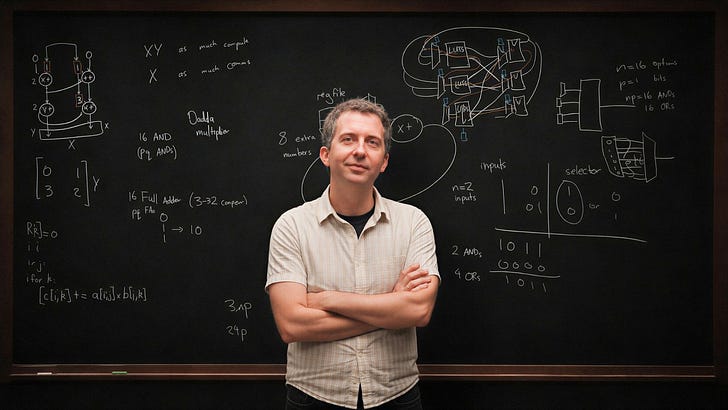
The physical area a multiplier circuit requires on a chip grows quadratically with the number of bits (e.g., p*q). This non-linear scaling is the fundamental reason why lower-precision formats like FP4 and FP8 offer disproportionately large performance and efficiency gains for AI workloads compared to a linear improvement.
Quantization and distillation don't simply create a smaller version of an LLM. These optimization processes alter the model's behavior to the point where it becomes a new entity—a "cousin." It may be legible and functional, but it will not produce the same outputs as the original.

Google's TurboQuant algorithm enables near-lossless context compression, drastically reducing memory usage and inference costs. This breakthrough could democratize powerful AI by making it far cheaper and faster to run, much like the fictional 'middle-out' compression from the show 'Silicon Valley' was a game-changer.

OpenAI achieved a major reduction in the cost of running its models through purely software and algorithmic improvements, such as quantization and smarter caching. This demonstrates that efficiency innovation can be as impactful as acquiring more hardware, suggesting a path to overcoming compute bottlenecks without relying solely on expensive chips.

Quantization is a compression technique that shrinks AI models to run on weaker hardware with minimal quality loss. Understanding this concept is key, as it effectively allows you to run models that would otherwise require server-grade equipment on a standard laptop, essentially doubling your hardware's capability.

The gap between a basic and a highly optimized inference setup is massive. Stacking techniques like quantization, custom speculative decoders, and KV-aware routing can yield performance improvements of 4x to 10x over a standard baseline for the same model and hardware.
Qwen 3.6 is offered in multiple quantized (compressed) versions. This strategic decision makes the model accessible for local deployment on consumer hardware, enabling privacy-sensitive reasoning tasks without relying on cloud infrastructure and its associated dependencies or costs.

Quantization is the key enabling technology for local AI. By compressing a model's precision, akin to JPEG for images, it drastically reduces memory needs (e.g., from 54GB to a fraction of that). This is what makes it possible to fit and run billion-parameter models on consumer-grade hardware.
Inference engineering is not a monolith. Data center teams focus on making models "less slow" for massive throughput. Local AI teams focus on making models "less dumb" on constrained hardware, using methods like advanced quantization to fit models in memory.
Modern AI models are moving towards extremely low-precision arithmetic (e.g., 4-bit numbers) because it's more efficient. The trade-off is analogous to image processing: you get a better result with more pixels (more computations) and fewer colors (less precision) than the other way around.