Get your free personalized podcast brief
We scan new podcasts and send you the top 5 insights daily.
While largely playing catch-up, Google's Antigravity IDE introduces unique slash commands that signal a different interaction style. The '/grillme' command, for example, promises a more aggressive and proactive agent for clarifying requirements, contrasting with the more passive, polite Q&A style of competitors like Anthropic's Claude Code.
Related Insights
The enthusiastic reception for Google's Workspace CLI reveals a counter-intuitive trend: old-school Command-Line Interfaces are becoming the preferred way for AI agents to interact with software. Unlike humans, agents don't need GUIs and benefit from the CLI's deterministic, low-friction nature, avoiding the 'abstraction tax' of newer API layers.

Unlike competitors focused on creating autonomous agents, Claude Code is designed as a 'pair programmer.' It emphasizes a collaborative workflow where the human and AI work together through planning and iteration, rather than the human simply delegating a task and awaiting the result.

Agentic coding tools like Claude Code represent a new, distinct modality of AI interaction, as significant as the advent of image generation or chatbots. This shift is creating a new category of power users who integrate AI into their daily workflows not just for queries, but for proactive, complex task execution.
AI platforms using the same base model (e.g., Claude) can produce vastly different results. The key differentiator is the proprietary 'agent' layer built on top, which gives the model specific tools to interact with code (read, write, edit files). A superior agent leads to superior performance.

For years, Google has integrated AI as features into existing products like Gmail. Its new "Antigravity" IDE represents a strategic pivot to building applications from the ground up around an "agent-first" principle. This suggests a future where AI is the core foundation of a product, not just an add-on.
Codex exposes every command and step, giving engineers granular control. Claude Code abstracts away complexity with a simpler UI, guessing user intent more often. This reflects a fundamental design difference: precision for technical users versus ease-of-use for non-technical ones.
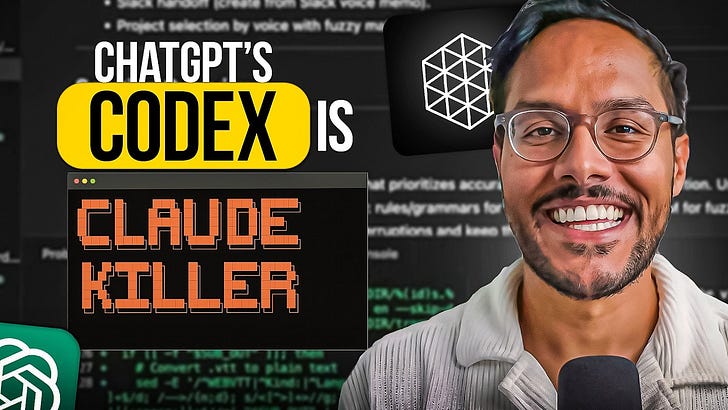
The user experience of leading AI coding agents differs significantly. Claude Code is perceived as engaging and 'fun,' like a video game, which encourages exploration and repeated use. OpenAI's Codex, while powerful, feels like a 'hard to use superpower tool,' highlighting how UX and model personality are key competitive vectors.

AI agents are the fastest-growing users of command-line tools. They have unique behaviors, like running "status" after every command, and struggle with interactive flows. Tools must be designed with this new, non-human persona in mind, not just for human developers.

Google's new agentic IDE, Antigravity, and its CLI are seen as mimicking features already available in tools like OpenAI's Codex and Anthropic's Claude Code. Core concepts like projects, sub-agents, and hooks feel like Google is closing feature gaps rather than innovating, positioning them as playing defense in the developer tool space.
OpenAI's Codex bets on a single, unified interface where the AI handles any task from one input, reducing friction. Conversely, Anthropic's Claude app bets that different work modes (Chat, Cowork, Code) are distinct enough to require separate, specialized interfaces, akin to traditional native apps.