Get your free personalized podcast brief
We scan new podcasts and send you the top 5 insights daily.
OpenAI's Codex bets on a single, unified interface where the AI handles any task from one input, reducing friction. Conversely, Anthropic's Claude app bets that different work modes (Chat, Cowork, Code) are distinct enough to require separate, specialized interfaces, akin to traditional native apps.

Related Insights
The dominant AI interface will be a universal conversational layer (chat/voice) for any task. This will be supplemented by specialized graphical UIs for power users needing deep functional control, much like an executive sometimes needs to edit a document directly instead of dictating to an assistant.
The latest models from Anthropic (Opus 4.6) and OpenAI (Codex 5.3) represent two distinct engineering methodologies. Opus is an autonomous agent you delegate to, while Codex is an interactive collaborator you pair-program with. Choosing a model is now a workflow decision, not just a performance one.

Anthropic's Cowork isn't a technological leap over Claude Code; it's a UI and marketing shift. This demonstrates that the primary barrier to mass AI adoption isn't model power, but productization. An intuitive UI is critical to unlock powerful tools for the 99% of users who won't use a command line.
Comparing chat interfaces to the MS-DOS command line, Atlassian's Sharif Mansour argues that while chat is a universal entry point for AI, it's the worst interface for specialized tasks. The future lies in verticalized applications with dedicated UIs built on top of conversational AI, just as apps were built on DOS.

Early AI developer tools mimicked traditional IDE extensions with UI panels. The new paradigm, seen in OpenAI's Codex, makes the chat conversation the central interface. This democratizes the tool by leveraging a universal skill—conversation—making it more accessible to non-developers.

Codex exposes every command and step, giving engineers granular control. Claude Code abstracts away complexity with a simpler UI, guessing user intent more often. This reflects a fundamental design difference: precision for technical users versus ease-of-use for non-technical ones.
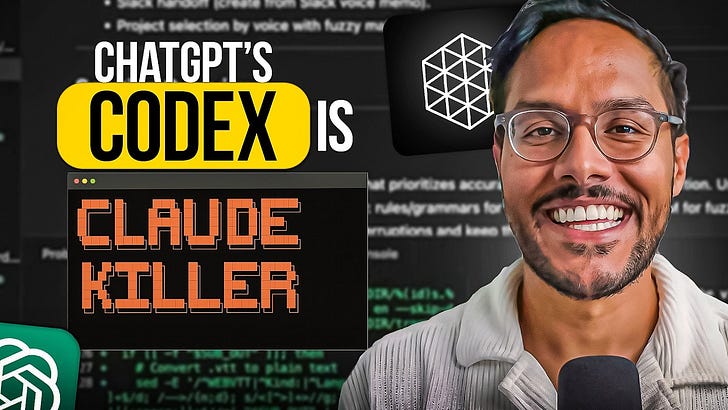
The user experience of leading AI coding agents differs significantly. Claude Code is perceived as engaging and 'fun,' like a video game, which encourages exploration and repeated use. OpenAI's Codex, while powerful, feels like a 'hard to use superpower tool,' highlighting how UX and model personality are key competitive vectors.

OpenAI is consolidating its fragmented products into a single desktop "super app." This is not innovation but a reaction to a confusing user experience and the success of rival Anthropic's Claude, which already offers a cohesive desktop application for coding and business tasks. The goal is to regain focus and compete more effectively.

The future of AI interaction won't be a multitude of specialized apps. Instead, it will likely converge into a smaller number of powerful, generalized input boxes that intelligently route user intent, much like the Chrome address bar or Google's main search page.

Despite different origins (consumer vs. enterprise), both OpenAI and Anthropic are building a similar "super app." This product merges chat, coding assistants (Codex/Claude Code), and automated agents, indicating the market is consolidating around a single, integrated AI workflow tool as the dominant paradigm.