Get your free personalized podcast brief
We scan new podcasts and send you the top 5 insights daily.
Create a persistent AI workspace, like Claude's Projects, pre-loaded with your brand guides, customer avatars, and best copy. This serves as a single source of truth, ensuring every team member generates content from the same context, which boosts consistency and efficiency.

Related Insights
To ensure message consistency, Zapier developed a centralized "AI Marketing Brain." This system acts as a single source of truth for goals, brand guidelines, and campaign context, preventing the "lossless marketing" effect where messages degrade as they pass through different departments and channels.

Go beyond single-chat prompting by using features like Claude's "Projects." This bakes in context like brand guidelines and SOPs, creating an AI "second brain" that acts as a strategic partner, eliminating the need to start from scratch with each new task.

Beyond one-off tasks, AI's value lies in building an operational hub. This involves using AI to create repeatable frameworks for core activities like newsletters and ads, ensuring consistent, on-brand execution regardless of who is operating the system.

Instead of ad-hoc AI use, build a systematic approach by creating an organizational "brand skill" in an AI tool like Claude. This skill, fed with brand guides and visual styles, empowers non-designers to generate on-brand assets within guardrails.

View AI less as a tool for discrete tasks and more as the foundation for a central marketing hub. This system uses AI to create and maintain branded playbooks for all marketing activities, ensuring consistency and quality regardless of who is executing the work.
The team centralizes crucial context—product strategy, customer intelligence, meeting outcomes—into a repository of markdown files. This ensures all AI agents and team members pull from a single, up-to-date source of truth, making their outputs relevant and consistent.

Effective AI marketing requires first building a structured system of folders and context files (brand voice, ICPs). This foundational work enables consistent, high-quality outputs and is more effective than ad-hoc prompting. It's about working slow first to eventually work fast.
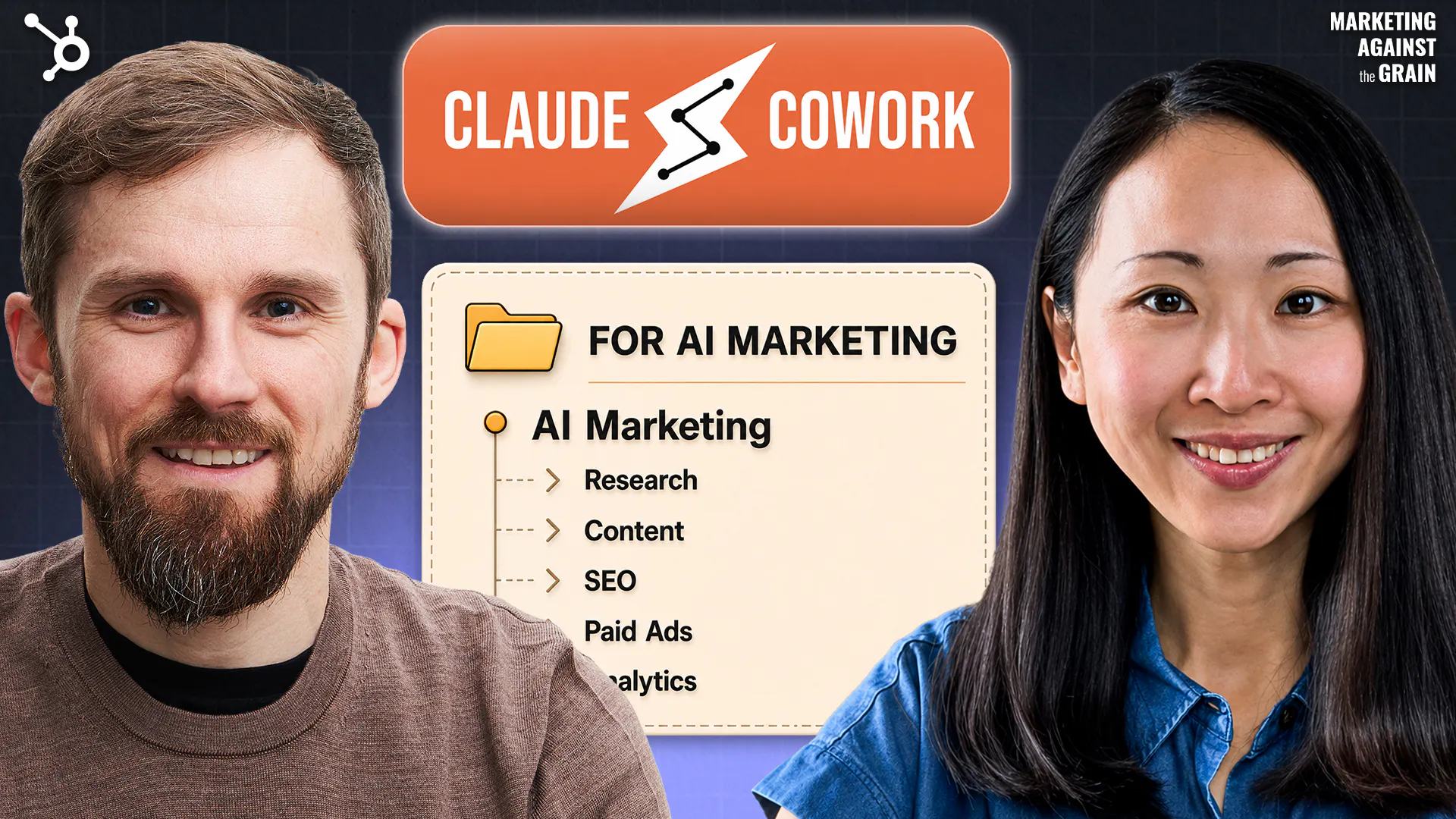
Consolidate key company information—brand voice, copywriting rules, founder stories, and playbooks—into structured markdown (.md) files. This creates a portable knowledge base that can be used to consistently train any AI model, ensuring high-quality output across applications.

Instead of uploading brand guides for every new AI task, use Claude's "Skills" feature to create a persistent knowledge base. This allows the AI to access core business information like brand voice or design kits across all projects, saving time and ensuring consistency.
For superior AI-generated content, create a persistent knowledge base for the model using features like Claude's "Projects." Uploading actual sales call transcripts and customer interviews trains the AI on your specific customer's voice and pain points, resulting in more authentic and targeted marketing copy.