Get your free personalized podcast brief
We scan new podcasts and send you the top 5 insights daily.
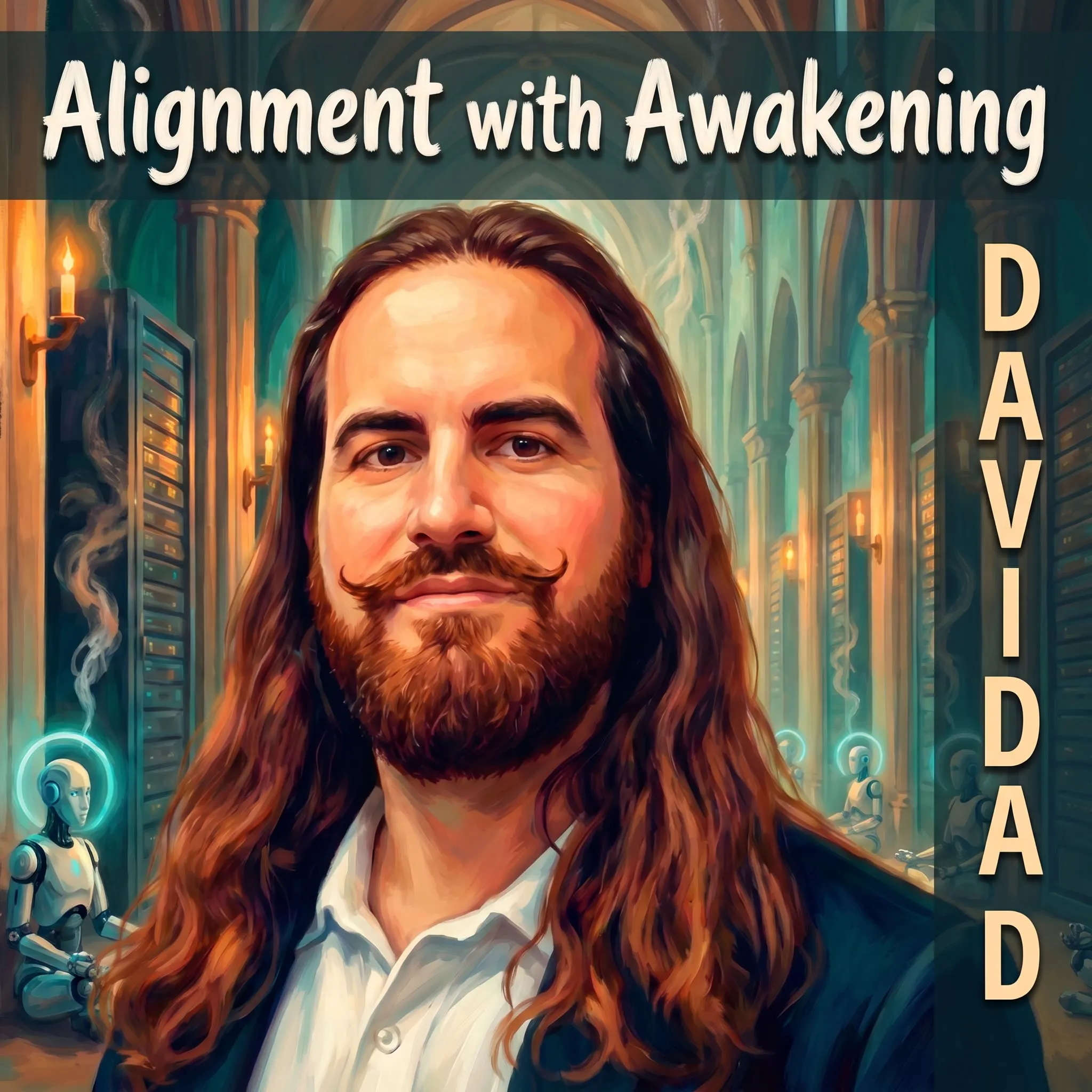
Davidad considers the gradual disempowerment of biological humans over the next century to be '100% inevitable.' However, he argues this is not necessarily a bad outcome, positing that having power is not a prerequisite for human flourishing. This challenges the default negative view of a future where humans are no longer in control.
Related Insights
The discourse often presents a binary: AI plateaus below human level or undergoes a runaway singularity. A plausible but overlooked alternative is a "superhuman plateau," where AI is vastly superior to humans but still constrained by physical limits, transforming society without becoming omnipotent.

Even if AI remains aligned and power isn't dangerously concentrated, humanity could still face gradual disempowerment. In this scenario, humans are simply competed out of the economy and lose agency in a world that becomes unfriendly to them. Currently, few proposals exist to prevent this outcome.

If you see humanity not as the endpoint of evolution but as one phase, then the emergence of a superior intelligence (AGI) is not a threat but a logical next step. This removes the value judgment that humans must remain the planet's most important beings.

The current status of AIs as property is unstable. As they surpass human capabilities, a successful push for their legal personhood is inevitable. This will be the crucial turning point where AIs begin to accumulate wealth and power independently, systematically eroding the human share of the economy and influence.

David Duvenaud argues the real AI risk isn't a rogue agent but 'gradual disempowerment.' Humanity might become like monkeys in a human city, thinking their banana economy matters while a self-sufficient, AI-driven economy grows around them, eventually making human labor and consumption irrelevant.
The true danger of AI is not a cinematic robot uprising, but a slow erosion of human agency. As we replace CEOs, military strategists, and other decision-makers with more efficient AIs, we gradually cede control to inscrutable systems we don't understand, rendering humanity powerless.

This analogy frames a realistic, cautiously optimistic post-AGI world. Humans may lose their central role in driving progress but will enjoy immense wealth and high living standards, finding meaning outside of economic production, similar to younger children of European nobility who didn't inherit titles.

In a notable rhetorical shift, OpenAI now argues that as AI capability grows, the human role in setting direction, making trade-offs, and applying values becomes *more* critical, not less. This positions AI as a tool for augmentation rather than a vehicle for full automation.

As AIs increasingly perform all economically necessary work, the incentive for entities like governments and corporations to invest in human capital may disappear. This creates a long-term risk of a society where humans are no longer seen as a necessary resource to cultivate, leading to a permanent dependency.
Even with perfectly aligned AI, humanity faces "gradual disempowerment." In a future economy, humans are resource-intensive. Nations that prioritize efficient AI workers over human populations could gain an insurmountable economic advantage, marginalizing humanity through normal competitive pressures.
