Get your free personalized podcast brief
We scan new podcasts and send you the top 5 insights daily.
Sen. Murphy advises against a quiet approach to AI regulation. He argues that since AI companies will inevitably fund Republican opponents, Democrats are better off proactively making AI regulation and the industry's political spending a central, and likely winning, campaign issue.

Related Insights
Political strategist Bradley Tusk warns that the tech industry is in a bubble regarding public perception of AI. He predicts AI will be a major target in upcoming elections, blamed for both job losses and rising energy prices from data centers. Challengers will use anti-AI sentiment as a powerful tool against incumbents, a reality most in tech are not prepared for.

With widespread public anxiety about AI and a lack of clear federal leadership, there is a significant political opening. A candidate who can articulate a sensible vision for AI regulation—one that protects citizens while fostering innovation—could capture the attention of a worried electorate.

Senator Warner is challenging AI companies to help define and pay for the economic transition their technology is causing. He argues that if the industry doesn't take the lead with specific policy ideas and funding for reskilling, they risk a ham-handed government response driven by populist anger.
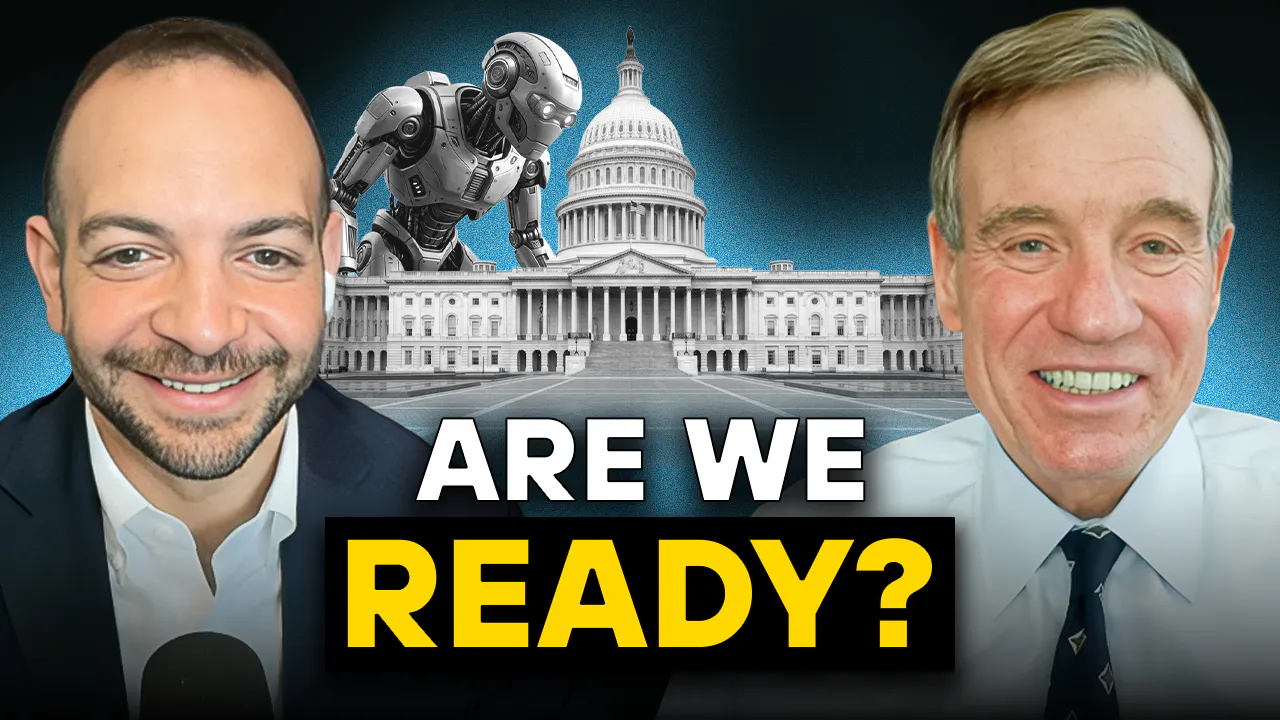
AI and immense tech wealth are becoming a lightning rod for populist anger from both political parties. The right is fracturing its alliance with tech over censorship concerns, while the left is turning on tech for its perceived alignment with the right, setting up a challenging political environment.
Digital AI (agents) threatens roles often held by Democrats like journalists and lawyers, while physical AI (robots) impacts jobs Republicans value, such as manufacturing and military. This dichotomy creates divergent political reactions to AI, with blue states being more aggressively anti-AI.

A new populist coalition is emerging to counter Big Tech's influence, uniting politicians from opposite ends of the spectrum like Senator Ed Markey and Rep. Marjorie Taylor Greene. This alliance successfully defeated an industry-backed provision to block state-level AI regulation, signaling a significant political realignment.

The political battle over AI is not a standard partisan fight. Factions within both Democratic and Republican parties are forming around pro-regulation, pro-acceleration, and job-protection stances, creating complex, cross-aisle coalitions and conflicts.
The economic and societal impact of AI is forcing politicians across the aisle to collaborate. From co-sponsoring legislation on AI-driven job loss to debating state vs. federal regulation, AI is creating common ground for lawmakers who would otherwise rarely work together.

Public backlash against AI isn't a "horseshoe" phenomenon of political extremes. It's a broad consensus spanning from progressives like Ryan Grimm to establishment conservatives like Tim Miller, indicating a deep, mainstream concern about the technology's direction and lack of democratic control.

The AI Data Center Moratorium Act, proposed by Sanders and AOC, cleverly uses public statements from leaders like Elon Musk and Demis Hassabis expressing AI fears. This political tactic leverages their own words against the industry to make the argument for a development halt more resonant and credible to the public.
