Get your free personalized podcast brief
We scan new podcasts and send you the top 5 insights daily.
The AI Data Center Moratorium Act, proposed by Sanders and AOC, cleverly uses public statements from leaders like Elon Musk and Demis Hassabis expressing AI fears. This political tactic leverages their own words against the industry to make the argument for a development halt more resonant and credible to the public.

Related Insights
Bernie Sanders' call for a moratorium on AI data centers, aimed at curbing billionaire power and job loss, is viewed as a strategic blunder. Critics argue it would unilaterally halt U.S. progress, effectively handing AI leadership to China, which would continue its development unabated.
Broad, high-level statements calling for an AI ban are not intended as draft legislation but as tools to build public consensus. This strategy mirrors past social movements, where achieving widespread moral agreement on a vague principle (e.g., against child pornography) was a necessary precursor to creating detailed, expert-crafted laws.

A new bill proposes halting all data center construction, using quotes from figures like Elon Musk and Demis Hassabis about AI risks as justification. This shows how AI leaders' public caution can be repurposed by politicians to push for extreme regulatory measures that could cripple the industry.
The rare agreement between libertarian billionaire Elon Musk and socialist senator Bernie Sanders on AI's threat to jobs is a significant indicator. This consensus from the political fringe suggests the issue's gravity is being underestimated by mainstream policymakers and is a sign of a profound, undeniable shift.

Tech leaders state they would support an AI development pause if competitors, especially China, also agreed. This is a strategic PR move, as they know a global consensus is unachievable. It allows them to appear responsible about AI safety without any actual risk of having to slow down progress.
AI is experiencing a political backlash from day one, unlike social media's long "honeymoon" period. This is largely self-inflicted, as industry leaders like Sam Altman have used apocalyptic, "it might kill everyone" rhetoric as a marketing tool, creating widespread fear before the benefits are fully realized.

Leading AI companies allegedly stoke fears of existential risk not for safety, but as a deliberate strategy to achieve regulatory capture. By promoting scary narratives, they advocate for complex pre-approval systems that would create insurmountable barriers for new startups, cementing their own market dominance.

Public opinion polls show strong opposition to data centers based on environmental and cost concerns. Senator Warner suggests these local fights are a tangible outlet for the public's more abstract fears about AI's societal impact, making data centers a key political battleground for the entire industry.
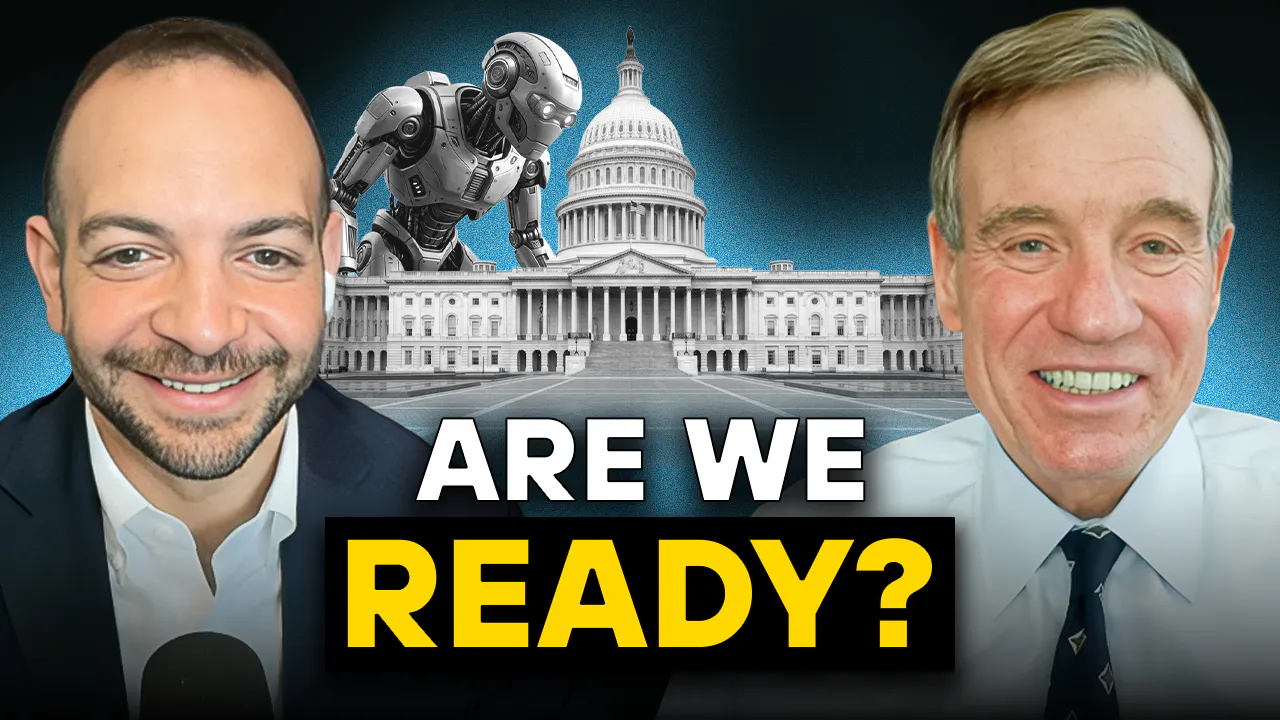
AI leaders' apocalyptic messaging about sentient AI and job destruction is a strategy to attract massive investment and potentially trigger regulatory capture. This "AB testing" of messages creates a severe PR problem, making AI deeply unpopular with the public.

Public support for local AI data centers has collapsed, with opposition now bridging the political spectrum. Left-leaning groups cite environmental strain, while right-leaning groups see big tech overreach. This rare bipartisan consensus makes data centers a tangible and politically potent symbol of AI backlash.
