Get your free personalized podcast brief
We scan new podcasts and send you the top 5 insights daily.
A custom '$land' skill delegates the entire post-push process to the agent. It autonomously handles waiting for reviews, fixing CI flakes, merging from upstream to resolve conflicts, and managing the merge queue. This automates the tedious 'last mile' of software delivery.
Related Insights
The developer's role is evolving from a linear workflow (code, submit PR, get review) to a parallel one. At Block, developers now manage multiple AI agents building numerous pull requests simultaneously, acting as an editor and context-switcher rather than the sole creator.

Integrate AI agents directly into core workflows like Slack and institutionalize them as the "first line of response." By tagging the agent on every new bug, crash, or request, it provides an initial analysis or pull request that humans can then review, edit, or build upon.
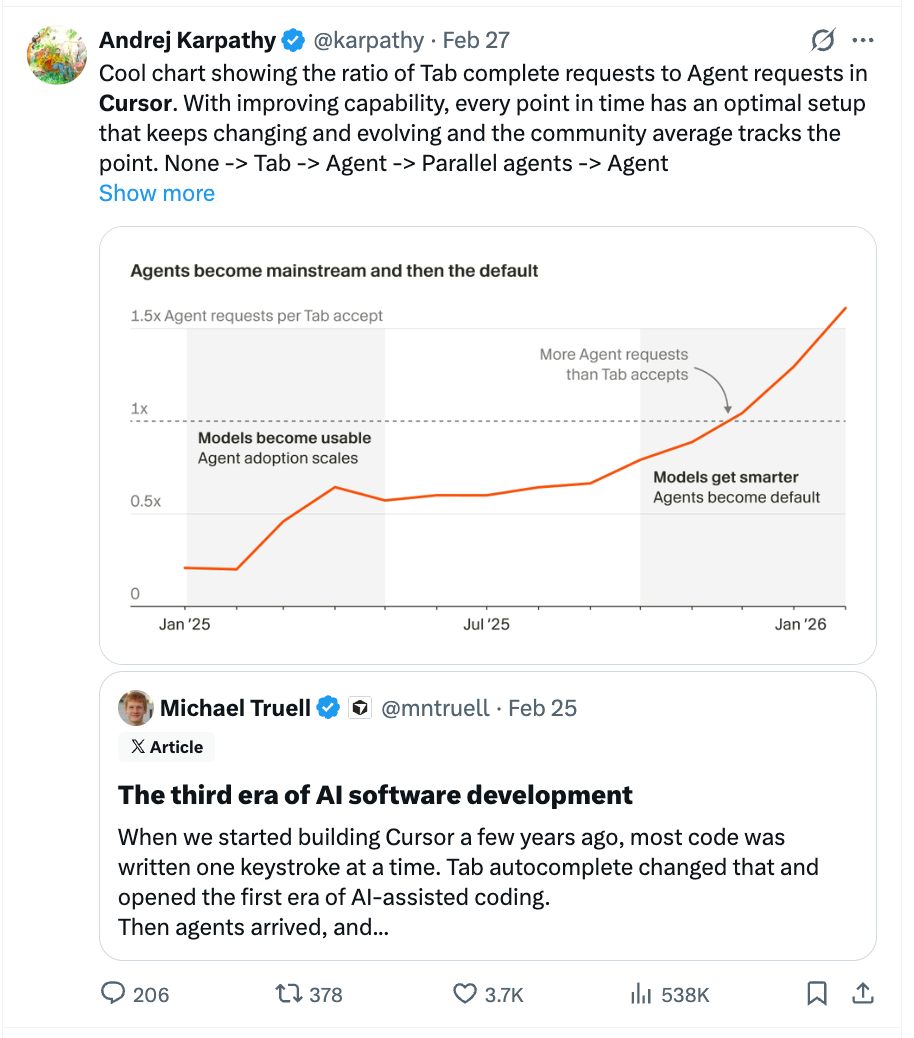
The ease of creating PRs with AI agents shifts the developer bottleneck from code generation to code validation. The new challenge is not writing the code, but gaining the confidence to merge it, elevating the importance of review, testing, and CI/CD pipelines.
Go beyond static AI code analysis. After an AI like Codex automatically flags a high-confidence issue in a GitHub pull request, developers can reply directly in a comment, "Hey, Codex, can you fix it?" The agent will then attempt to fix the issue it found.
Configure an AI stop hook to not only run quality checks but also to automatically commit the changes if all checks pass. This creates a fully automated loop: the AI generates code, the hook validates it, and if it's clean, it's committed to the repository with a generated message.
The team leverages Codex's automation for advanced dev workflows. This includes keeping pull requests mergeable by automatically resolving conflicts and fixing build issues, and running scheduled jobs to find and fix subtle, latent bugs in random files.

Instead of a multi-week process involving PMs and engineers, a feature request in Slack can be assigned directly to an AI agent. The AI can understand the context from the thread, implement the change, and open a pull request, turning a simple request into a production feature with minimal human effort.
With AI agents autonomously generating pull requests, the primary constraint in software development is no longer writing code but the human capacity to review it. Companies like Block are seeing PRs per engineer increase massively, creating a new challenge for engineering managers to solve.

The ideal AI-powered engineering workflow isn't just one tool, but a fluid cycle. It involves synchronous collaboration with an AI for planning and review, then handing off to an asynchronous agent for implementation and testing, before returning to synchronous mode for the next phase.
In an agent-driven workflow, human review becomes the primary bottleneck. By moving reviews to after the merge, the team prioritizes agent throughput and treats human attention as a scarce resource for high-level guidance, not gatekeeping individual pull requests.