Get your free personalized podcast brief
We scan new podcasts and send you the top 5 insights daily.
Contrary to common assumptions, standard initial steroid therapy is ineffective for the vast majority of adult ITP patients. Approximately 80% progress to chronic disease, highlighting the urgent need for more effective first- and second-line therapies to alter the disease course.

Related Insights
The VEHIT2 trial protocol, combining yanalumab and eltrombopag shortly after steroid failure, represents a paradigm shift. It moves beyond sequential single-agent therapy to explore if early, potent intervention can fundamentally reduce the long-term severity and chronic nature of ITP.
Beyond raising platelet counts, the newly approved BTK inhibitor rilzabrutinib provides dramatic improvements in the fatigue associated with ITP. This unique benefit, likely due to its anti-inflammatory properties, makes it a strong consideration for patients where fatigue is a primary quality of life issue.
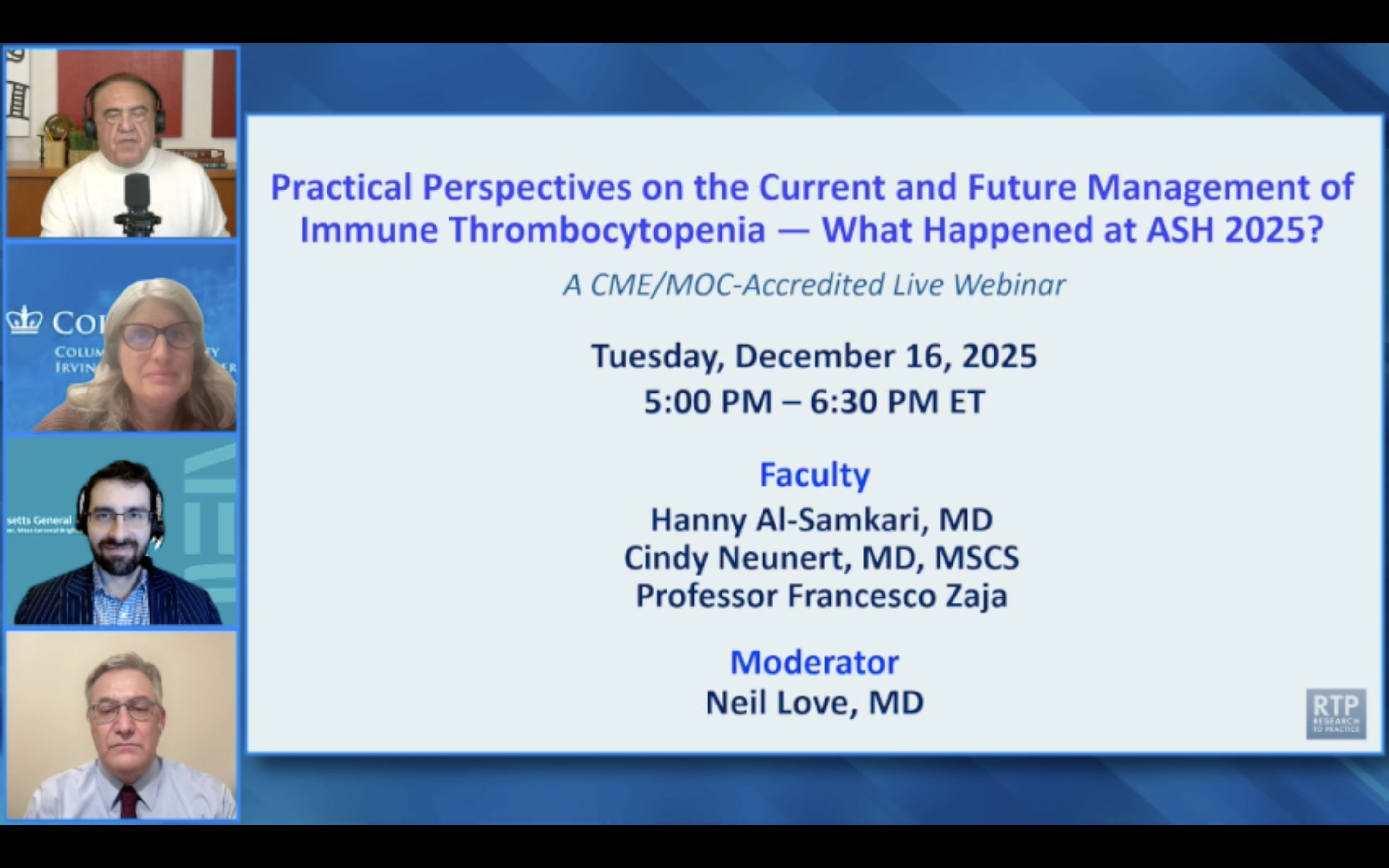
The treatment paradigm for ITP is shifting towards early combination therapy. Recent clinical trials are investigating augmented first- and second-line regimens, such as combining dexamethasone with rituximab or romiplostim, to achieve more durable, treatment-free responses than monotherapy.
Patients with ITP who fail or are intolerant to one TPO receptor agonist (e.g., eltrombopag) should not be considered a class failure. Switching to another TPO agent is a viable strategy that can induce a response in nearly half of these cases, particularly for intolerance.
In the VahIT-three trial, heavily pre-treated ITP patients achieved a 44% response rate with just four infusions of unalumab. This offers a significant advantage over chronic daily therapies, providing a short treatment course with the potential for durable response in a difficult-to-treat population.
Despite significant progress in managing symptoms for autoimmune conditions, very few treatments fundamentally alter the disease's course. The major unmet needs and investment opportunities lie in therapies that can induce remission or target common underlying pathologies like fibrosis, moving beyond mere symptom relief.
The LUNA-three trial demonstrated that ITP patients on rilzabrutinib showed improved fatigue. Notably, even patients whose platelet counts did not respond to the drug still had better fatigue outcomes than the placebo group, suggesting a separate anti-inflammatory benefit on quality of life.
Historical data showing high cure rates for splenectomy in ITP is outdated. Recent data indicates that if a patient has already failed both a TPORA and rituximab, the chance of a successful splenectomy is less than 50%, repositioning it as a later-line salvage option.
Named after the two-faced god Janus, yanalumab has a dual mechanism. It acts as a highly potent B-cell depleter while also blocking the BAF receptor pathway, which is critical for auto-reactive B-cell survival. This offers potential for deep, lasting, treatment-free remission.
In cases of severe ITP unresponsive to standard therapies, the anti-CD38 monoclonal antibody daratumumab can be highly effective. It works by eliminating the long-lived plasma cells responsible for secreting platelet autoantibodies, a mechanism distinct from other ITP treatments.