Get your free personalized podcast brief
We scan new podcasts and send you the top 5 insights daily.
OpenAI has abandoned traditional benchmark score charts for its new GPT-6 models. Instead, they exclusively use graphs plotting performance against cost, forcing developers to evaluate models based on economic value and task-specific efficiency rather than just raw intelligence scores.

Related Insights
Many influential AI model benchmarks focus on raw capabilities, like problem-solving accuracy, but neglect a critical business metric: the cost to achieve that result. Future benchmarks must incorporate the dollar cost per task to provide a more practical assessment for commercial applications.

The release of models like Sonnet 4.6 shows that the industry is moving beyond singular 'state-of-the-art' benchmarks. The conversation now focuses on a more practical, multi-factor evaluation. Teams now analyze a model's specific capabilities, cost, and context window performance to determine its value for discrete tasks like agentic workflows, rather than just its raw intelligence.
The era of using the most powerful AI model for every task is ending. Companies are now focused on the trade-off between quality, cost, and latency. The key question is no longer "Which model is best?" but "Which model is good enough for this task at the lowest price point?"

The latest model releases from OpenAI (GPT-5.6) and Meta (MuseSpark 1.1) emphasize performance-per-dollar, not just peak performance. This marks a market maturation where labs realize enterprise adoption hinges on managing token budgets. Models are now being benchmarked on cost and latency, making efficiency a key battleground.
Altman argues that as AI capabilities grow, abstract technical benchmarks become less relevant. He suggests the ultimate measure of an AI's effectiveness will be its direct economic contribution, jokingly proposing "GDP impact" as the next major metric to watch.
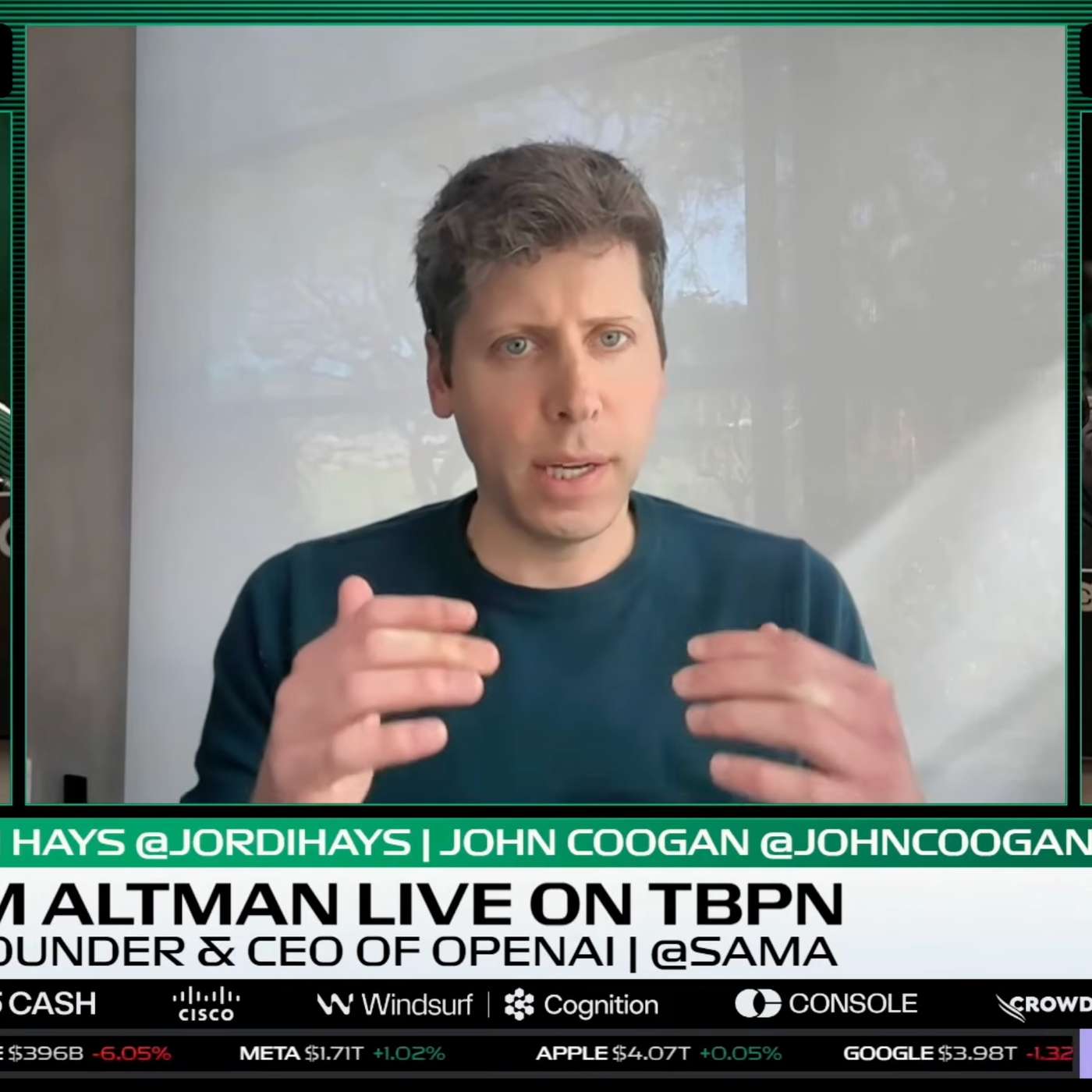
Beyond raw intelligence, the cost-performance ratio is critical for an AI model's practical adoption. The host highlights that GPT-6 Sol being both a favorite and cheap is a major advantage over Anthropic's Opus 5.5, which is twice as expensive. This heavily influences which model becomes the go-to for daily work.

OpenAI's GPT-5.5 is more expensive per token, but a new evaluation framework is emerging. The key metric isn't raw cost, but the model's efficiency in solving a problem. This 'intelligence per dollar' reframes cost analysis around performance and compute, where more expensive models can be cheaper overall if they solve tasks more efficiently.
Focusing on token pricing is misleading. A more powerful model may be more expensive per token but significantly cheaper per task because its higher efficiency requires fewer prompts and iterations to achieve a final result. The correct way to measure cost-effectiveness is by the total cost to complete a job, not the price of the raw material.
OpenAI's new GDP-val benchmark evaluates models on complex, real-world knowledge work tasks, not abstract IQ tests. This pivot signifies that the true measure of AI progress is now its ability to perform economically valuable human jobs, making performance metrics directly comparable to professional output.
A cheap model that fails often becomes expensive due to retries, fallbacks, and human review. The true measure of economic efficiency is the cost to reliably complete a task, not the raw inference cost, which can be a misleading metric at scale.
