Get your free personalized podcast brief
We scan new podcasts and send you the top 5 insights daily.
Schmidt defines agents as request, reasoning, activity, summary, and says almost every business flow can become concatenated agents. But he bluntly says almost none of the companies listening will make the necessary cultural changes. Companies are organized around comfortable belief systems and predictable routines, so the flattening stalls.

Related Insights
Even among founders of AI-first companies, the most pressing issue is not technology but the cultural and operational challenge of integrating humans and agents. The primary struggle is getting teams to work with agents effectively and figuring out how roles must change.

Pega's research shows that organizations getting value from agentic AI first re-engineered their processes. They moved from siloed, channel-based departments to smaller, agile teams with end-to-end campaign control, using AI agents as force multipliers for specific tasks.
Sendoso found that building AI agents was technically easier than managing the cultural shift required for team adoption. Getting people on board, managing expectations, and creating new workflows proved to be the most critical and difficult part of their AI journey.

Despite the power of new AI agents, the primary barrier to adoption is human resistance to changing established workflows. People are comfortable with existing processes, even inefficient ones, making it incredibly difficult for even technologically superior systems to gain traction.

Unlike previous technologies that integrated into existing workflows, AI agents require us to fundamentally re-engineer our work processes to make them effective. Early adopters who adapt their operations to how agents "think" will gain compounding advantages over competitors.
Many companies try automating massive, multi-team processes from day one. A better strategy is to first empower individual employees to build their own agents, fostering a culture of innovation before tackling complex, cross-functional automation.

Success with AI requires redesigning an organization's core operating system—its structure, decision-making, and culture—to match AI's speed. Simply adding AI as a tool to outdated, hierarchical systems causes initiatives to stall and fail to scale, as the underlying structure is built for predictability, not speed.

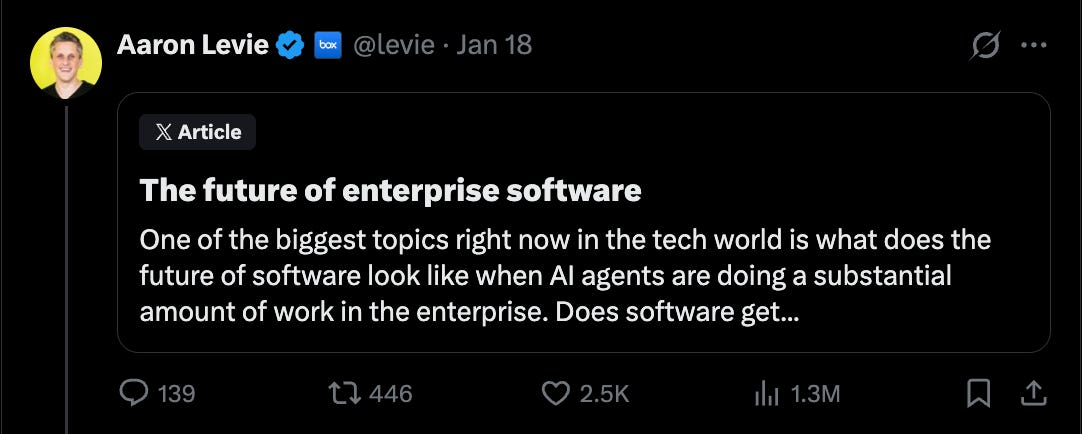
According to Box CEO Aaron Levy, the biggest barrier to deploying AI agents isn't technology but corporate structure. Agents deliver the most value on processes that cross departments, but data fragmentation and a lack of central ownership across these silos prevent effective implementation.

The transition to agent-centric workflows is not a simple software deployment; it's a complex re-engineering of business processes. This creates a huge opportunity for a new generation of consulting firms that specialize in getting organizations "agent-ready."
Providing teams with AI tools and optimized workflows is the easy part. The primary challenge in AI transformation is overcoming human inertia and changing ingrained habits. AI can't solve the human tendency to default to familiar routines, making behavioral change the true bottleneck.
