Get your free personalized podcast brief
We scan new podcasts and send you the top 5 insights daily.
For a platform like Arena, a large funding round is an operational necessity, not just for growth. A significant portion covers the massive, ongoing cost of funding model inference for millions of free users, a key expense often overlooked in consumer AI products.
![[State of Evals] LMArena's $100M Vision — Anastasios Angelopoulos, LMArena thumbnail](https://assets.flightcast.com/V2Uploads/nvaja2542wefzb8rjg5f519m/01K4D8FB4MNA071BM5ZDSMH34N/square.jpg)
Related Insights
Sourcegraph introduced an ad-supported free tier for its AMP coding agent. This strategy is not just about user acquisition; it's a research play. The ad revenue allows them to use the most advanced (and expensive) AI models and learn from a broad user base, giving them the freedom to push boundaries without being tied to specific enterprise feature requests.

Sam Altman dismisses concerns about OpenAI's massive compute commitments relative to current revenue. He frames it as a deliberate "forward bet" that revenue will continue its steep trajectory, fueled by new AI products. This is a high-risk, high-reward strategy banking on future monetization and market creation.

The seemingly rushed and massive $100 billion funding goal is confusing the market. However, it aligns with Sam Altman's long-stated vision of creating the "most capital-intensive business of all time." The fundraise is less about immediate need and more about acquiring a war chest for long-term, infrastructure-heavy projects.

Unlike traditional SaaS, achieving product-market fit in AI is not enough for survival. The high and variable costs of model inference mean that as usage grows, companies can scale directly into unprofitability. This makes developing cost-efficient infrastructure a critical moat and survival strategy, not just an optimization.

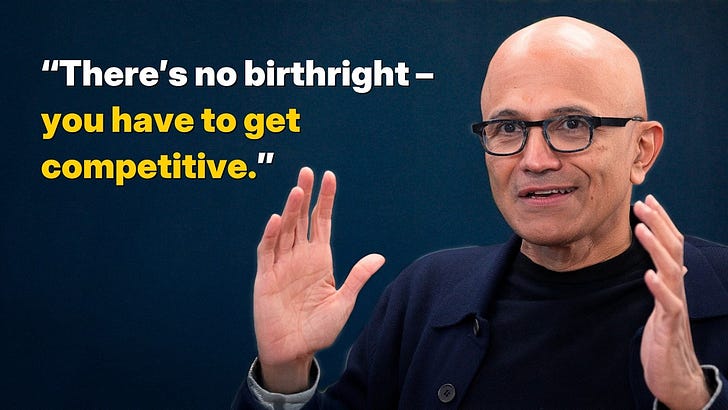
To navigate the massive capital requirements of AI, Nadella reframes the investment in cutting-edge training infrastructure. Instead of being purely reactive to customer demand, a significant portion is considered R&D, allowing for sustained, order-of-magnitude scaling necessary for breakthroughs.
Unlike traditional capital-intensive industries, OpenAI's model is asset-light; it rents, rather than owns, its most expensive components like chips. This lack of collateral, combined with its cash-burning operations, makes traditional debt financing impossible. It is therefore forced to raise massive, dilutive equity rounds to fund its ambitious growth.
AI-native companies grow so rapidly that their cost to acquire an incremental dollar of ARR is four times lower than traditional SaaS at the $100M scale. This superior burn multiple makes them more attractive to VCs, even with higher operational costs from tokens.

Current AI spending appears bubble-like, but it's not propping up unprofitable operations. Inference is already profitable. The immense cash burn is a deliberate, forward-looking investment in developing future, more powerful models, not a sign of a failing business model. This re-frames the financial risk.

Perplexity achieves profitability on its paid subscribers, countering the narrative of unsustainable AI compute costs. Critically, the cost of servicing free users is categorized as a research and development expense, as their queries are used to train and improve the system. This accounting strategy presents a clearer path to sustainable unit economics for AI services.

Sam Altman claims OpenAI is so "compute constrained that it hits the revenue lines so hard." This reframes compute from a simple R&D or operational cost into the primary factor limiting growth across consumer and enterprise. This theory posits a direct correlation between available compute and revenue, justifying enormous spending on infrastructure.
