Get your free personalized podcast brief
We scan new podcasts and send you the top 5 insights daily.
Kevin Weil argues that AI mastery in chemistry and biology lags software engineering because wet-lab experiments take days or weeks instead of running in fast virtual environments. Closing this gap requires automated robotic laboratories capable of generating dense, high-volume physical datasets to feed future scientific models.

Related Insights
The explosion of AI-generated molecular candidates creates a new problem: physically testing them at scale. A significant portion of R&D effort should be redirected from AI model development to inventing novel, high-throughput instrumentation and assays to experimentally validate the flood of predictions AI produces.

Lab work is "high mix, low volume," like driving, making it hard to automate. Traditional automation is like a subway: efficient but inflexible. AI enables "autonomous" labs, akin to Waymo cars, that handle the vast variability of experiments, which constitutes 99% of lab work.

The primary bottleneck for creating powerful foundation models in biology is the lack of clean, large-scale experimental data—orders of magnitude less than what's available for LLMs. This creates a major opportunity for "data foundries" that use robotic labs to generate high-quality biological data at scale.

Software engineering and math enable continuous, digital self-improvement through simulation. Chemistry and material science models cannot independently close the loop until experiments are physically executed in a laboratory.
While AI promises to design therapeutics computationally, it doesn't eliminate the need for physical lab work. Even if future models require no training data, their predicted outputs must be experimentally validated. This ensures a continuous, inescapable cycle where high-throughput data generation remains critical for progress.

Unlike pre-programmed industrial robots, "Physical AI" systems sense their environment, make intelligent choices, and receive live feedback. This paradigm shift, similar to Waymo's self-driving cars versus simple cruise control, allows for autonomous and adaptive scientific experimentation rather than just repetitive tasks.
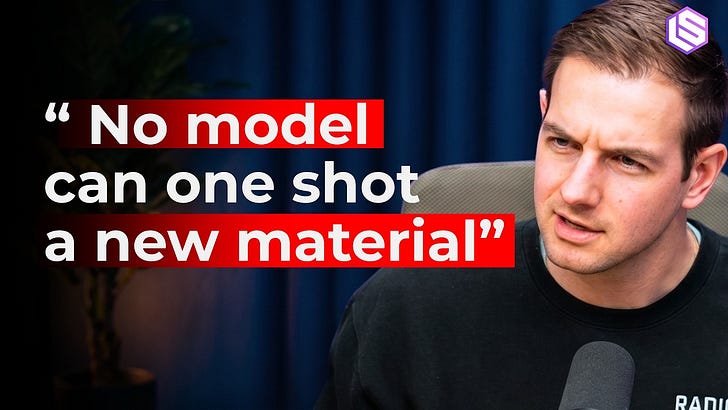
Unlike many AI fields obsessed with compute, the primary bottleneck in materials discovery is the speed and cost of running physical experiments. Progress depends on experimental throughput, not just bigger models or more GPUs.
Ken Goldberg quantifies the challenge: the text data used to train LLMs would take a human 100,000 years to read. Equivalent data for robot manipulation (vision-to-control signals) doesn't exist online and must be generated from scratch, explaining the slower progress in physical AI.

The ultimate bottleneck for fully automated scientific discovery is performing physical experiments. The ideal breakthrough would be a universal "everything lab" that could execute any physical experiment on demand, closing the loop between computational hypothesis and real-world validation.

The founder of AI and robotics firm Medra argues that scientific progress is not limited by a lack of ideas or AI-generated hypotheses. Instead, the critical constraint is the physical capacity to test these ideas and generate high-quality data to train better AI models.