Get your free personalized podcast brief
We scan new podcasts and send you the top 5 insights daily.
The DYNAMIC trial disappointingly showed that intensifying adjuvant chemotherapy for high-risk, ctDNA-positive stage 3 colorectal cancer patients does not improve outcomes. This suggests that for these tumors, underlying biology dictates recurrence more strongly than the aggressiveness of chemotherapy.

Related Insights
Historically, discussing adjuvant therapy for Stage III colon cancer was quick and straightforward, while Stage II was complex. The advent of ctDNA testing has reversed this dynamic. Stage II decisions are now clearer (treat if positive), while Stage III discussions have become much longer and more nuanced as clinicians integrate ctDNA data with patient preferences.

Circulating tumor DNA (ctDNA) testing is described as unequivocally the most prognostic tool available for colorectal cancer. Patients who remain serially negative have a minimal recurrence risk, while a positive result almost universally predicts a future clinical recurrence by 6-8 months.

The landmark DYNAMIC-2 study showed that using ctDNA to guide adjuvant therapy decisions in Stage II colon cancer cut chemotherapy use by 50% (from 30% to 15% of patients). This de-escalation was achieved without any negative impact on patient outcomes, validating the approach.
Unlike immunotherapy, where ctDNA clearance strongly predicts good outcomes, chemotherapy can cause a temporary decrease in ctDNA that doesn't correlate with long-term survival. This "smudging" effect complicates ctDNA interpretation for patients receiving chemo-immunotherapy combinations.

The practice-changing DYNAMIC trial showed that a ctDNA-guided strategy for stage II colorectal cancer reduces adjuvant chemotherapy use by 50%. Despite this significant de-escalation of treatment, patient outcomes and survival rates were identical to the standard-of-care approach.

Despite the success of ctDNA-guided de-escalation in Stage II disease, the DYNAMIC-3 trial in Stage III patients showed that ctDNA-negative patients had worse outcomes with de-escalated therapy. This serves as a critical warning against this de-escalation strategy in higher-risk patients for now.
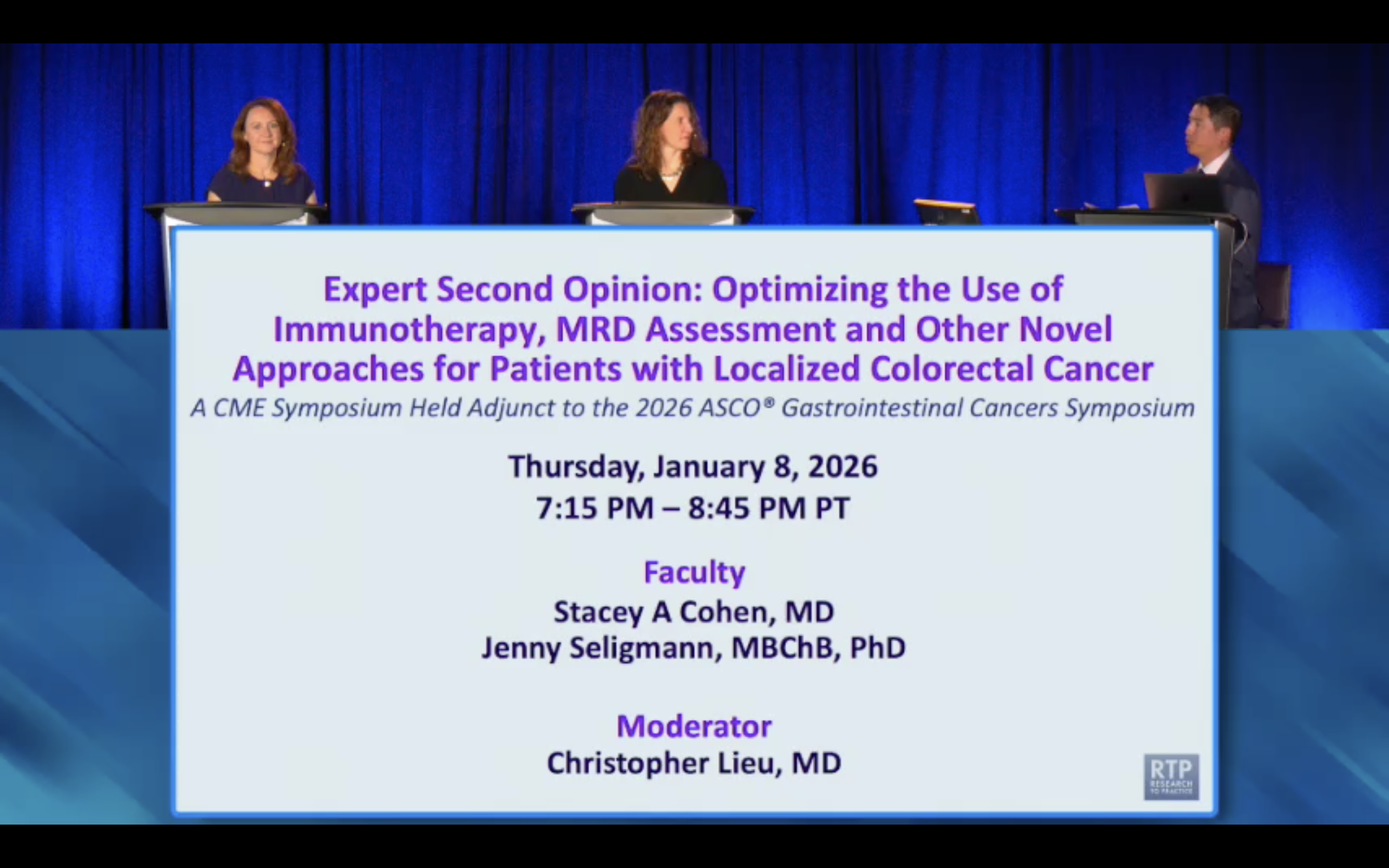
Oncologists are more comfortable using a positive ctDNA test to escalate care (e.g., recommend chemo for a low-risk Stage II patient). However, they are more hesitant to use a negative test to de-escalate or withhold standard chemo for higher-risk patients, pending more definitive trial data.
Observational data from the BESPOKE study showed that the survival benefit from adjuvant chemotherapy was only seen in patients who tested positive for ctDNA post-surgery. In contrast, ctDNA-negative patients had overlapping survival curves whether they received chemotherapy or not, questioning its utility for that group.
For every 10 Stage III patients receiving adjuvant chemo, 5 are already cured by surgery and 2-3 will recur regardless. This means therapy only benefits 2-3 patients, leading to significant overtreatment for the majority who endure toxicity without benefit.
The interpretation of ctDNA is context-dependent. Unlike in the adjuvant setting, in the neoadjuvant setting, remaining ctDNA positive post-treatment signifies that the current therapy has failed. These high-risk patients need a different therapeutic approach, not an extension of the ineffective one.
