Get your free personalized podcast brief
We scan new podcasts and send you the top 5 insights daily.
Getting a click relies on making viewers curious via the title and thumbnail. But keeping them requires immediately validating their click in the first 5-10 seconds. Don't use this critical time for branding; instantly reinforce the value proposition you teased.

Related Insights
The title makes a broad promise (e.g., 'How I motivate myself'). The thumbnail should add intrigue by hinting at the *how* with a named process (e.g., 'The CCC Method'). This makes viewers curious about the proprietary system they'll learn, compelling them to click to uncover the secret.
Capture audience attention by establishing credibility (Proof), outlining the video's structure (Plan), and stating what the viewer will gain (Promise). This three-part framework, executed in the first 30 seconds, builds immediate trust and significantly reduces viewer drop-off.

Clipping expert Chris of Good Future Media reveals the secret to viral short-form video: the first three seconds must immediately communicate the payoff for the viewer. If the opening spoken line isn't gripping enough, a visual text hook must be added to explicitly state the value proposition of the clip.

Initial hooks like thumbnails and opening lines are the entire battleground for capturing an audience. While the 'one-second economy' is hyperbole, we live in a '10-second economy' where the first few moments determine whether you earn a minute of someone's time or a year of their loyalty.

Don't create long, founder-led monologues for launch videos. The vast majority of viewer drop-off happens after the initial 30 seconds. Focus nearly all creative energy on making the first 30 seconds incredible by getting straight to the core value props. The rest of the video's length is secondary.

Dhar Mann believes a video idea isn't viable until a compelling title and thumbnail ("packaging") exist. He frames this not as 80% of success, but as the initial gatekeeper that requires the most effort. If the packaging fails to capture attention, the quality of the video content itself becomes irrelevant because no one will click.
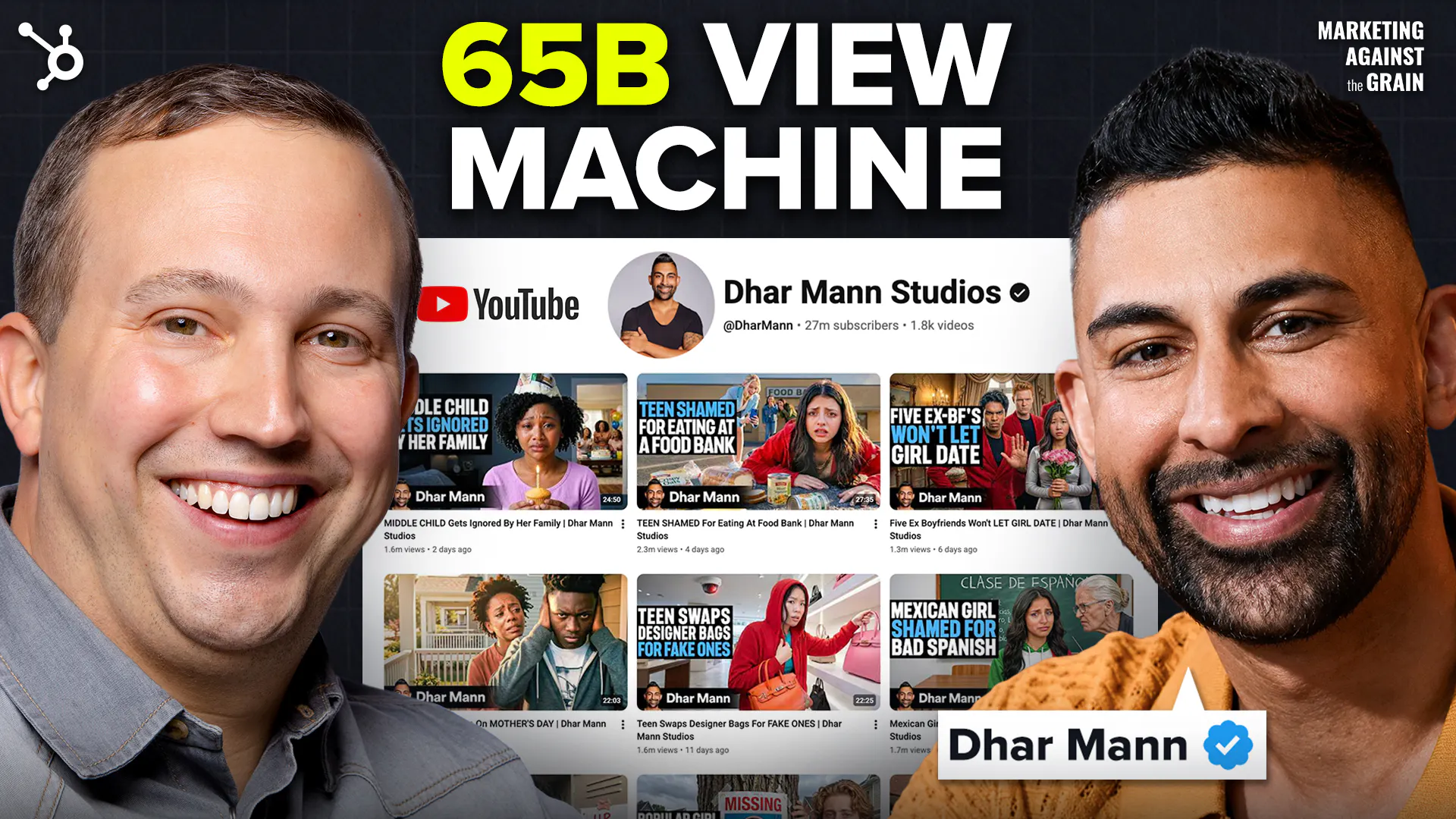
The thumbnail and title must work together as a package. Instead of restating the title's text, the thumbnail should add context, create a visual question, or generate an information gap. This makes the viewer curious to read the title and ultimately click the video.

A strong hook is no longer enough to retain YouTube viewers. With attention so fleeting, success demands meticulous scripting and "retention editing" to ensure every second of the video provides value, preventing viewers from dropping off mid-stream.
Standard hooks grab attention, but curiosity-driven hooks create an "action gap." By showing an impending action—a measuring tape retracting to reveal a message or an object about to hit someone—you compel viewers to watch until the action is resolved. This psychological trick significantly boosts retention rates.

Successful short-form video follows a structure: 1) Capture attention with strong visual and verbal hooks. 2) Maintain attention by creating a 'dance between conflict and context.' 3) Reward attention by providing value (education, inspiration) that generates algorithm-pleasing engagement signals like shares and saves.
