Get your free personalized podcast brief
We scan new podcasts and send you the top 5 insights daily.
The team argues that generating a novel view of a world is an AI-complete problem. To correctly predict a new viewpoint in a complex scenario (e.g., revealing a killer in a mystery film), the model must possess a deep, holistic understanding of the world, much like LLMs need for next-token prediction.

Related Insights
The seemingly simple task of next-token prediction, when perfected, requires a model to understand concepts as deeply as the source. To accurately predict what Einstein would say in a new situation, a system must be as intelligent as Einstein, proving prediction is fundamental to intelligence.

A core debate in AI is whether LLMs, which are text prediction engines, can achieve true intelligence. Critics argue they cannot because they lack a model of the real world. This prevents them from making meaningful, context-aware predictions about future events—a limitation that more data alone may not solve.

Unlike video generation models that merely predict pixels, Moonlake argues a true world model must understand and predict the consequences of actions over time. This requires an abstracted, semantic understanding of the world, not just visual fidelity.
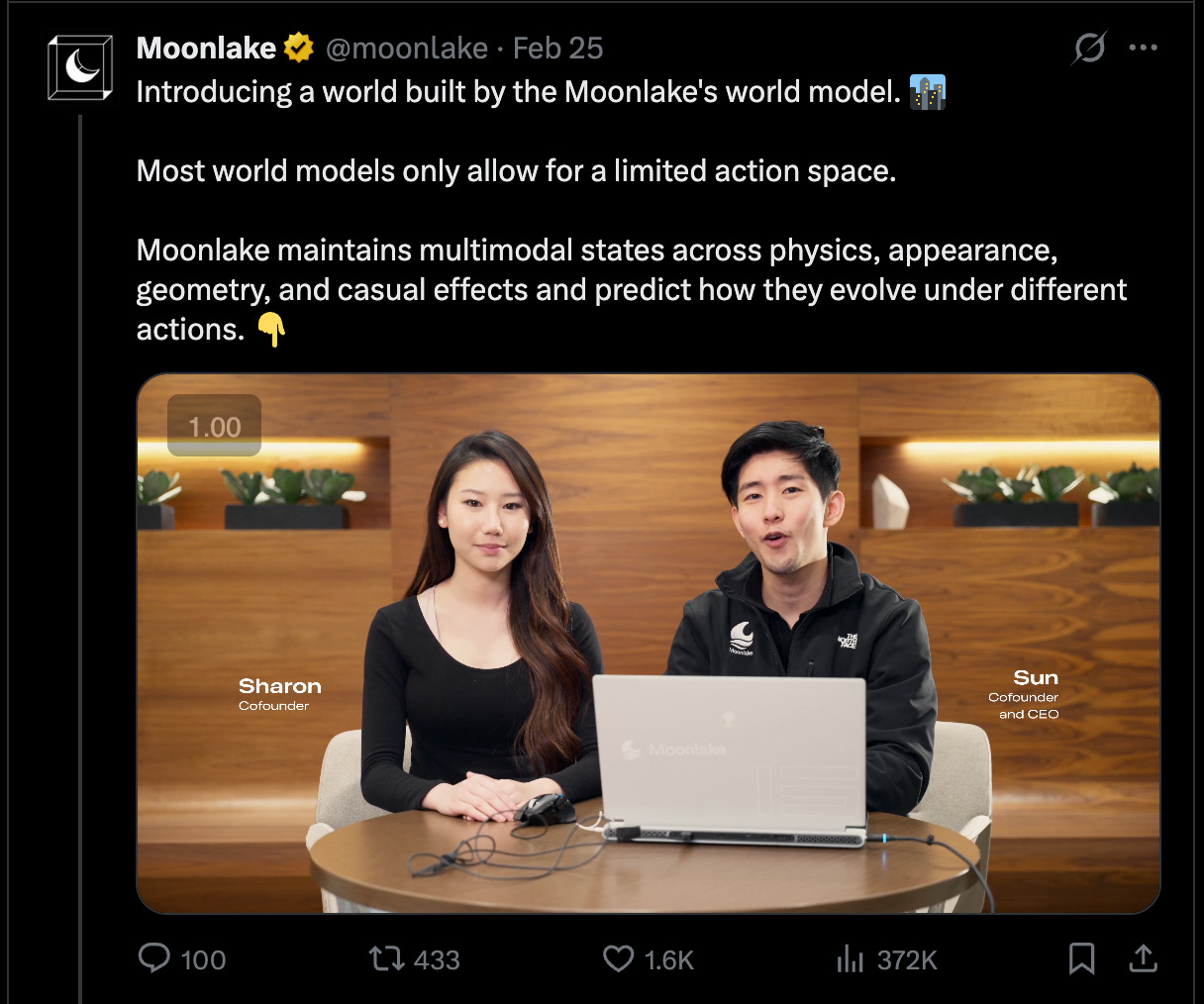
The next major leap in AI may come from "world models," which aim to give LLMs an experiential, physical understanding of concepts like space and physics. This mirrors the difference between knowing facts from a book and having real-world experience.
Human understanding is the ability to connect new information to a global, unified model of the universe. Until recently, AI models were isolated (e.g., a chess model). The major advance with large multimodal models is their ability to create a single, cohesive reality model, enabling true, generalizable understanding.

Language is just one 'keyhole' into intelligence. True artificial general intelligence (AGI) requires 'world modeling'—a spatial intelligence that understands geometry, physics, and actions. This capability to represent and interact with the state of the world is the next critical phase of AI development beyond current language models.

Inspired by LLMs, Atlas treats 3D reconstruction as "generation with a really long context." This allows the model to ingest dozens of views to ground its output, bridging the gap between purely imaginative generation and precise, data-driven reconstruction.
Atlas is built on predicting the next view from any camera angle, a fundamentally different primitive than the next-token prediction of LLMs or the next-frame prediction of video models. This approach enables true spatial reasoning and understanding.
Demis Hassabis sees video generation as more than a content tool; it's a step toward building AI with "world models." By learning to generate realistic scenes, these models develop an intuitive understanding of physics and causality, a foundational capability for AGI to perform long-term planning in the real world.

Human intelligence is multifaceted. While LLMs excel at linguistic intelligence, they lack spatial intelligence—the ability to understand, reason, and interact within a 3D world. This capability, crucial for tasks from robotics to scientific discovery, is the focus for the next wave of AI models.
