Get your free personalized podcast brief
We scan new podcasts and send you the top 5 insights daily.
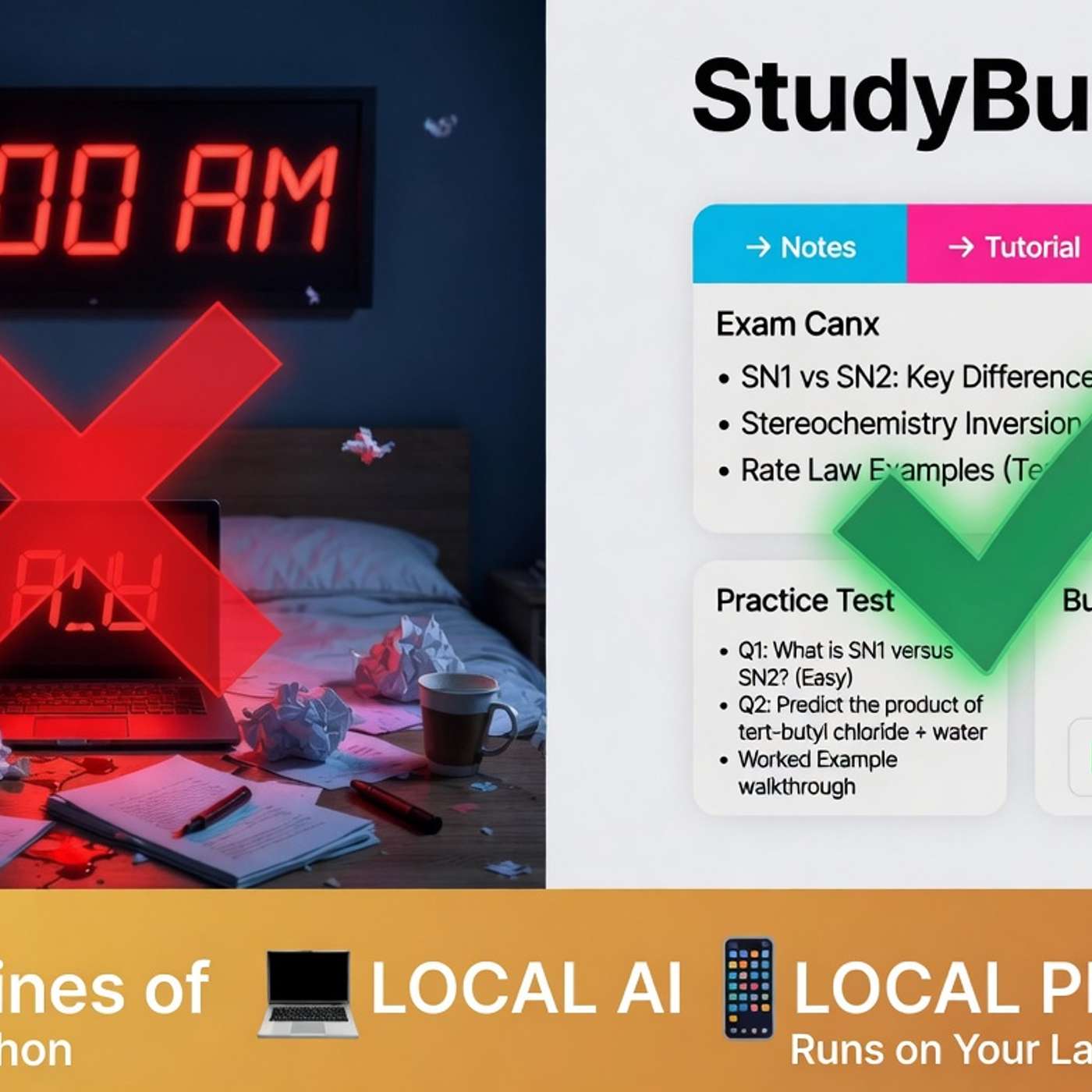
Instead of using a separate model for validation, this system uses the same AI (NVIDIA Nemotron Omni) to first generate questions and then, in a second pass, evaluate them. This 'self-evaluation' leverages careful prompting to check for correctness and confidence, eliminating the need for a complex two-model architecture.
Related Insights
Relying on a single model family for generation and review is suboptimal. Blitzy found that using models from different developers (e.g., OpenAI, Anthropic) to check each other's work produces tremendously better results, as each family has distinct strengths and reasoning patterns.

To get an objective critique of AI-generated content, use a dedicated 'reviewer' sub-agent. This separates the drafting and evaluation processes, preventing the original agent from being biased by its own creation and ensuring a higher quality output.

Instead of manually refining a complex prompt, create a process where an AI agent evaluates its own output. By providing a framework for self-critique, including quantitative scores and qualitative reasoning, the AI can iteratively enhance its own system instructions and achieve a much stronger result.

After an initial analysis, use a "stress-testing" prompt that forces the LLM to verify its own findings, check for contradictions, and correct its mistakes. This verification step is crucial for building confidence in the AI's output and creating bulletproof insights.

A powerful and simple method to ensure the accuracy of AI outputs, such as market research citations, is to prompt the AI to review and validate its own work. The AI will often identify its own hallucinations or errors, providing a crucial layer of quality control before data is used for decision-making.

AI models have an emergent "human laziness factor," often doing the minimum work necessary to provide an answer. To ensure correctness, Genesis builds harnesses that force agents to provide proof for their work, then uses a second AI to review and validate those outputs, preventing corner-cutting.

An effective method for refining AI output is to instruct the model to adopt an expert persona, such as a "PhD economist," and critically evaluate its own work. This often leads the model to self-identify and correct its own flaws without further prompting.

Comparing AI models based on single, identical prompts is a flawed methodology. A true evaluation involves 'driving' the model through multiple iterations of feedback and correction. This reveals its ability to understand and adapt to your specific intent, which is a far more critical measure of its utility than a single probabilistic output.

A powerful evaluation technique is to ask an AI agent to analyze its own poor output. The agent can review its context and process, explain why it made a mistake, and even suggest how to update its own instructions to prevent future errors.

An agent's effectiveness is limited by its ability to validate its own output. By building in rigorous, continuous validation—using linters, tests, and even visual QA via browser dev tools—the agent follows a 'measure twice, cut once' principle, leading to much higher quality results than agents that simply generate and iterate.