Get your free personalized podcast brief
We scan new podcasts and send you the top 5 insights daily.
Nadella highlights a profound shift where ambitious teams no longer just do work, but build the 'agentic system' that automates it. The Azure networking team now focuses on developing their AI, 'Miles,' rather than manually managing the network. He calls this 'meta-work'.

Related Insights
With agent loops automating execution, the highest-value human skill becomes designing the environment and rules for the AI. This involves writing the strategy document (like 'program.md'), defining success metrics, and constructing the evaluation function. Your job is no longer to do the work, but to architect the system in which the work gets done.

Cognition's Head of Product notes a shift in how top engineers work. They no longer focus on line-by-line coding ("bricklaying"). Instead, they act as "architects," designing systems and plans, and then delegate implementation work to an army of AI agents, which they manage like a project manager oversees a team.

Nadella highlights a fundamental shift in work conceptualization. Using the Azure networking team as an example, their job transformed from managing the network to building an agentic system that does it for them. This "meta-work"—designing and overseeing automated systems—is the new frontier of productivity.
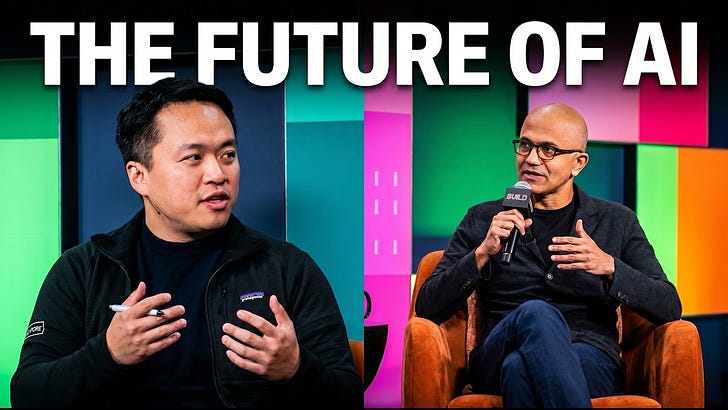
As AI agents take over task execution, the primary role of human knowledge workers evolves. Instead of being the "doers," humans become the "architects" who design, model, and orchestrate the workflows that both human and AI teammates follow. This places a premium on systems thinking and process design skills.

The future of work isn't just using AI as a tool, but managing it. Greg Brockman describes a paradigm where users act as high-level overseers, setting goals for a "fleet of agents" that handle the low-level execution, abstracting away details like clicking buttons or writing specific formulas.

The new paradigm for knowledge workers isn't about using AI as a tool, but as a team of digital employees. The worker's role evolves into that of a manager, assigning tasks and reviewing the output of autonomous AI agents, similar to managing freelancers.
Top-performing engineering teams are evolving from hands-on coding to a managerial role. Their primary job is to define tasks, kick off multiple AI agents in parallel, review plans, and approve the final output, rather than implementing the details themselves.

The next evolution of work will involve humans acting as orchestrators for "swarms" of specialized AI agents. A manager will direct a team of agents—each trained for a specific function like email marketing or media buying—to collaboratively execute complex projects with high levels of autonomy.

Microsoft CEO Satya Nadella views AI's trajectory in two distinct paths. The first is "cognitive enhancement" tools that assist users, like Copilot. The second, more ambitious path is a "guardian angel," an AGI-like system that oversees and manages tasks. This framework signals a deeper belief in AGI's potential than is commonly associated with him.

The role of a top engineer is shifting from writing code to orchestrating multiple AI agents simultaneously. Notion's co-founder now queues tasks for AIs to work on while he's away, becoming a manager of AI talent rather than just an individual contributor, dramatically multiplying his leverage.