Get your free personalized podcast brief
We scan new podcasts and send you the top 5 insights daily.
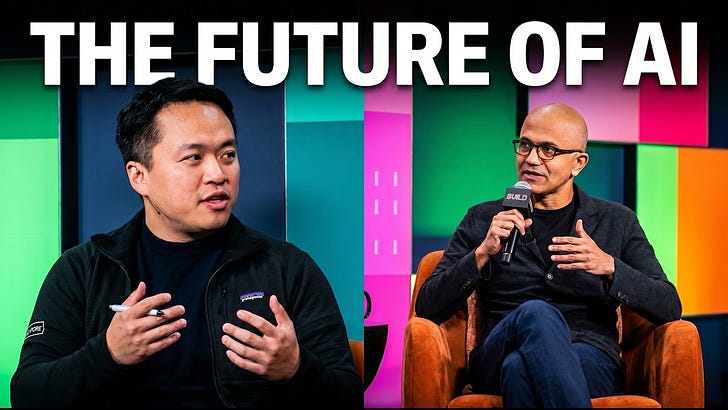
Nadella highlights a fundamental shift in work conceptualization. Using the Azure networking team as an example, their job transformed from managing the network to building an agentic system that does it for them. This "meta-work"—designing and overseeing automated systems—is the new frontier of productivity.
Related Insights
With agent loops automating execution, the highest-value human skill becomes designing the environment and rules for the AI. This involves writing the strategy document (like 'program.md'), defining success metrics, and constructing the evaluation function. Your job is no longer to do the work, but to architect the system in which the work gets done.

As AI agents take over task execution, the primary role of human knowledge workers evolves. Instead of being the "doers," humans become the "architects" who design, model, and orchestrate the workflows that both human and AI teammates follow. This places a premium on systems thinking and process design skills.

As AI agents take over routine tasks like purchasing and scheduling, the primary human role will evolve. Instead of placing orders, people will be responsible for configuring, monitoring, and training these AI systems, effectively becoming managers of automated workflows.

The future of work isn't just using AI as a tool, but managing it. Greg Brockman describes a paradigm where users act as high-level overseers, setting goals for a "fleet of agents" that handle the low-level execution, abstracting away details like clicking buttons or writing specific formulas.

The new paradigm for knowledge workers isn't about using AI as a tool, but as a team of digital employees. The worker's role evolves into that of a manager, assigning tasks and reviewing the output of autonomous AI agents, similar to managing freelancers.
The adoption of powerful AI agents will fundamentally shift knowledge work. Instead of executing tasks, humans will be responsible for directing agents, providing crucial context, managing escalations, and coordinating between different AI systems. The primary job will evolve from 'doing' to 'managing and guiding'.
The future of knowledge work isn't about humans performing tasks, but about training an AI agent to perform them once. This is a structurally more efficient model, amortizing the initial training effort over the agent's entire lifecycle, which will create a new job category centered on agent management and training.

The future of software isn't just AI-powered features. It's a fundamental shift from tools that assist humans to autonomous agents that perform tasks. Human roles will evolve from *doing* the work to *orchestrating* thousands of these agents.
The next leap in productivity isn't just using an AI assistant for synchronous tasks. It's becoming an "IC manager of agents," overseeing a team of 20-30 AI agents working concurrently on long-running, asynchronous tasks, creating a massive leverage factor.

The future of knowledge work isn't just collaborating with a single AI assistant. The next step is managing a team of AI bots, which will then evolve into overseeing an entire organizational chart of bots managing other bots. An individual worker's role will shift from a doer to a manager of a vast, scalable, digital workforce.
