Get your free personalized podcast brief
We scan new podcasts and send you the top 5 insights daily.
The best chance to abolish the Electoral College failed not on its merits, but because Southern senators voted against it to punish Senator Birch Bayh. They were retaliating against him for blocking two of Nixon's controversial Supreme Court nominees, sacrificing major reform for political payback.

Related Insights
The core structural threat to political incumbents is now from primary challengers, not the general election. This forces candidates to appeal to their party's most extreme base rather than the median voter, creating a system that structurally rewards polarization and discourages broad-based governance.

The check on authoritarian power doesn't require a majority opposition. In the U.S. Senate, a small faction of just 20 Republicans could privately threaten to join Democrats on an impeachment vote, effectively forcing the administration to reverse course. Their inaction signals political cowardice.

The over 12,000 failed attempts to amend the Constitution are not just legislative footnotes; they constitute a meaningful archive of what the American people have wanted from their government but were unable to achieve, offering a people's history of constitutional desires.
The electoral process inherently favors wealthy, socially connected, and power-seeking individuals. This systematically excludes more reserved but capable citizens, creating a political class with significant blind spots that is often unresponsive to the majority's needs.

Politicians are fundamentally incapable of drawing fair electoral boundaries due to an inherent conflict of interest: they want to ensure their party wins. Using a randomly sampled citizens' commission, as Michigan did, removes this conflict. This allows ordinary people, guided by a sense of fairness, to create equitable maps where politicians and courts have failed.

The infamous Supreme Court decision, which denied Black people citizenship, was more than a legal precedent; it was a political accelerant. The ruling galvanized Northern anger against slavery's expansion, directly fueling the rise of the new Republican party and Abraham Lincoln, setting the stage for the Civil War.

The KKK's campaign of terror had a quantifiable and devastating impact on elections. In some Georgia counties with Black majorities, the Republican vote for Ulysses S. Grant was reduced from over a thousand to single digits, or even zero. This demonstrates that paramilitary violence was a brutally effective tool for achieving political outcomes.
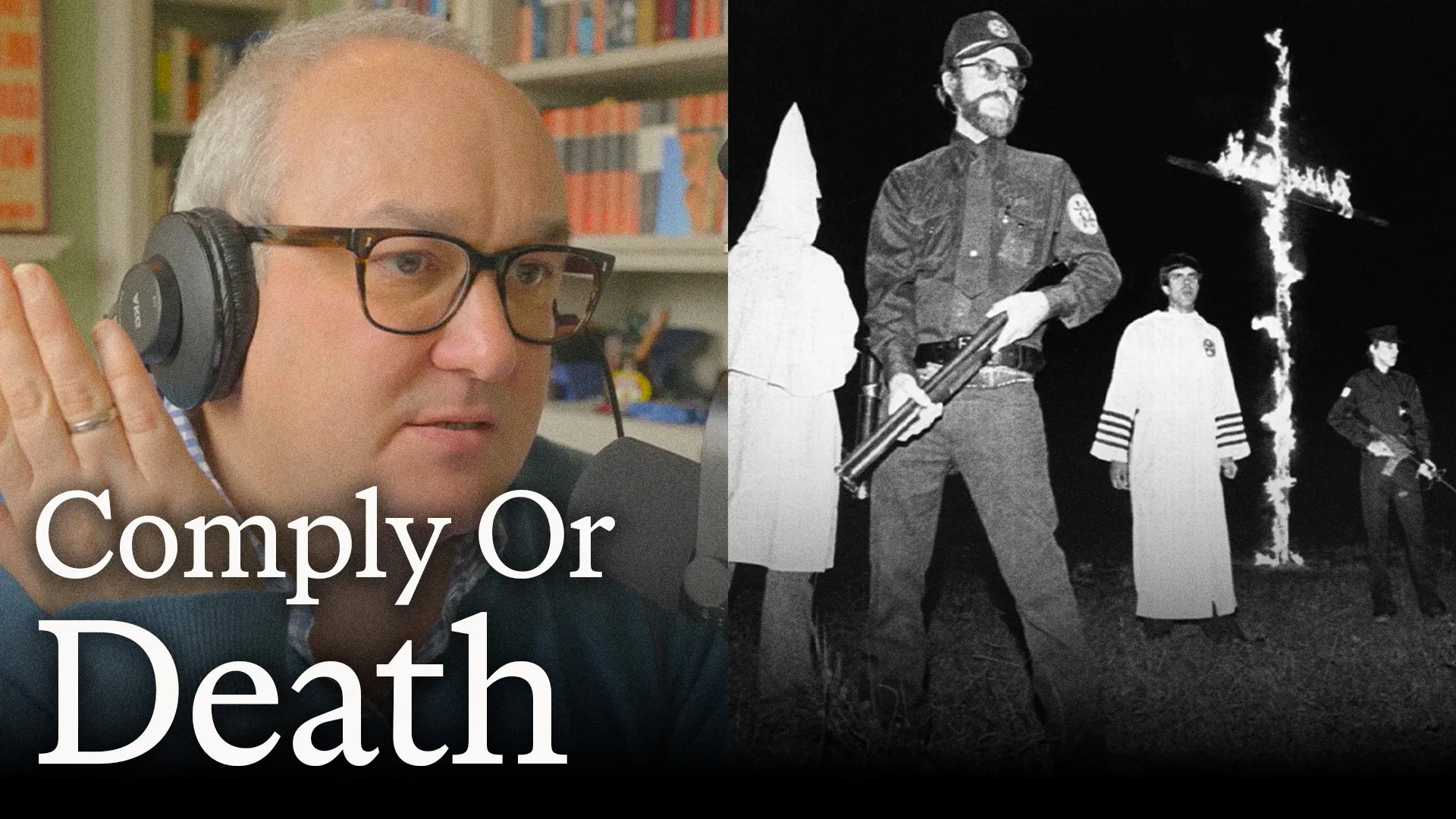
The defining characteristic of a functional democracy is not who wins, but the behavior of those who lose. A democracy is healthy only when the losing side accepts the result as legitimate and agrees to compete again in the future. The moment losers begin to systematically challenge the fairness of the process, the entire democratic foundation is at risk.
The framers, haunted by the violence of the Revolutionary War, intentionally designed Article V as a mechanism for peaceful change. They saw it as a crucial innovation to prevent future bloody insurrections when the government acts unconstitutionally, offering a path for reform instead of rebellion.
The US was structured as a republic, not a pure democracy, to protect minority rights from being overridden by the majority. Mechanisms like the Electoral College, appointed senators, and constitutional limits on federal power were intentionally undemocratic to prevent what the founders called "mobocracy."