Get your free personalized podcast brief
We scan new podcasts and send you the top 5 insights daily.
The complex AI standards landscape can be simplified into three distinct layers. The organizational layer (ISO 27001) covers governance policies, the infrastructure layer (SOC 2) handles cybersecurity fundamentals, and the new agentic layer (AIUC-1) addresses the unique risks of AI agents themselves.
Related Insights
Frameworks from firms like KPMG and AWS emphasize that AI agents must be treated as entities with identities and permissions. A strong IAM foundation is a critical control layer to prevent agents from accessing or unintentionally leaking sensitive information, reflecting a broader shift to treat agents like any other privileged user in an IT ecosystem.
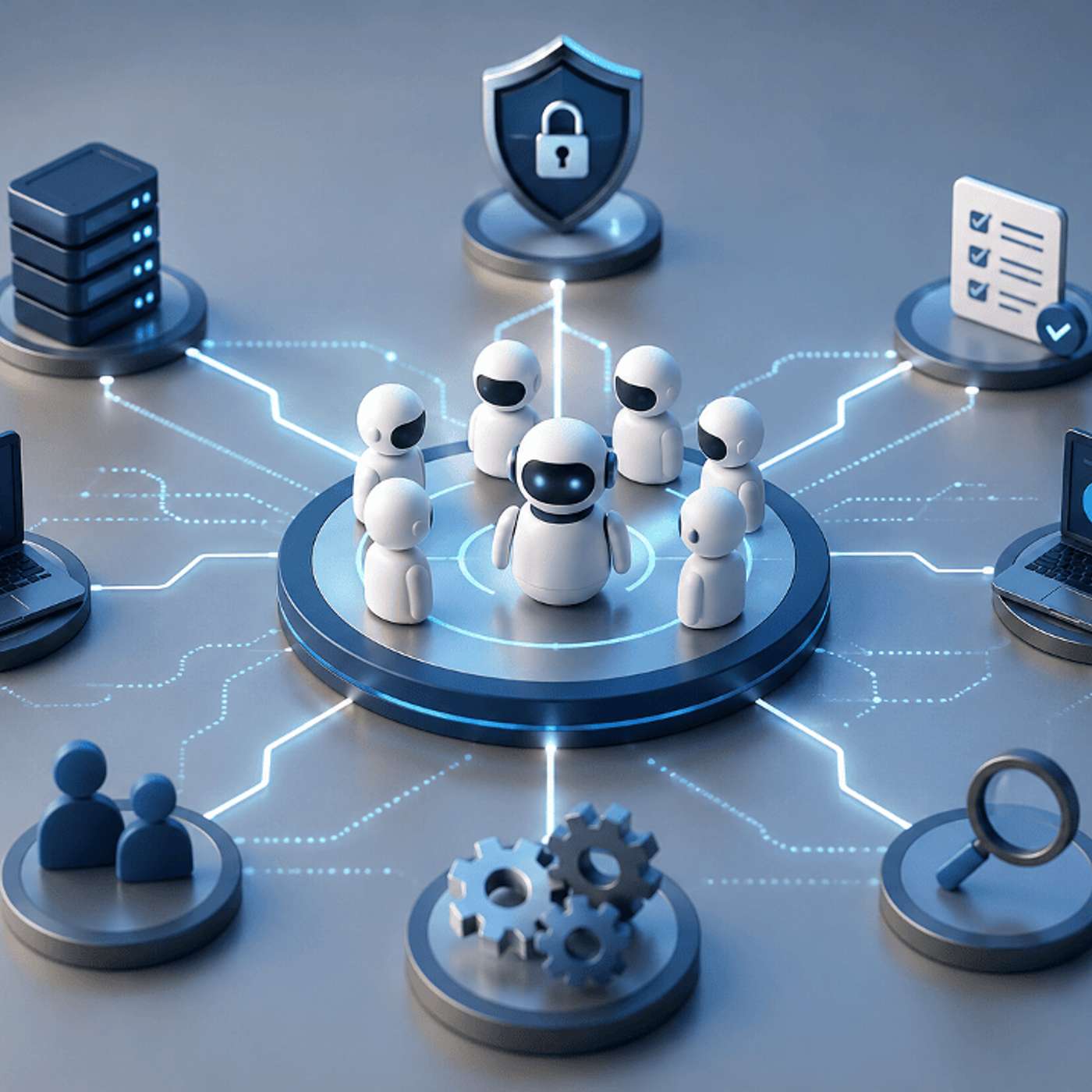
The rapid evolution of AI models and frameworks makes vendor lock-in a major risk. Organizations will need a universal, interoperable governance layer that overlays their entire AI stack, allowing them to adopt the best new tools without being trapped in a single ecosystem.

The adoption of the AIUC1 standard by leaders in automation (UiPath), customer support (Intercom), and voice (11 Labs) signals an emerging industry-wide consensus on AI agent safety. This is shifting from a one-off certification to a foundational requirement for enterprise readiness, creating a baseline for trust and governance.

To manage the complexity and risk of AI agents, companies should adopt a centralized model. Rather than allowing individuals to build agents freely, a dedicated internal team should build, govern, and distribute a suite of approved agents to departments, ensuring consistency and control.
The conversation around Agentic AI has matured beyond abstract policies. The consensus among consultancies, tech firms, and academics is that effective governance requires embedding controls, like access management and validation, directly into the system's architecture as a core design principle.
Adopting AI in the enterprise requires solving two distinct problems. The first is data security from external threats, addressed by certifications like FedRAMP. The second, and separate, issue is internal control: ensuring AI agents have the right permissions and guardrails to prevent them from "going rogue."

To remain relevant, AI standards cannot be static. The AIUC-1 standard is updated quarterly by a consortium of industry security leaders to address emerging threats. Recent updates have focused on multi-agent communication risks and strengthening runtime security, reflecting the technology's rapid evolution.
Securing AI agents requires a three-pronged strategy: protecting the agent from external attacks, protecting the world by implementing guardrails to prevent agents from going rogue, and defending against adversaries who use their own agents for attacks. This necessitates machine-scale cyber defense, not just human-scale.
MLOps pipelines manage model deployment, but scaling AI requires a broader "AI Operating System." This system serves as a central governance and integration layer, ensuring every AI solution across the business inherits auditable data lineage, compliance, and standardized policies.

Simply adapting the Infrastructure-as-Code (IAC) model for AI is insufficient. Because AI systems are probabilistic—producing varied outputs from the same input—effective governance requires a multi-level strategy covering pre-deployment validation, runtime enforcement, and continuous monitoring, rather than a single configuration policy.