Get your free personalized podcast brief
We scan new podcasts and send you the top 5 insights daily.
To handle increased code output from AI agents, engineering teams must shift platform efforts to strengthening their CI/CD pipeline. Braintrust pauses feature work to improve CI, viewing it as earning the right to move faster. A robust CI system is the foundation for AI-driven development.

Related Insights
The core needs of AI agents—version control, testing, observability—mirror those of human developers. However, the sheer scale and speed of agentic workflows mean existing tools like Kubernetes are insufficient, requiring a fundamental reimagining of the entire infrastructure stack.

The ease of creating PRs with AI agents shifts the developer bottleneck from code generation to code validation. The new challenge is not writing the code, but gaining the confidence to merge it, elevating the importance of review, testing, and CI/CD pipelines.
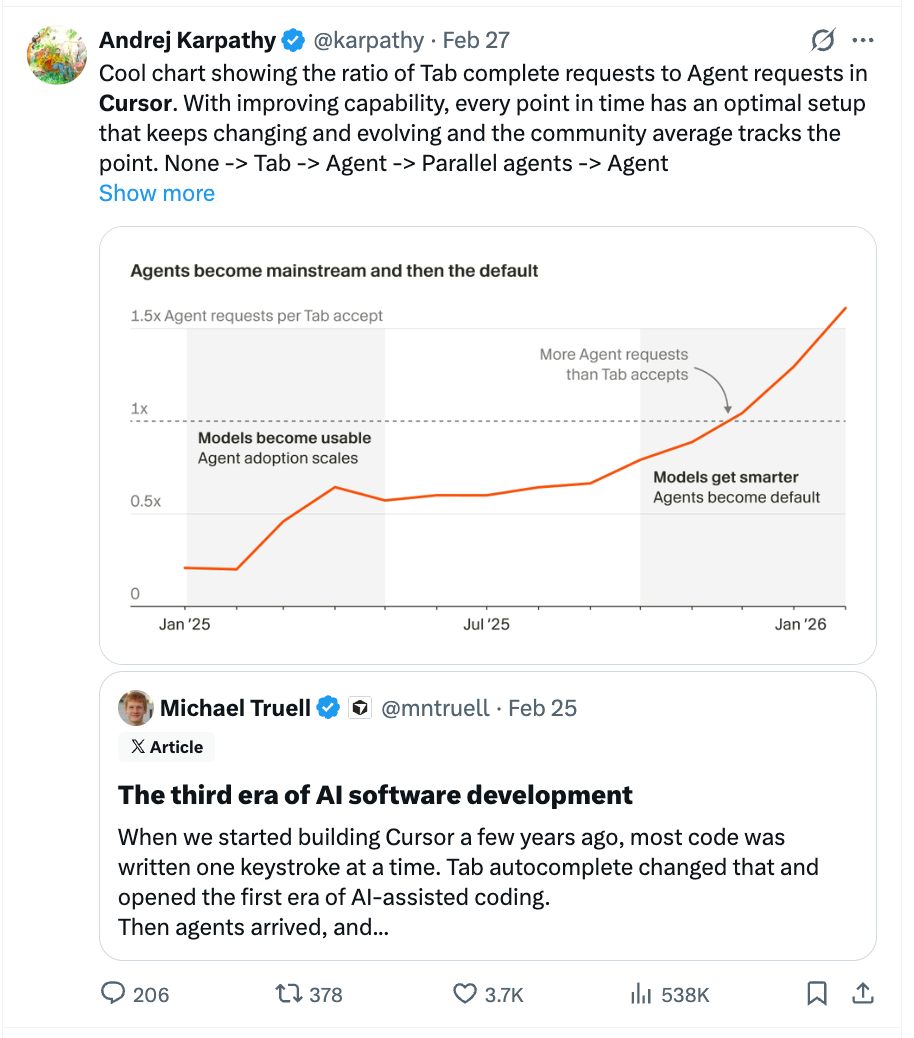
Tools like Git were designed for human-paced development. AI agents, which can make thousands of changes in parallel, require a new infrastructure layer—real-time repositories, coordination mechanisms, and shared memory—that traditional systems cannot support.

With AI making code generation cheap, the limiting factors for development velocity are now defining what to build (product) and ensuring its quality (review). Engineers will increasingly focus on high-level systems architecture rather than typing code.

Traditional software development processes, like peer code reviews, were built for a cadence of 10-15 PRs per month. When AI agents enable a 10x increase in output, the human team becomes the bottleneck, forcing a shift towards AI-driven review and validation.

AI agents operate on a tight feedback loop. A slow CI/CD pipeline becomes the primary bottleneck, negating the speed benefits of AI-generated code. Fast CI is now a strategic necessity for any engineering team serious about leveraging AI.

With AI generating 1,300 pull requests weekly at Stripe, the critical path is shifting. When coding becomes a commodity, the bottleneck moves to human review and validation. Engineering teams must refocus from pure creation to oversight and quality assurance at scale.

The focus in AI engineering is shifting from making a single agent faster (latency) to running many agents in parallel (throughput). This "wider pipe" approach gets more total work done but will stress-test existing infrastructure like CI/CD, which wasn't built for this volume.
The sheer volume of AI-generated code is causing Shopify's CI/CD pipelines to "start creaking." This bottleneck suggests that the entire paradigm of pull requests and Git—designed for human-scale development—may be obsolete in an "agentic world" and require a completely new design.

With AI agents autonomously generating pull requests, the primary constraint in software development is no longer writing code but the human capacity to review it. Companies like Block are seeing PRs per engineer increase massively, creating a new challenge for engineering managers to solve.
