Get your free personalized podcast brief
We scan new podcasts and send you the top 5 insights daily.
While AI solving long-standing math problems is impressive, its real value is questionable if those problems lack economic significance. The key indicator of AI's impact is its ability to solve problems that unlock tangible economic value, a test many current 'breakthroughs' have yet to pass.

Related Insights
As AI models achieve previously defined benchmarks for intelligence (e.g., reasoning), their failure to generate transformative economic value reveals those benchmarks were insufficient. This justifies 'shifting the goalposts' for AGI. It is a rational response to realizing our understanding of intelligence was too narrow. Progress in impressiveness doesn't equate to progress in usefulness.

Discussions on AI's future often miss the point by arguing on different planes. Technologists describe an infinite number of problems AI *can* solve. Economists, however, question if these solutions are worth the cost, pointing out the current capex spend equates to thousands of dollars per US worker—a questionable ROI for many roles.

Many influential AI model benchmarks focus on raw capabilities, like problem-solving accuracy, but neglect a critical business metric: the cost to achieve that result. Future benchmarks must incorporate the dollar cost per task to provide a more practical assessment for commercial applications.

Traditional AI benchmarks fail to capture the value of models that enable entirely new capabilities. The concept of an 'unlock index' suggests we should evaluate models based on the new applications they make possible—like the visual proactivity of TML's interaction model—rather than just performance on existing tasks.

The most significant gap in AI research is its focus on academic evaluations instead of tasks customers value, like medical diagnosis or legal drafting. The solution is using real-world experts to define benchmarks that measure performance on economically relevant work.

Altman argues that as AI capabilities grow, abstract technical benchmarks become less relevant. He suggests the ultimate measure of an AI's effectiveness will be its direct economic contribution, jokingly proposing "GDP impact" as the next major metric to watch.
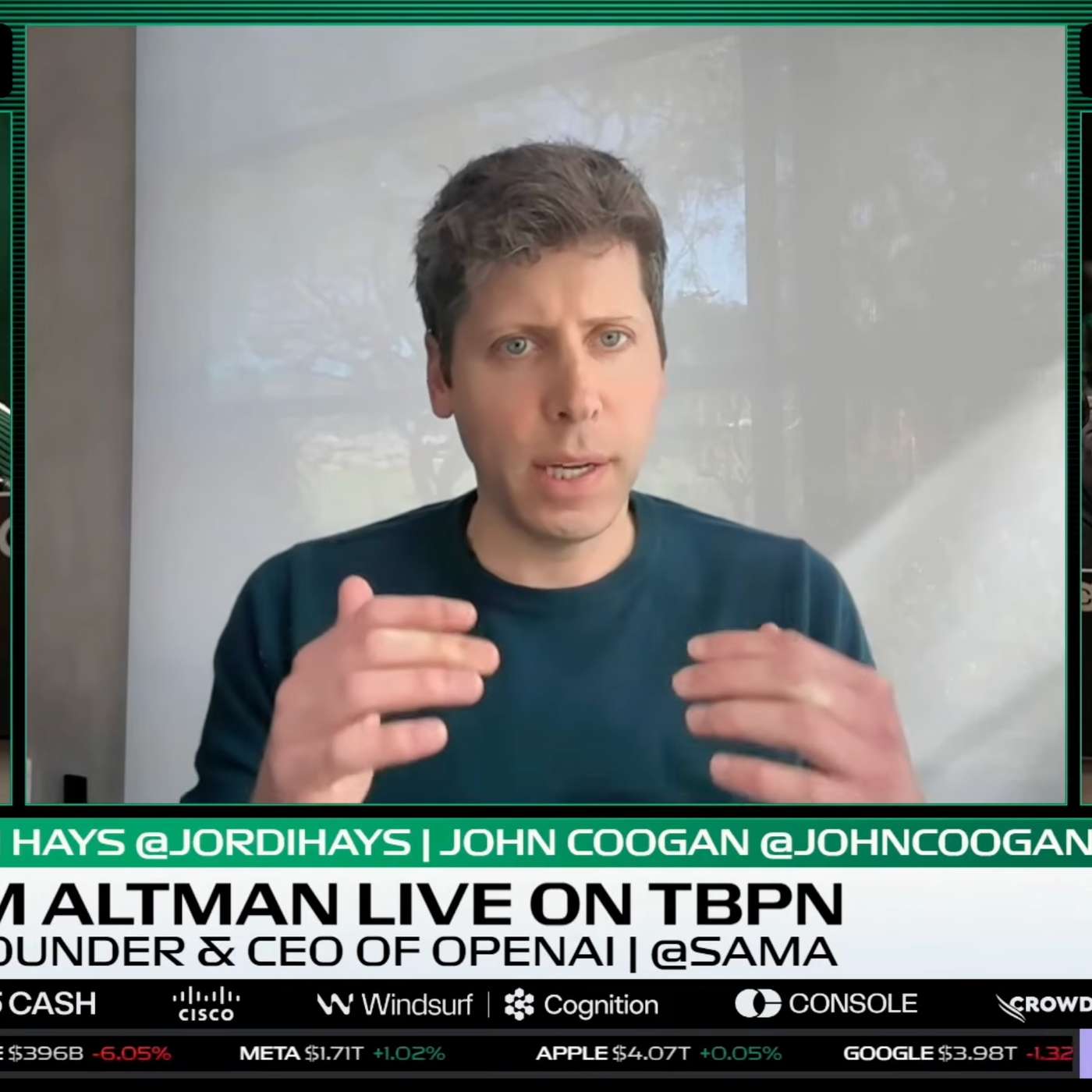
Sam Altman suggests that as AI models create enormous economic value, proxy metrics like task completion benchmarks will become obsolete. The most meaningful chart will be the model's direct impact on GDP. This signals a fundamental shift from the research phase of AI to an era of broad economic transformation.

The hype around future model improvements overshadows a key reality: current models are already "sufficiently intelligent" for countless valuable tasks. Even if all AI innovation stopped today, we could still unlock trillions in economic value just by integrating existing technology across the economy.

OpenAI's new GDP-val benchmark evaluates models on complex, real-world knowledge work tasks, not abstract IQ tests. This pivot signifies that the true measure of AI progress is now its ability to perform economically valuable human jobs, making performance metrics directly comparable to professional output.
A significant disconnect exists between AI's market valuation, which prices in massive future GDP growth, and its current real-world economic impact. An NBER study shows 80% of US firms report no productivity gains from AI, highlighting that market hype is far ahead of actual economic integration and value creation.