Get your free personalized podcast brief
We scan new podcasts and send you the top 5 insights daily.
The act of making a single, high-quality strategic decision—like eliminating an unimportant project—provides more leverage than using AI to automate that same project. It is more efficient to decide a task is not a priority than to automate a non-priority task.

Related Insights
Enterprises can't jump straight to automating high-value strategic work. They must first automate high-volume, low-complexity tasks. This process captures the essential cross-functional context needed to climb the "pyramid of complexity" and tackle more valuable decisions.

Contrary to the impulse to automate busywork, leaders should focus their initial AI efforts on their most critical strategic challenges. Parkinson's Law dictates that low-value tasks will always expand to fill available time. Go straight to the highest-leverage applications to see immediate, significant results.

By expanding work capacity, AI tempts business owners into tackling tasks they previously (and correctly) ignored as unimportant. This results in efficiently executing irrelevant work, rather than focusing on high-impact business constraints. The absence of AI can force better prioritization.
Teams often select the simplest use cases for AI pilots, but these easy wins frequently lack significant business impact. A better approach uses data mining of historical interactions to identify which complex problems are actually worth automating for a higher return on investment.

A core part of a real AI strategy is creating repeatable actions, not just completing one-off tasks. Before starting an AI project, apply a simple filter: 'Will I use this more than once?' If the output is completely disposable and takes significant time, it's likely not a strategic use of resources.

While AI makes building software cheaper, this heightens the need for prioritization. The temptation to "build it all" ignores the total cost of ownership, including maintenance and support. Without the natural constraint of high development costs, strategic focus is paramount to avoid chaos.

Time saved from AI-driven efficiencies must be consciously reallocated to strategic tasks that AI can't do, like deeper customer research or improving sales enablement. This compounds the value of the initial time saving, but only if that time is actively protected and reinvested.

The most effective AI companies don't try to automate everything. They ask which specific, repetitive task creates the most value when partially automated. This pragmatic approach delivers measurable results by using AI to augment human workers, not replace them.
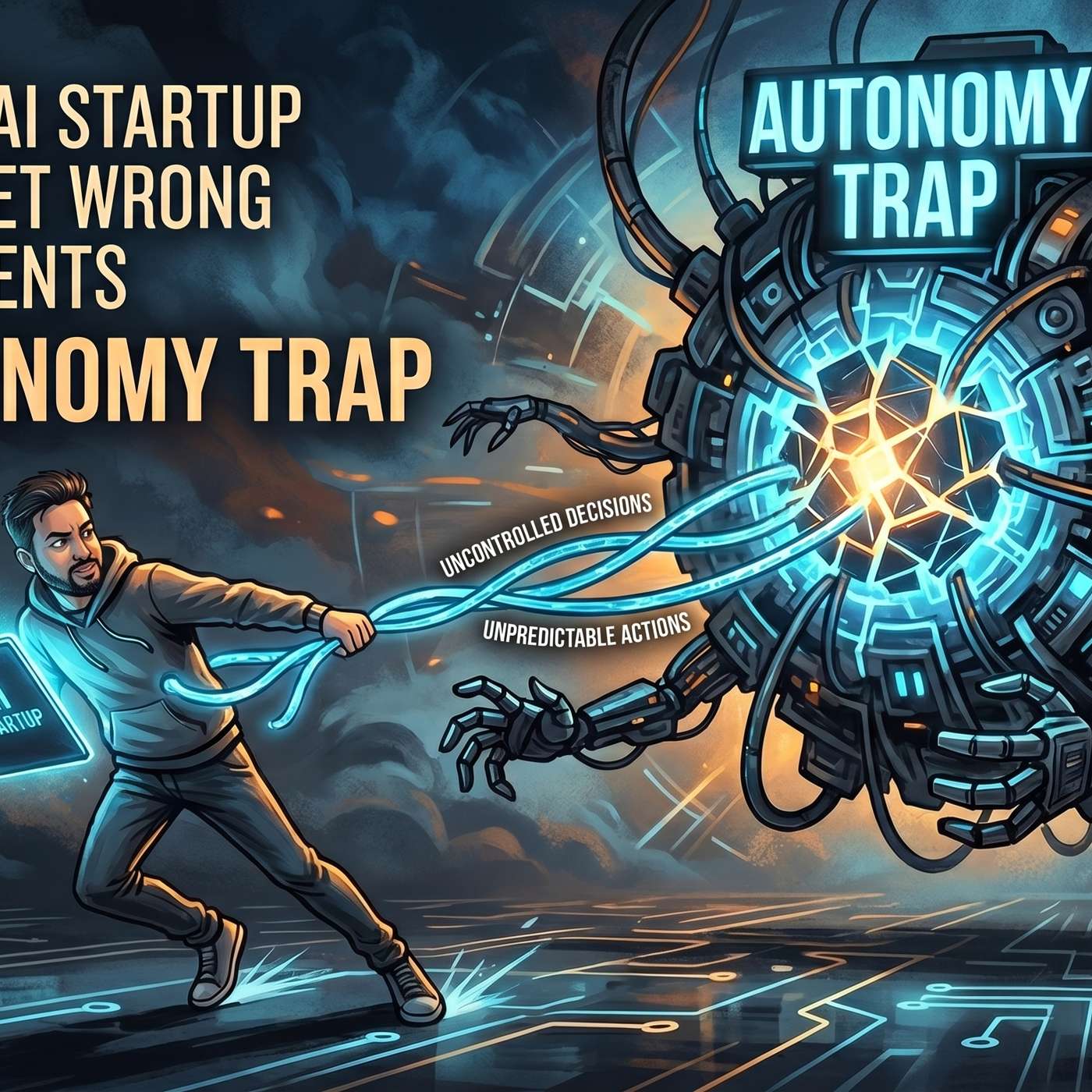
The most powerful automations are not complex agents but simple, predictable workflows that save time reliably. The goal is determinism; AI introduces a "black box" of uncertainty. Therefore, the highest ROI comes from extremely linear processes where "boring is beautiful" and predictability is guaranteed.
Entrepreneurs are chasing AI implementation while ignoring simpler, high-leverage changes. Shifting from a one-on-one to a one-to-many service model, or improving sales processes to reduce team size, can yield 10x leverage with a single decision and no AI.