Get your free personalized podcast brief
We scan new podcasts and send you the top 5 insights daily.
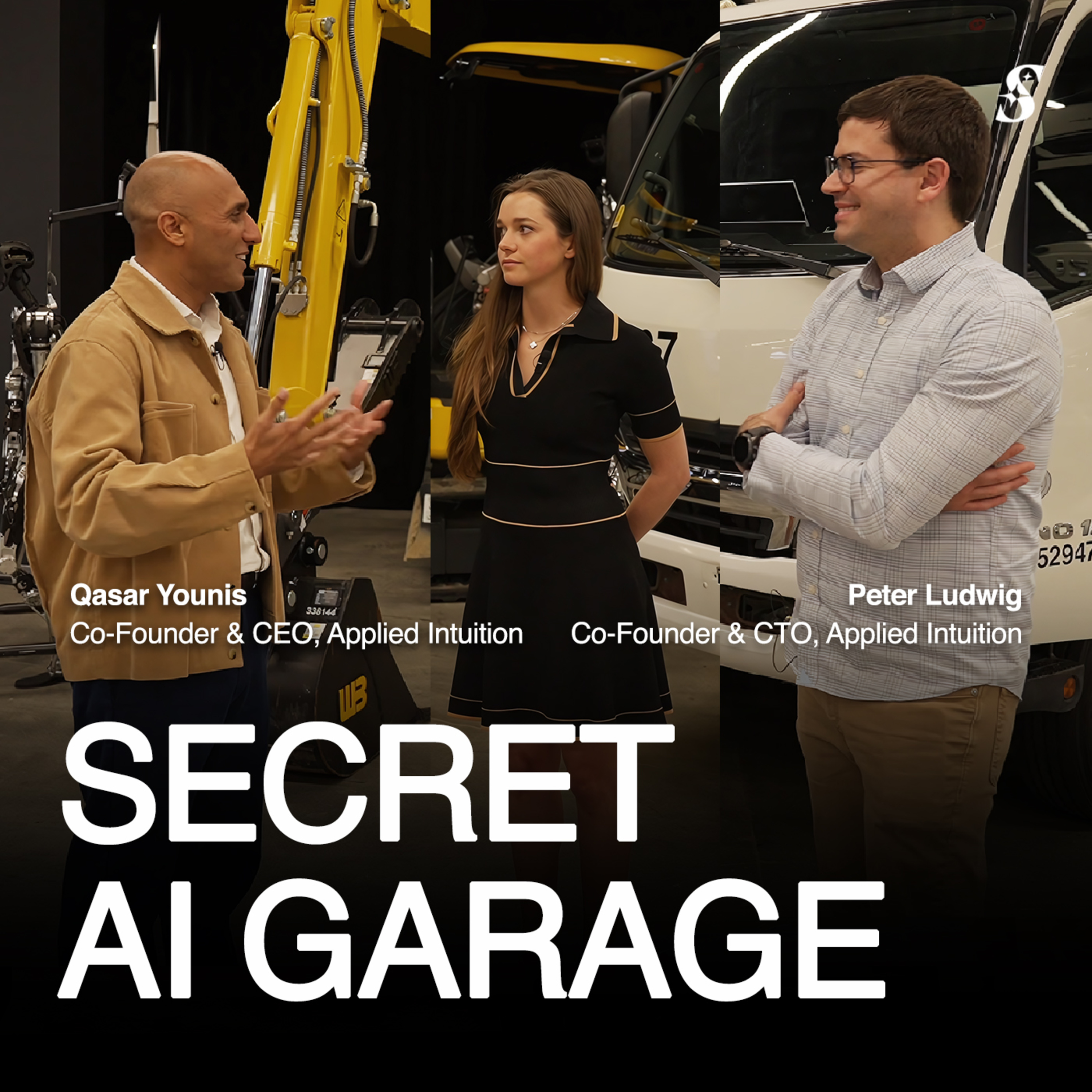
Applied Intuition uses the same fundamental software platform across cars, trucks, boats, and construction equipment. This is possible because all are machines interacting with the physical world governed by consistent laws of physics, enabling a scalable "Teslification" of multiple industrial sectors with a single core technology.
Related Insights
For decades, hardware startups failed because building the necessary bespoke software was too difficult and expensive. The rise of general-purpose AI provides a powerful, adaptable software layer "out of the box." This dramatically lowers the barrier to scaling for hardware-intensive businesses like robotics and drones, making them more attractive for creative financing.

Instead of creating bespoke self-driving kits for every car model, a humanoid robot can physically sit in any driver's seat and operate the controls. This concept, highlighted by George Hotz, bypasses proprietary vehicle systems and hardware lock-in, treating the car as a black box.

The neural nets powering autonomous vehicles are highly generalizable, with 80-90% of the underlying software being directly applicable to other verticals like trucking. A company's long-term value lies in its scaled driving data and core AI competency, not its initial target market.

NVIDIA is releasing an open-source, end-to-end AI software and hardware stack for autonomous driving. This strategy mimics Google's Android playbook: by enabling any automaker to build self-driving cars, NVIDIA aims to sell more of its onboard computers and dominate the chip market.
Rivian's CEO explains that early autonomous systems, which were based on rigid rules-based "planners," have been superseded by end-to-end AI. This new approach uses a large "foundation model for driving" that can improve continuously with more data, breaking through the performance plateau of the older method.

Unlike pre-programmed industrial robots, "Physical AI" systems sense their environment, make intelligent choices, and receive live feedback. This paradigm shift, similar to Waymo's self-driving cars versus simple cruise control, allows for autonomous and adaptive scientific experimentation rather than just repetitive tasks.
To achieve scalable autonomy, Flywheel AI avoids expensive, site-specific setups. Instead, they offer a valuable teleoperation service today. This service allows them to profitably collect the vast, diverse datasets required to train a generalizable autonomous system, mirroring Tesla's data collection strategy.

Waive's core strategy is generalization. By training a single, large AI on diverse global data, vehicles, and sensor sets, they can adapt to new cars and countries in months, not years. This avoids the AV 1.0 pitfall of building bespoke, infrastructure-heavy solutions for each new market.

By solving the core "intelligence" problem with a foundation model, the barrier to entry for creating novel robotic applications and form factors will dramatically decrease. This will enable a "Cambrian explosion" of hardware creativity, as builders will no longer need to solve AI from scratch for each new idea.
![Sergey Levine - Building LLMs for the Physical World - [Invest Like the Best, EP.465] thumbnail](https://megaphone.imgix.net/podcasts/fdcd4328-2c77-11f1-a72b-977309fd08f1/image/b1bb4368d6e13a4a804924681ffe3ab1.jpg?ixlib=rails-4.3.1&max-w=3000&max-h=3000&fit=crop&auto=format,compress)
Traditional vehicles have complex, disparate wiring and compute systems. Applied Intuition first simplifies this into a centralized "one box" architecture, which is a necessary step before they can effectively deploy advanced autonomy and AI capabilities, much like developing apps for a modern smartphone.