Get your free personalized podcast brief
We scan new podcasts and send you the top 5 insights daily.
The strategy of using a baseline MRI to track changes is undermined by human psychology. When a new spot appears on a later scan, very few patients are comfortable with a 'wait and see' approach, creating immense pressure for immediate, potentially unnecessary invasive biopsies.

Related Insights
True early cancer detection involves finding microscopic tumor DNA in blood samples. This can identify cancer years before it's visible on an MRI, creating an opportunity for a patient's own immune system to potentially eliminate it before it ever becomes a clinical disease.

Years after remission, a routine scan showing a potential issue can trigger an intense, multi-week period of fear that mirrors the trauma of the original diagnosis. This underscores that for survivors, the psychological battle with cancer never truly ends, and the fear of its return is a persistent reality.

Contrary to trends in wellness, a full-body MRI doesn't catch cancer early. A mass visible on an MRI already contains billions of cells and may have spread. Furthermore, it often leads to a rabbit hole of invasive tests for benign abnormalities, causing unnecessary harm.
Even with negative biopsies, post-immunotherapy scans and scopes can show residual masses or mucin pools that are mistaken for active cancer. This makes determining a true complete clinical response difficult and can lead to unnecessary surgeries where no cancer is found, as these changes can take years to resolve.

While more data seems better, comprehensive imaging scans can be problematic. Each measurement carries a false positive risk, so the cumulative probability of receiving a disruptive, incorrect result becomes material, leading to unnecessary stress and follow-up procedures.
![Alex Karnal - The Trillion-Dollar Health Revolution - [Invest Like the Best, EP.467] thumbnail](https://megaphone.imgix.net/podcasts/cbc5538c-3d2c-11f1-abeb-8fa0b9345ba8/image/7338c7270d70078f65b4911eb9cd5b0b.jpg?ixlib=rails-4.3.1&max-w=3000&max-h=3000&fit=crop&auto=format,compress)
Unlike rectal cancer where MRI aids response assessment, MSI-high colon cancer lacks a reliable imaging modality to confirm a pathologic complete response after neoadjuvant immunotherapy. This makes a "watch and wait" approach far more challenging and not currently recommended outside of a clinical trial.
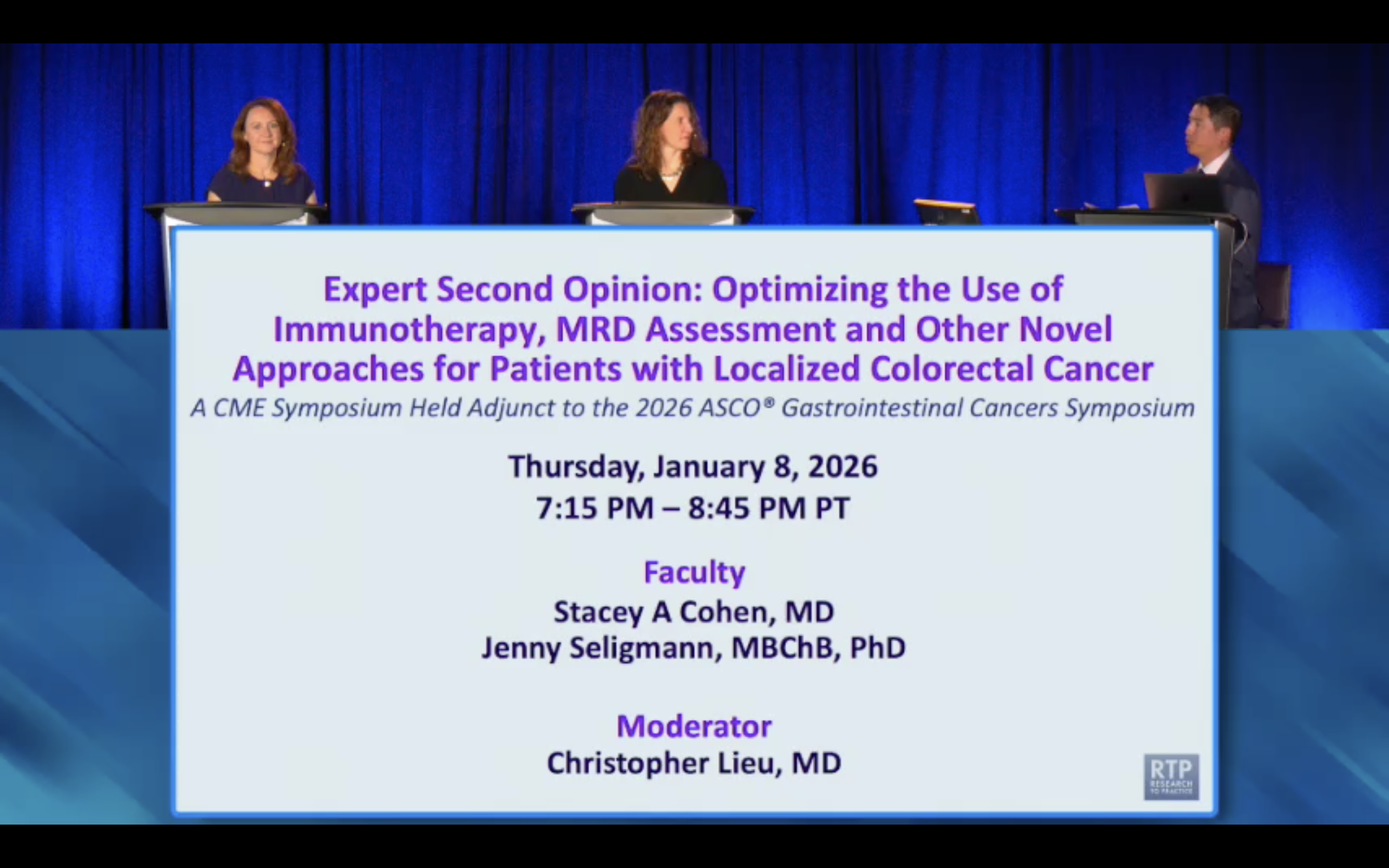
Unlike rectal cancer where MRI is effective, there is no reliable imaging to monitor for complete response in colon cancer. The alternative, frequent colonoscopies, is impractical and unsafe. This lack of viable surveillance tools makes non-operative management too risky, even with promising response rates to immunotherapy.
While re-biopsying at disease progression is the "by-the-book" standard to confirm biomarkers like HER2, clinicians acknowledge it is often skipped. The difficulty of obtaining tissue and the desire to provide patients with potential treatment options create a gap between guidelines and clinical reality.

An expert questions the utility of PCI, arguing that historical studies supporting its use were flawed because they lacked baseline brain MRIs. This means many patients may have been treated for existing, not prophylactic, metastases. Modern MRI surveillance may be a better approach to avoid long-term radiation toxicity in survivors.

Regularly scheduled FET PET scans over extended periods help clinicians confidently monitor fluctuating lesions. This longitudinal data provides the reassurance needed to be patient and avoid prematurely escalating treatment for what may ultimately prove to be benign, treatment-related changes.