Get your free personalized podcast brief
We scan new podcasts and send you the top 5 insights daily.
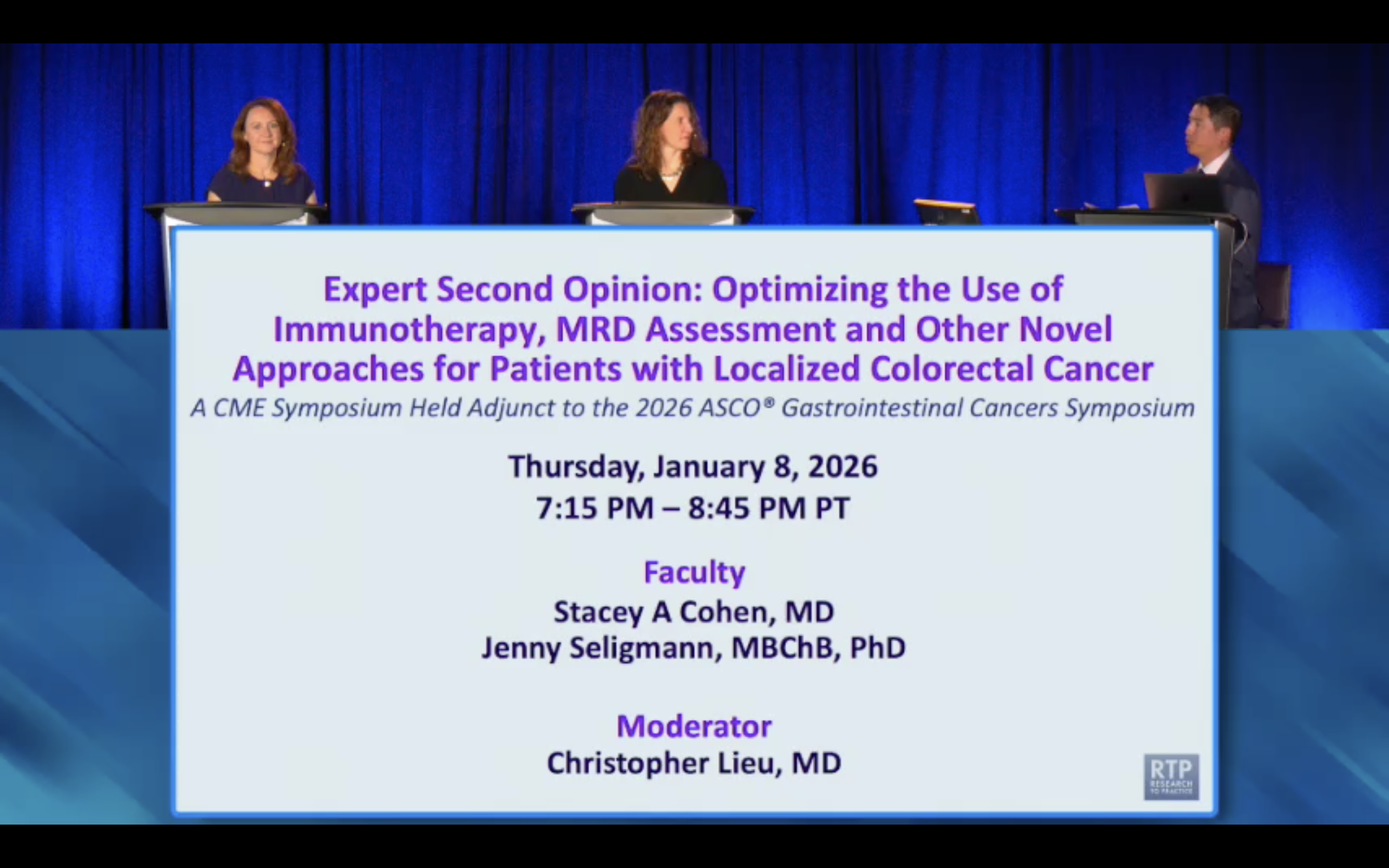
Unlike rectal cancer where MRI aids response assessment, MSI-high colon cancer lacks a reliable imaging modality to confirm a pathologic complete response after neoadjuvant immunotherapy. This makes a "watch and wait" approach far more challenging and not currently recommended outside of a clinical trial.
Related Insights
A significant challenge in assessing complete response after neoadjuvant immunotherapy for rectal cancer is the presence of mucin pools. These imaging abnormalities can persist for up to two years, mimicking residual tumor and complicating decisions about non-operative management.
Sentinel lymph node biopsy was historically inconsistent in CSCC because a positive finding had no approved systemic treatment path. With adjuvant cemiplimab's approval, identifying microscopic nodal disease now directly impacts treatment eligibility, potentially making the procedure a new standard of care for certain high-risk patients.
While neoadjuvant immunotherapy shows astounding success in MSI-high rectal cancer, the primary difficulty for clinicians lies in accurately assessing complete response via endoscopy and MRI, and managing unique complications like mucin pools or stenosis, rather than simply administering the treatment.
Historically, discussing adjuvant therapy for Stage III colon cancer was quick and straightforward, while Stage II was complex. The advent of ctDNA testing has reversed this dynamic. Stage II decisions are now clearer (treat if positive), while Stage III discussions have become much longer and more nuanced as clinicians integrate ctDNA data with patient preferences.
With 72% response rates to neoadjuvant immunotherapy, surgeons are shifting from immediate, aggressive surgery to a "wait-and-see" approach. Shrinking the tumor first can turn a morbid, disfiguring operation into a much simpler procedure, fundamentally changing the initial surgical evaluation for cutaneous squamous cell carcinoma (CSCC).
While the ATOMIC trial established FOLFOX plus atezolizumab as a new standard for adjuvant therapy in MSI-high colon cancer, its design lacked an immunotherapy-only arm. This leaves a critical, unanswered question about the actual contribution and necessity of the chemotherapy component.
After immunotherapy, many colorectal cancer patients have residual nodules on scans that appear to be partial responses. However, ctDNA testing can confirm these are often just scar tissue, not active disease. This provides the confidence to stop therapy at the two-year mark and avoid unnecessary surgeries for what are effectively complete responses.
A potential complication of successful neoadjuvant immunotherapy in rectal cancer is the development of stenosing scar tissue. This can block the lumen, making endoscopic surveillance impossible and necessitating surgery for a patient who may have otherwise achieved a complete clinical response.
Dr. Radvanyi advocates for a paradigm shift: treating almost all cancers with neoadjuvant immunotherapy immediately after diagnosis. This "kickstarts" an immune response before standard treatments like surgery and chemotherapy, which are known to be immunosuppressive, can weaken the patient's natural defenses against the tumor.

While the ATOMIC trial combined FOLFOX with atezolizumab, clinicians should not de-escalate by simply dropping oxaliplatin. Historical data suggests single-agent 5-FU is ineffective and potentially harmful in MSI-high patients, a risk that is not presumed to be overcome by adding immunotherapy.