Get your free personalized podcast brief
We scan new podcasts and send you the top 5 insights daily.
Richard Starson emphasizes that solid-state lasers and conventional kinetic interceptors struggle economically and technically against massive, cheap drone swarms. Stelios builds megawatt-class microwave systems that output enough power to disable electronics across a wide area up to two miles, providing scalable non-kinetic defense.

Related Insights
Warfare has evolved to a "sixth domain" where cyber becomes physical. Mass drone swarms act like a distributed software attack, requiring one-to-many defense systems analogous to antivirus software, rather than traditional one-missile-per-target defenses which cannot scale.

To counter the high cost of traditional interceptors, Ukraine has developed a strategy of using cheap, fast FPV (first-person view) drones to destroy incoming Shaheed drones. The newest versions use AI for autonomous final-stage guidance, creating a new paradigm in air defense.

Military commanders are not concerned with cost during a firefight, but higher-level strategic planners are. The unsustainable cost of using multi-million-dollar missiles on cheap drones is driving demand for cheaper interceptors and directed energy, shifting procurement priorities at the national level.

Kateryna Bondar points out that no single silver-bullet technology can reliably defeat drone swarms across changing battlefield conditions. Instead, effective defense relies on an integrated architecture coordinating mobile machine-gun crews, interceptor drones, and light civilian aircraft working together in one unified system.

Modern conflicts demonstrate that low-cost drones can effectively neutralize multi-million dollar missiles. This economic imbalance creates a massive market opportunity for tech companies that can produce cheaper, high-volume, and effective weapons systems.
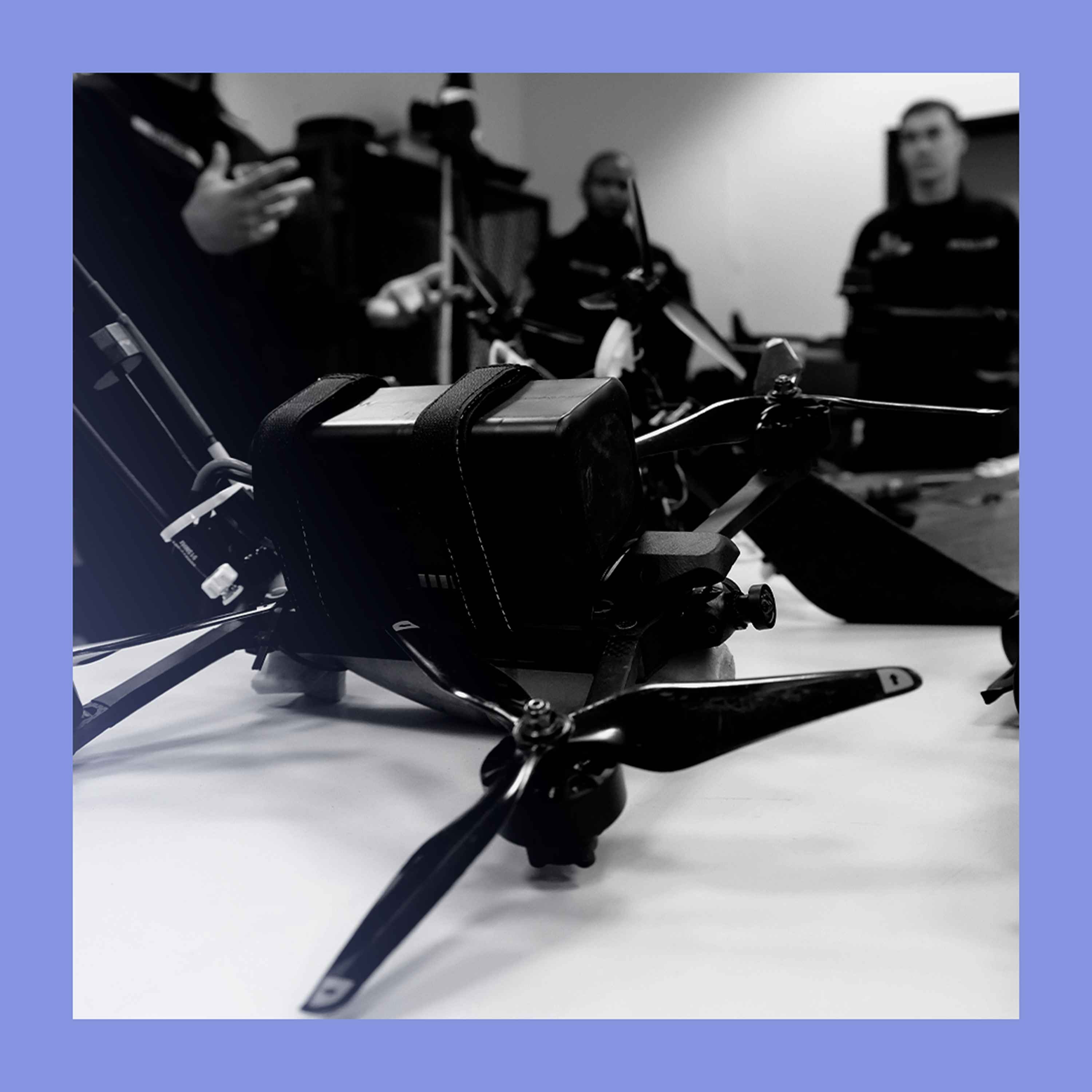
Conceding the U.S. cannot out-manufacture China in a drone-for-drone war, Mock Industries' founder argues for an asymmetric strategy. This involves decentralized, easily deployed systems that make China's large, centralized assets (and our own) obsolete, shifting the battlefield dynamics entirely.

Directed energy weapons have distinct roles. Lasers are precision weapons for single targets, concentrating energy in a narrow beam. In contrast, high-powered microwaves emit a wider beam to disrupt the electronics of multiple targets simultaneously, such as a drone swarm.
The US military excels at offense (attacking large targets) but is weak in defense, particularly against decentralized threats like swarms of small drones. This makes it difficult to secure shipping lanes like the Strait of Hormuz, as there is no central target to destroy, and a defensive shield is required.

Nations like Iran and Russia deploy vast numbers of cheap drones (around $55,000 each), forcing defenders to use multi-million dollar missiles. This creates a severe cost imbalance, making traditional, high-end air defense economically unsustainable over time.
Directed energy weapons supplement, not replace, missiles. Future strategy involves an integrated, layered defense where commanders select from a portfolio of options—from microwaves for drone swarms to costly "exquisite" missiles for hypersonic threats—creating a more flexible and economically viable response.