Get your free personalized podcast brief
We scan new podcasts and send you the top 5 insights daily.
This framework demystifies building an eval. Define your input data (e.g., user queries), specify the task your AI performs (from an LLM call to a complex agent), and create scoring functions that normalize outputs to a 0-1 range for consistent comparison.

Related Insights
Before building an AI agent, product managers must first create an evaluation set and scorecard. This 'eval-driven development' approach is critical for measuring whether training is improving the model and aligning its progress with the product vision. Without it, you cannot objectively demonstrate progress.

Standardized benchmarks for AI models are largely irrelevant for business applications. Companies need to create their own evaluation systems tailored to their specific industry, workflows, and use cases to accurately assess which new model provides a tangible benefit and ROI.
Treating AI evaluation like a final exam is a mistake. For critical enterprise systems, evaluations should be embedded at every step of an agent's workflow (e.g., after planning, before action). This is akin to unit testing in classic software development and is essential for building trustworthy, production-ready agents.
When using an LLM to evaluate another AI's output, instruct it to return a binary score (e.g., True/False, Pass/Fail) instead of a numbered scale. Binary outputs are easier to align with human preferences and map directly to the binary decisions (e.g., ship or fix) that product teams ultimately make.

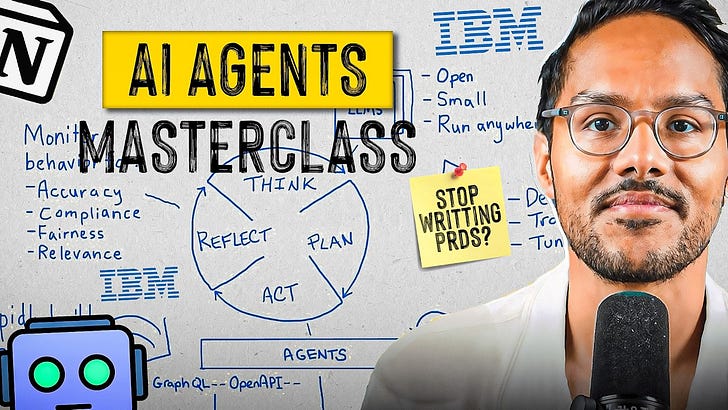
The primary bottleneck in improving AI is no longer data or compute, but the creation of 'evals'—tests that measure a model's capabilities. These evals act as product requirement documents (PRDs) for researchers, defining what success looks like and guiding the training process.

Building a functional AI agent is just the starting point. The real work lies in developing a set of evaluations ("evals") to test if the agent consistently behaves as expected. Without quantifying failures and successes against a standard, you're just guessing, not iteratively improving the agent's performance.

A one-size-fits-all evaluation method is inefficient. Use simple code for deterministic checks like word count. Leverage an LLM-as-a-judge for subjective qualities like tone. Reserve costly human evaluation for ambiguous cases flagged by the LLM or for validating new features.

The 'environment' concept extends beyond RL. It's a universal framework for any model interaction, encompassing the task, the harness, and the rubric. This same structure can be used for evaluations, A/B testing, prompt optimization, and synthetic data generation, making it a core building block for AI development.

The prompts for your "LLM as a judge" evals function as a new form of PRD. They explicitly define the desired behavior, edge cases, and quality standards for your AI agent. Unlike static PRDs, these are living documents, derived from real user data and are constantly, automatically testing if the product meets its requirements.

Instead of waiting for external reports, companies should develop their own AI model evaluations. By defining key tasks for specific roles and testing new models against them with standard prompts, businesses can create a relevant, internal benchmark.