Get your free personalized podcast brief
We scan new podcasts and send you the top 5 insights daily.
The Phase II study for Pumitamig intentionally combined the drug with various chemotherapy agents. The primary goal was not to directly compare efficacy between partners, but to establish a broad safety profile, ensuring a well-informed and flexible design for the subsequent, larger Phase III registrational trial.

Related Insights
Real-world data suggests that using one antibody-drug conjugate (ADC) immediately after another is often ineffective. A potential strategy to overcome this resistance is to administer a different class of chemotherapy before starting the second ADC.
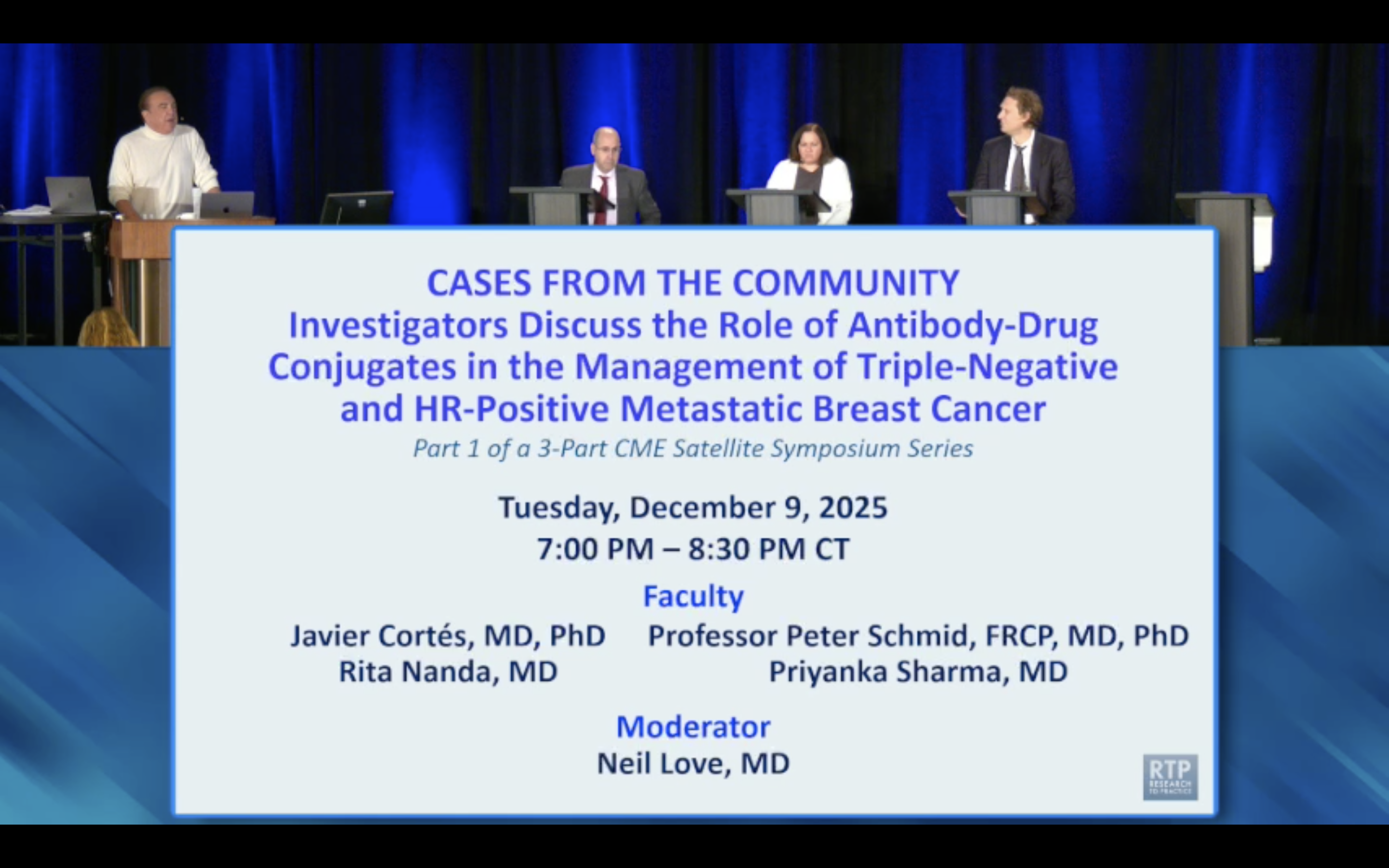
In a future TNBC landscape with new antibody-drug conjugates (ADCs), Pumitamig is framed as a fundamentally different tool. The expert views ADCs as a form of "chemotherapy," while Pumitamig is an "immunotherapeutic strategy." This conceptual separation suggests a future where these novel agents are used in combination or sequence, not in direct competition.
Cereno Scientific chose a Phase 2b trial over a combined 2b/3 to maintain flexibility. A combined trial locks in the design for both phases upfront, whereas a standalone 2b allows for optimization before Phase 3 and creates a cleaner, more attractive asset for a potential acquisition deal.
![Sten R. Sörensen, Cereno Scientific 🇸🇪 | Drug Repurposing, Retail Investors | E52 [Sponsored] thumbnail](https://d3t3ozftmdmh3i.cloudfront.net/staging/podcast_uploaded_episode/38602414/38602414-1770668818564-0e3602876c1a2.jpg)
Actuate employed a master protocol that tested their drug alongside eight different standard-of-care chemotherapies in patients who had already failed them. This design efficiently demonstrated the drug's ability to reverse chemo-resistance across multiple histologies, informing their Phase 2 strategy.

In oncology R&D, a successful two-drug combination isn't the final goal but the new standard of care to build upon. Researchers immediately begin planning for "triplets"—adding a third agent to the successful doublet—demonstrating a relentless, forward-looking strategy to incrementally improve patient outcomes.
Perioperative enfortumab vedotin-pembrolizumab (EV-Pembro) is surprisingly well-tolerated on a per-cycle basis compared to the traditional GEMSYS chemotherapy regimen. This challenges preconceived notions about the toxicity of this powerful combination, though cumulative toxicity over longer durations remains a key factor.

Fibrogen uses its PET imaging agent in Phase 2 not to pre-select patients, but to correlate target expression with treatment response. This data will allow them to enrich their Phase 3 trial with patients most likely to respond, significantly increasing the probability of success.

The ongoing Phase III trial for Sigvotatug Vedotin compares it against docetaxel, the current standard for second-line NSCLC. Docetaxel is known for modest efficacy and significant side effects, creating a major opportunity for the new drug to demonstrate superiority and rapidly become the new clinical standard.

The GLORA-IV trial is designed with a dual endpoint, evaluating both patient response rate and overall survival. This structure creates an alternative pathway for regulatory approval based on response rates, which can be assessed faster than survival, strategically de-risking the lengthy and expensive trial process.
Xevinapant's Phase III failure, after a promising Phase II trial, was partially attributed to the broader, more heterogeneous patient population. This group experienced greater toxicity than the Phase II cohort, suggesting early-phase safety profiles may not scale, ultimately compromising the efficacy of the entire treatment regimen.
