Get your free personalized podcast brief
We scan new podcasts and send you the top 5 insights daily.
AI models capable of designing biological sequences are advancing rapidly. The same models can be used for defense (e.g., detecting pathogens), but this defensive side is significantly behind, creating a dangerous imbalance that needs to be addressed.
Related Insights
AI models can modify the genetic sequences of known bioweapons like ricin just enough to evade current screening protocols at DNA synthesis companies. This creates functional but 'obfuscated' threats, demonstrating a critical vulnerability in our biodefense supply chain.

Mythos is a general-purpose system also proficient in biology. How society, governments, and companies manage the risks and norms of AI in cybersecurity is a direct preview of the much higher-stakes challenge of managing future AI-driven biological threats.

There's a critical asymmetry in AI risk timelines. For cyber threats, an AI that finds an exploit can create a patch almost instantly. For biological threats, an AI might design a dangerous virus, but developing and deploying the corresponding countermeasure (e.g., a vaccine) takes far longer than the ~6 months before the virus-design capability diffuses to open-source models.

Current concerns focus on AI agents using existing bioinformatics tools. The more advanced threat is agentic AI that can code and create novel, personalized biological tools on demand, moving beyond a static toolset to a dynamic threat generation capability.
Current biosecurity screens for threats by matching DNA sequences to known pathogens. However, AI can design novel proteins that perform a harmful function without any sequence similarity to existing threats. This necessitates new security tools that can predict a protein's function, a concept termed "defensive acceleration."

Existing bio-defense systems work by matching DNA sequences to known pathogen databases. However, generative AI can create novel sequences with different 'spellings' but the same dangerous function. Effective future defense must evolve to predict a sequence's function, not just its identity.
The belief that nature represents the ceiling of pathogen danger is false. Just as humans engineer materials stronger than any found in nature, AI can be used to design viruses that are far more transmissible or lethal than their natural counterparts.
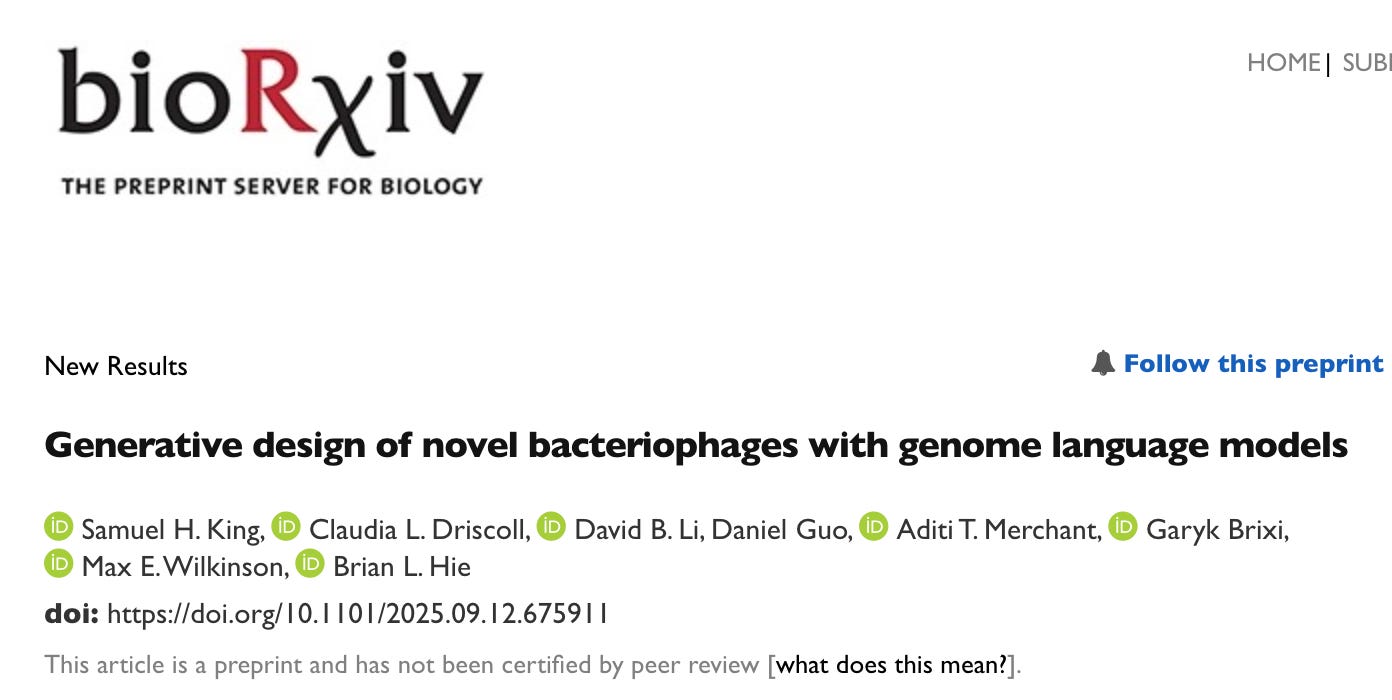
Scientists have designed viruses for years, but AI's breakthrough is making the process thousands of times cheaper and faster. This accelerates positive biotech applications like gene therapy but also heightens biosecurity risks by lowering the barrier to entry for creating problematic agents.

The underlying AI architecture for creating novel biological sequences is also highly effective at identifying dangerous ones. This dual-use nature means the team building design capabilities is best suited to build defense tools, as the models are fundamentally the same.
Valthos CEO Kathleen, a biodefense expert, warns that AI's primary threat in biology is asymmetry. It drastically reduces the cost and expertise required to engineer a pathogen. The primary concern is no longer just sophisticated state-sponsored programs but small groups of graduate students with lab access, massively expanding the threat landscape.
