Get your free personalized podcast brief
We scan new podcasts and send you the top 5 insights daily.
To build an AI that can reason about biology, researchers must first create a massive "dictionary" of normal cellular behavior. This involves capturing ~50 petabytes of unperturbed dynamics in organisms like zebra fish. Only after establishing this baseline of "native dynamics" can the model effectively interpret data from perturbed or diseased states.

Related Insights
The bottleneck for AI in drug discovery is not the algorithm but the lack of high-quality, large-scale biological data. New platforms are needed to generate this necessary "substrate" for AI models to learn from, challenging the narrative that better models alone are the solution.

Standard AI models trained on public, observational biological data excel at descriptive tasks but underperform even linear models on causal predictions. To predict cellular responses to drug-like perturbations, models must be trained specifically on causal data generated from targeted experiments.
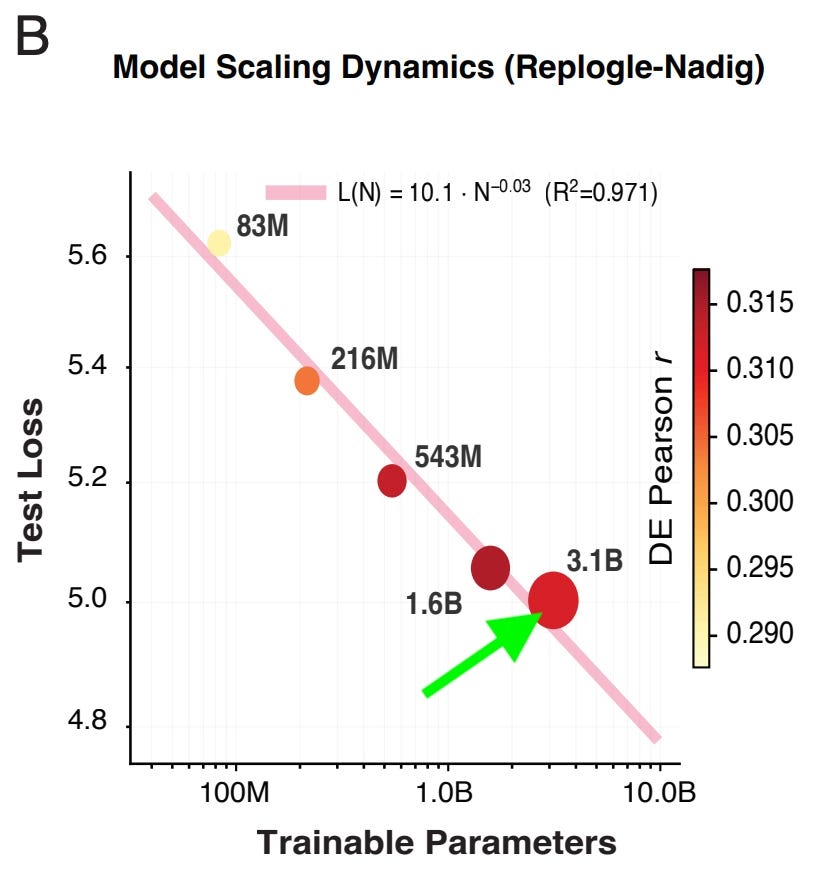
The primary bottleneck for creating powerful foundation models in biology is the lack of clean, large-scale experimental data—orders of magnitude less than what's available for LLMs. This creates a major opportunity for "data foundries" that use robotic labs to generate high-quality biological data at scale.

AI models trained on descriptive data (e.g., RNA-seq) can classify cell states but fail to predict how to transition a diseased cell to a healthy one. True progress requires generating massive "causal" datasets that show the effects of specific genetic perturbations.

The primary obstacle to creating sophisticated AI models of cells isn't the AI itself, but the data. Existing datasets often perturb only one cellular variable at a time, failing to capture the complex interactions that arise from simultaneous changes. New platforms are needed to generate this multi-dimensional data.
While AI excels where large, clean datasets exist (like protein folding), it struggles with modeling slow, progressive diseases like Alzheimer's or obesity. These are organ-level phenomena, and the necessary data doesn't exist yet. In vivo platforms are critical for generating this required foundational data.
To truly understand biological systems, data scale is less important than data quality. The most informative data comes from capturing the dynamic interactions of a system *while* it's being perturbed (e.g., by a drug), not from static snapshots of a system at rest.

Applying AI to biology isn't just a big data problem. The training data must be structured for reinforcement learning. This means it must be complete (including negative results) and allow for a feedback loop where AI predictions are tested in the lab, and the results are used to refine the model.
Unlike general AI which leverages vast, existing datasets, Noetik believes progress in biology requires designing and generating specific, high-quality data with foresight into the models that will be trained. They compare this to the intentional, decades-long creation of the PDB dataset for protein folding.
While petabytes of observational DNA sequence data exist, it's insufficient for the next wave of AI. The key to creating powerful, functional models is generating causal data—from experiments that systematically test function—which is a current data bottleneck.
