Get your free personalized podcast brief
We scan new podcasts and send you the top 5 insights daily.
Contrary to the standard research path of testing in animals before humans, scientists first observed that cancer patients on opioids had poorer immunotherapy outcomes. They then validated this clinical observation by recreating the effect in animal models to understand the underlying biological mechanism, reversing the typical discovery pipeline.
Related Insights
The high failure rate of drugs in human trials after passing animal tests stems from a fundamental biological reality: a "mouse is not a small human." This "structural mismatch" is especially severe for modern, human-specific therapies like CAR-T and RNA, rendering animal models poor proxies.

Instead of the traditional lab-to-clinic pipeline, a "reverse translation" approach uses AI to analyze data from patients who fail standard-of-care treatments. This identifies the specific unmet need and biological target first, guiding subsequent lab research for higher success rates.
Current drug development heavily relies on animal testing. However, significant biological differences mean we may be filtering out effective human medicines that fail in animal models, creating a hidden opportunity cost for medical breakthroughs.

Instead of testing a single drug candidate in cheap models before moving to expensive ones, Gordian's parallel testing platform makes it cost-effective to use clinically relevant large animals, like horses, at the very beginning of the discovery process. This flips the traditional R&D funnel on its head.
The push away from animal models is a technical necessity, not just an ethical one. Advanced therapeutics like T-cell engagers and multispecific antibodies depend on human-specific biological pathways. These mechanisms are not accurately reproduced in animal models, rendering them ineffective for testing these new drug classes.

For CNS diseases, where animal models are notoriously unreliable predictors of efficacy, the most pragmatic R&D model is to quickly move promising new chemical entities into human trials. The focus shifts from extensive preclinical validation to early biological experimentation in humans for proof-of-concept.

Numenos AI found that unifying biological data without traditional borders, such as incorporating mouse data or cancer data for dermatological diseases, surprisingly increases the predictive accuracy of their models. This challenges the siloed approach to traditional research.
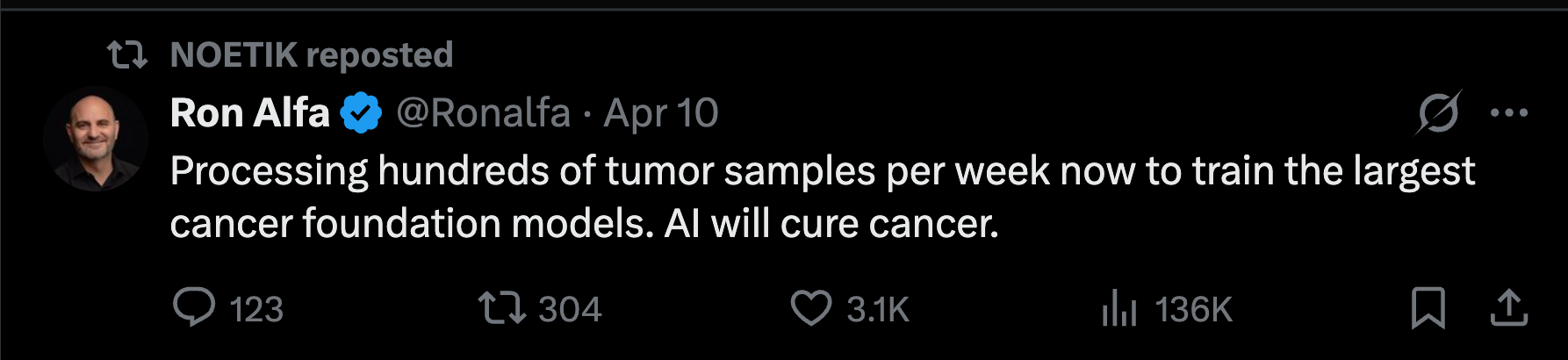
To bridge the gap between animal models and human trials, Noetik trains models on its human data and then runs inference on mouse histology (H&E) images. This allows them to predict human-relevant biology and gene expression directly from the mouse model, overcoming a key translational hurdle in drug development.
Unlike using genetically identical mice, Gordian tests therapies in large, genetically varied animals. This variation mimics human patient diversity, helping identify drugs that are effective across different biological profiles and addressing patient heterogeneity, a primary cause of clinical trial failure.
The "Valley of Death" where most biotech companies fail is not due to bad science but to the crippling cost of animal trials, which are poor predictors of human outcomes. Parrish argues for shifting focus directly to human data, as mice are not a reliable biological proxy for humans.