Get your free personalized podcast brief
We scan new podcasts and send you the top 5 insights daily.
Trop-2 antibody-drug conjugates (ADCs) outperform chemotherapy in metastatic triple-negative breast cancer regardless of the patient's Trop-2 expression level. While higher expression correlates with better response, the ADCs are superior even in low-expressing tumors, making it an ineffective selection tool versus chemo.

Related Insights
After a triple-negative breast cancer patient progresses on a first-line TROP2 antibody-drug conjugate (ADC), experts advise against immediately sequencing another ADC. Due to suspected cross-resistance, the recommended strategy is to return to traditional chemotherapy agents like taxanes or carboplatin, which remain effective options, before considering another ADC in later lines.

Modern antibody-drug conjugates (ADCs) like trastuzumab deruxtecan can kill nearby cancer cells that don't express the target protein. This 'bystander effect' is a game-changer, allowing ADCs to be effective even in tumors with varied (heterogeneous) protein expression, which has historically been a major clinical challenge.

A defining characteristic of antibody-drug conjugates is not just their response rate, but their remarkable duration of response. Patients who respond often maintain that response for a significantly longer period than with standard chemotherapy, a benefit likely attributable to the ADC's effect on the tumor microenvironment.

In metastatic breast cancer, approximately one-third of patients are unable to proceed to a second line of therapy due to disease progression or declining performance status. This high attrition rate argues for using the most effective agents, such as ADCs, in the first-line setting.
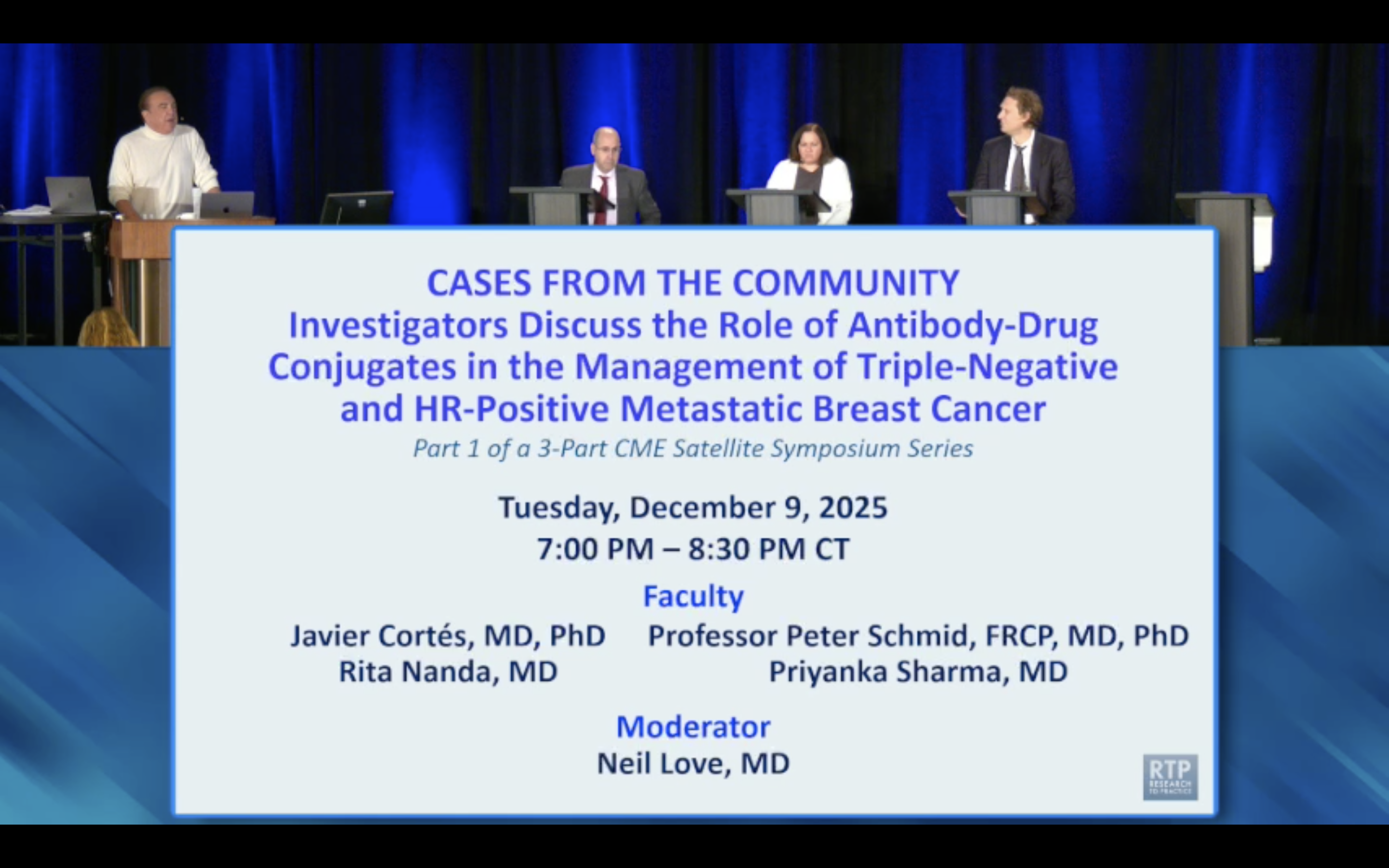
A significant clinical challenge is the sequencing of antibody-drug conjugates (ADCs). Retrospective data from large databases indicates that using a second TROP2-targeted ADC after a first one provides very limited efficacy, highlighting an urgent need for prospective trials to define optimal sequencing strategies and overcome resistance.
A decade ago, metastatic triple-negative breast cancer (mTNBC) had a median survival of about one year. Today, the duration of response to modern antibody-drug conjugates (ADCs) in the first-line setting can be longer than what the entire overall survival used to be, highlighting a massive therapeutic advancement.
The difficulty in finding a single predictive biomarker for antibody-drug conjugate (ADC) efficacy suggests that complex, multi-marker classifiers, like those in the ISPY 2.2 trial, represent the future for guiding ADC therapy selection over simple IHC cutoffs.
Contrary to expectations, TROP2 expression is not a reliable predictive biomarker for response to TROP2-targeting antibody-drug conjugates (ADCs). These drugs have shown activity across various expression levels, challenging the standard biomarker-driven approach to patient selection.
The differing efficacy and toxicity profiles of TROP2 ADCs like sacituzumab govitecan and Dato-DXD suggest that the drug's linker and payload metabolism are crucial determinants of clinical outcome. This indicates that focusing solely on the target antigen is an oversimplification of ADC design and performance.

Despite being "targeted therapies," multiple promising antibody-drug conjugates (ADCs) for small cell lung cancer (SCLC) show no correlation between the target protein's expression level and patient response. This suggests the payload or other factors are the primary drivers of efficacy, complicating biomarker development for patient selection.