Get your free personalized podcast brief
We scan new podcasts and send you the top 5 insights daily.
The ASCENT-07 trial, while failing its primary endpoint, revealed a promising efficacy signal for its Trop-2 ADC in IHC0 tumors. This finding from a "negative" study directly spurred a new trial, Tropion-Brest-O6, to investigate another ADC specifically in this refined patient population, demonstrating the iterative nature of clinical research.

Related Insights
Despite the ASCENT-07 trial failing its primary progression-free survival (PFS) endpoint, an early overall survival (OS) signal emerged. This divergence suggests the drug may confer a survival advantage not captured by the initial endpoint, complicating the definition of a "negative" trial and warranting further follow-up.
Progress in drug development often hides inside failures. A therapy that fails in one clinical trial can provide critical scientific learnings. One company leveraged insights from a failed study to redesign a subsequent trial, which was successful and led to the drug's approval.

Clinicians lack evidence to guide treatment for triple-negative breast cancer that relapses shortly after neoadjuvant chemo-immunotherapy. Pivotal trials for new ADCs like Dato-DXD included very few patients with prior immunotherapy, creating a significant and common evidence gap in clinical practice.

In the ASCENT-07 trial, investigators may have prematurely switched patients from the standard chemotherapy arm to superior, commercially available ADCs at the first hint of progression. This real-world practice can mask an experimental drug's true benefit on progression-free survival.
In metastatic breast cancer, approximately one-third of patients are unable to proceed to a second line of therapy due to disease progression or declining performance status. This high attrition rate argues for using the most effective agents, such as ADCs, in the first-line setting.
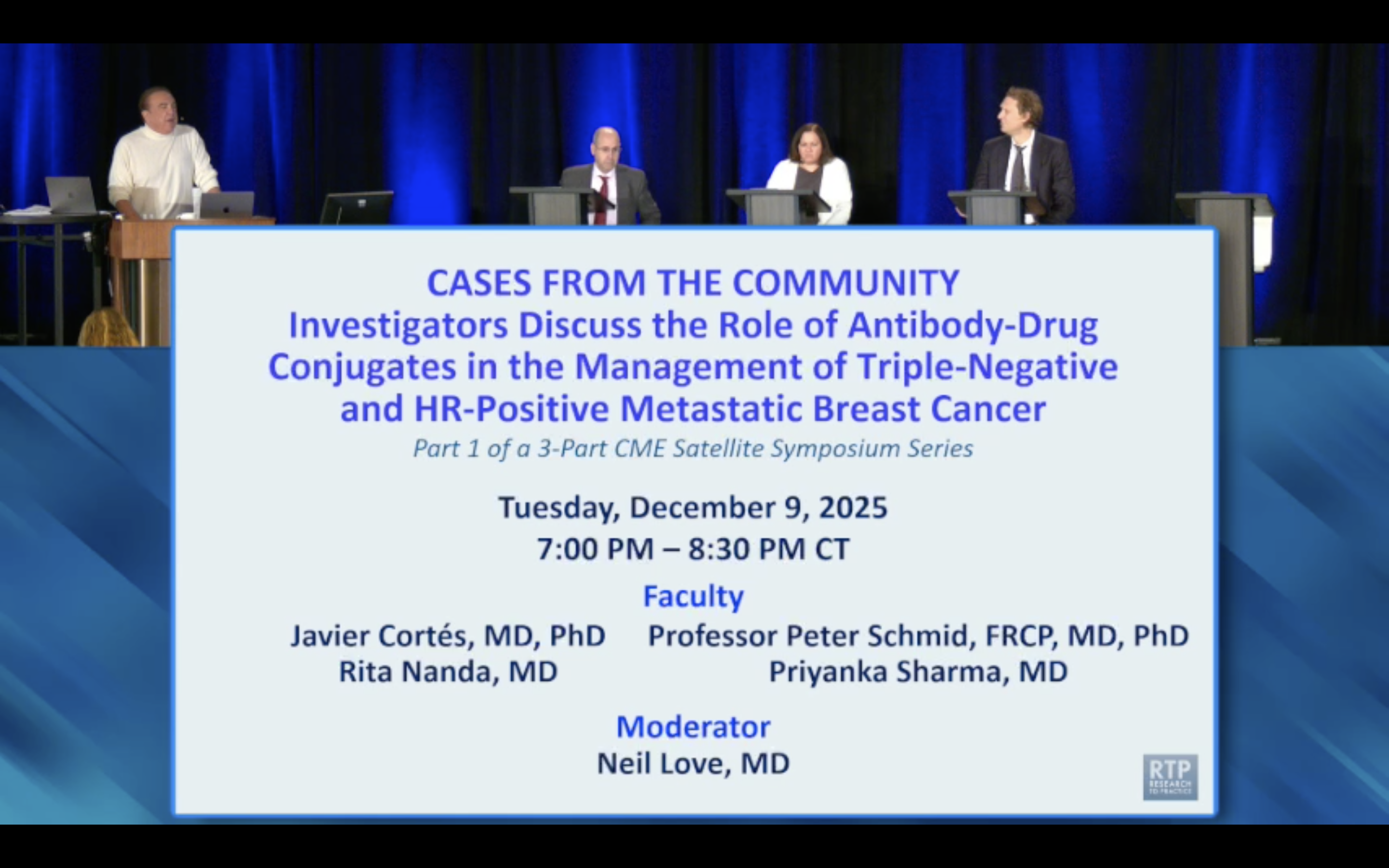
The failure of the TROPiCS-04 trial for sacituzumab govitecan may not indicate the TROP2 ADC class is ineffective. Experts suggest problems with dosing and toxicity management (e.g., neutropenia) during the trial could be the real culprit, arguing that the drug class still holds promise.

Emerging data shows that a second ADC, particularly one with the same payload, often has limited efficacy. This suggests clinicians must be highly strategic in selecting the first ADC, as it may be their most impactful opportunity for this class of drugs.
Contrary to concerns about cross-resistance between HER2 antibody-drug conjugates (ADCs), retrospective data shows TDM-1 remains effective after progression on TDXD. This suggests the different cytotoxic payloads are key, allowing for effective sequencing and challenging the assumption that progression on one ADC class member precludes using another.

Experts believe the stark difference in complete response rates (5% vs 30%) between two major ADC trials is likely due to "noise"—variations in patient populations (e.g., more upper tract disease) and stricter central review criteria, rather than a fundamental difference in the therapies' effectiveness.
The speakers highlight that negative trials in kidney cancer, which showed no benefit to immunotherapy re-challenge, were "super helpful." This is because they provided definitive evidence to stop a common clinical practice that was not helping patients and potentially causing harm, underscoring the constructive role of well-designed "failed" studies.