Get your free personalized podcast brief
We scan new podcasts and send you the top 5 insights daily.
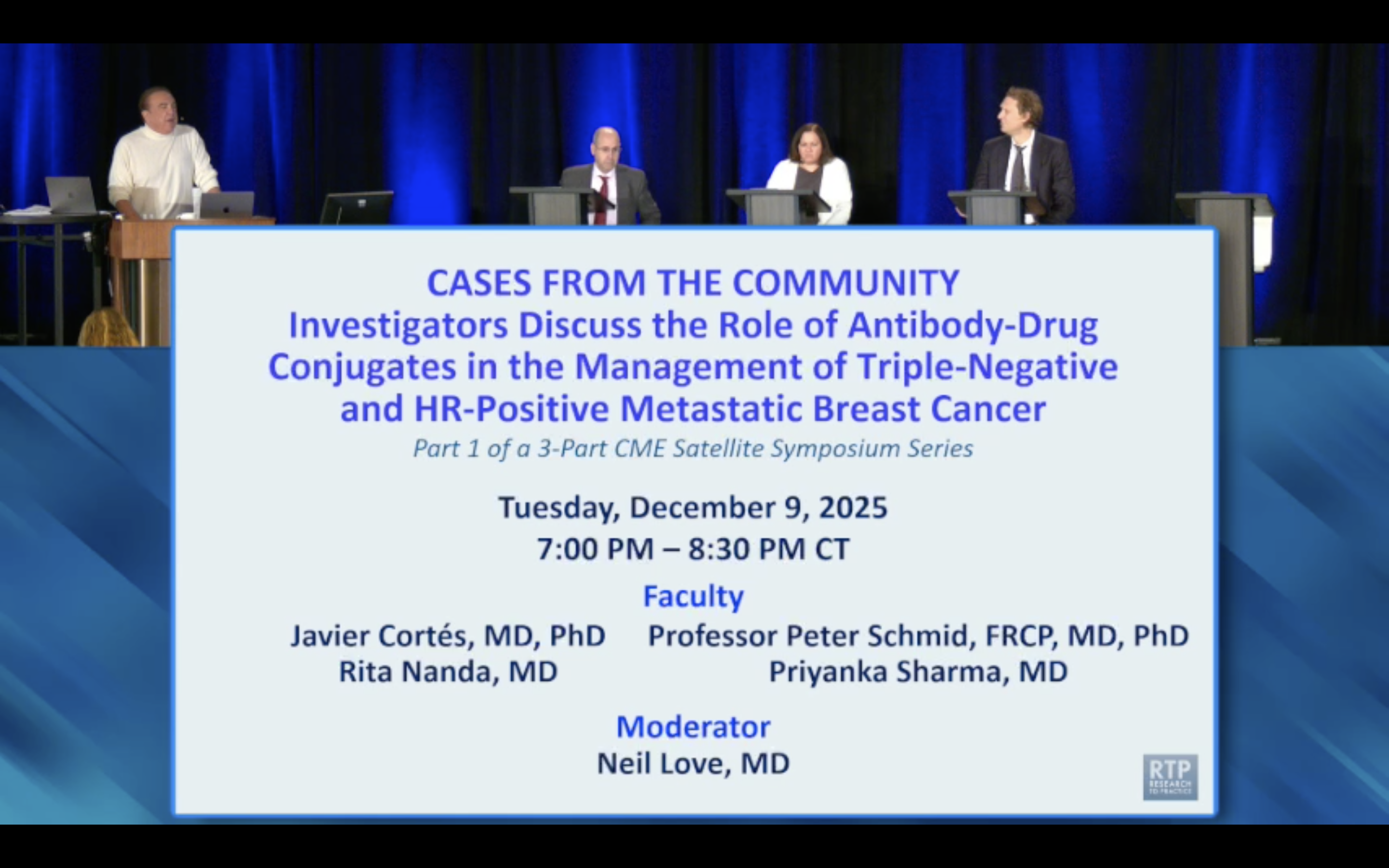
Clinicians lack evidence to guide treatment for triple-negative breast cancer that relapses shortly after neoadjuvant chemo-immunotherapy. Pivotal trials for new ADCs like Dato-DXD included very few patients with prior immunotherapy, creating a significant and common evidence gap in clinical practice.

Related Insights
While platinum chemotherapy is considered the standard treatment after a patient progresses on a first-line ADC-IO combination, experts admit this is a standard "based on nothing." There is no clinical trial data to prove its efficacy in this specific setting; it serves only as a placeholder for new clinical trials.

Unlike immunotherapy, where re-challenge after progression is dubious, there is an emerging clinical practice of re-challenging patients with the same antibody-drug conjugate (ADC), such as enfortumab vedotin (EV), after a treatment break forced by toxicity. Anecdotally, patients are showing great responses, highlighting a key area for prospective data generation.
Real-world data suggests that using one antibody-drug conjugate (ADC) immediately after another is often ineffective. A potential strategy to overcome this resistance is to administer a different class of chemotherapy before starting the second ADC.
In a data-free zone, a survey of 78 US oncologists revealed an emerging consensus to wait six months before re-challenging with EV-Pembro after prior immunotherapy. This demonstrates how clinical practice norms can form around arbitrary time points when definitive evidence on optimal treatment-free intervals is lacking.
A subtle finding in the DESTINY-Breast11 trial, where TDXD alone underperformed TDXD followed by THP, suggests that taxane-based chemotherapy might remain effective even after a patient's HER2-positive cancer becomes resistant to the antibody-drug conjugate TDXD.
Emerging data shows that a second ADC, particularly one with the same payload, often has limited efficacy. This suggests clinicians must be highly strategic in selecting the first ADC, as it may be their most impactful opportunity for this class of drugs.
A significant criticism of the pivotal KEYNOTE-564 trial is that only half the patients in the control arm received standard-of-care immunotherapy upon relapse. This lack of subsequent optimal treatment complicates the interpretation of the overall survival benefit, raising questions about its true magnitude.
While immunotherapy was a massive leap forward, Dr. Saav Solanki states the next innovation frontier is combining it with newer modalities. Antibody-drug conjugates (ADCs) and T-cell engagers are being used to recruit the immune system into the tumor microenvironment, helping patients who don't respond to current immunotherapies.

For patients who previously received immunotherapy (IO), a recurrence more than 12 months after completing treatment makes re-challenging with an IO agent a reasonable option. The likelihood of benefit is lower if the recurrence is within 6-12 months and minimal if under 6 months.
Clinical trial data shows that despite specific toxicities, antibody-drug conjugates (ADCs) can be better tolerated overall than standard chemotherapy. For example, trials for both sacituzumab govitecan and dato-DXd reported fewer patients discontinuing treatment in the ADC arm compared to the chemotherapy arm.