Get your free personalized podcast brief
We scan new podcasts and send you the top 5 insights daily.
In an AI-driven world, your competitive advantage is the proprietary 'context layer' you provide—your brand voice, customer insights, and strategic learnings. This ensures your output is unique and not just the generic 'best practice' marketing that AI models produce by default.
Related Insights
As more teams use AI, campaign strategies become homogenized because AI suggests traditional plays based on existing data. The key differentiator becomes human oversight, where marketers add unique, creative insights to AI-generated foundations, ensuring campaigns stand out.

As AI commoditizes content creation, the most valuable asset is unique, proprietary data that LLMs cannot access. Marketing teams that own the research function can generate this first-party data, creating a defensible moat and establishing true thought leadership.

A company's defensible advantage isn't just its data, but a codified "brand intelligence layer." This involves embedding the workflows, quality checks, KPIs, and decision-making frameworks of your best marketers into your AI agents, turning tacit human expertise into a scalable, technological asset.

Widespread AI adoption makes scaled, personalized outreach easy, raising the bar for everyone and creating more noise. The only way to cut through is with a vertical AI approach that combines specialized models with unique, industry-specific data to deliver contextual intelligence that competitors can't easily replicate.

As AI tools become commoditized, competitive advantage shifts from merely using AI to *how* you use it. The unique value marketers provide will be their creative ideas, strategic judgment, and personal taste in refining and directing AI-generated campaigns.

As AI becomes commoditized, the key differentiator will shift from *if* a company uses AI to *how good* its underlying data is. AI is only as effective as the context it's given, meaning companies with unified customer data will pull far ahead of those without it.

Since LLMs contain all established marketing playbooks, executing 'best practices' is no longer a competitive advantage. Everyone has access to the same baseline. The only way to win is to learn and iterate faster than the competition, operating outside the standardized knowledge base of AI.

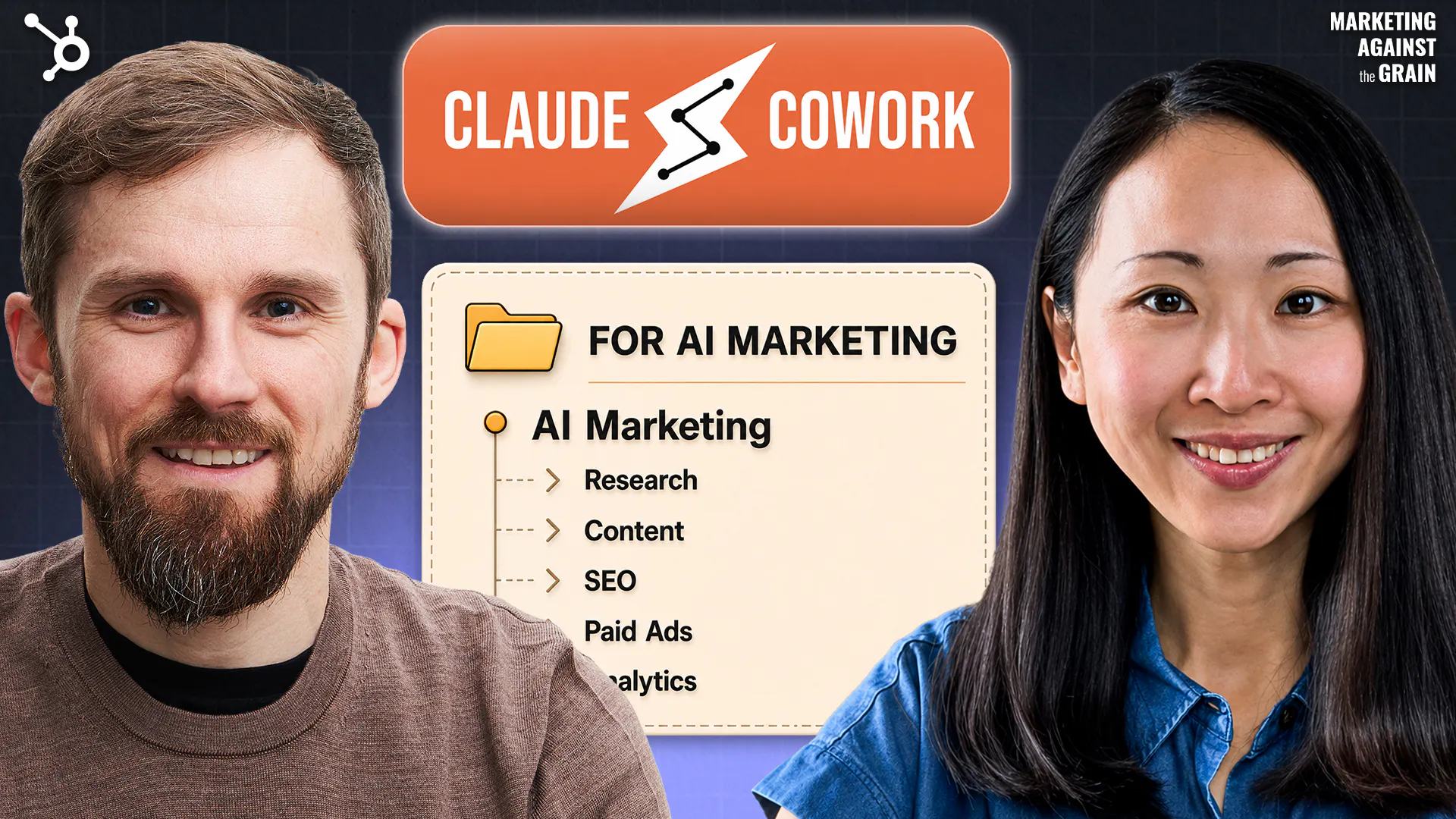
Effective AI marketing requires first building a structured system of folders and context files (brand voice, ICPs). This foundational work enables consistent, high-quality outputs and is more effective than ad-hoc prompting. It's about working slow first to eventually work fast.
Marketers should immediately start creating a private AI model by feeding it all company data: customer reviews (positive and negative), Reddit posts, brand voice guidelines, and past content. This creates a unique 'AI mind' that will outperform generic models and give the company a significant long-term edge in content creation and personalization.

AI agents like Manus provide superior value when integrated with proprietary datasets like SimilarWeb. Access to specific, high-quality data (context) is more crucial for generating actionable marketing insights than simply having the most powerful underlying language model.
