Get your free personalized podcast brief
We scan new podcasts and send you the top 5 insights daily.
Cybersecurity is no longer separate from data and AI. As companies deploy internal AI agents, these agents generate massive amounts of log data. Securing the enterprise now requires analyzing this data at scale, effectively collapsing the cyber and data/AI markets into a single discipline.

Related Insights
Each AI agent acting on a user's behalf creates a new "non-human identity" with its own keys and API access. This proliferation of autonomous agents dramatically increases the number of potential exploit points, a problem traditional security models weren't designed to handle.

Fragmented identity systems already delay responses to human threats by an average of 12 hours. The machine-speed complexity of AI agents will make this fragmentation untenable, forcing the market towards unified platforms that can manage both human and machine identities seamlessly.

The cybersecurity landscape is now a direct competition between automated AI systems. Attackers use AI to scale personalized attacks, while defenders must deploy their own AI stacks that leverage internal data access to monitor, self-attack, and patch vulnerabilities in real-time.

The future of work involves potentially millions of AI agents operating within a company. This requires a new governance layer, including agent inventories, inspectable reasoning traces, identity management, and sandboxed execution environments to maintain security and control.

The market panic selling cybersecurity stocks post-Anthropic's leak is illogical. The coming "agentic era"—with AI rapidly building and deploying code—will create an explosion of new security threats. This represents a golden age for cybersecurity companies, not a threat to their existence.

Security's focus shifted from physical (bodyguards) to digital (cybersecurity) with the internet. As AI agents become primary economic actors, security must undergo a similar fundamental reinvention. The core business value may be the same (like Blockbuster vs. Netflix), but the security architecture must be rebuilt from first principles.

As autonomous agents become prevalent, they'll need a sandboxed environment to access, store, and collaborate on enterprise data. This core infrastructure must manage permissions, security, and governance, creating a new market opportunity for platforms that can serve as this trusted container.
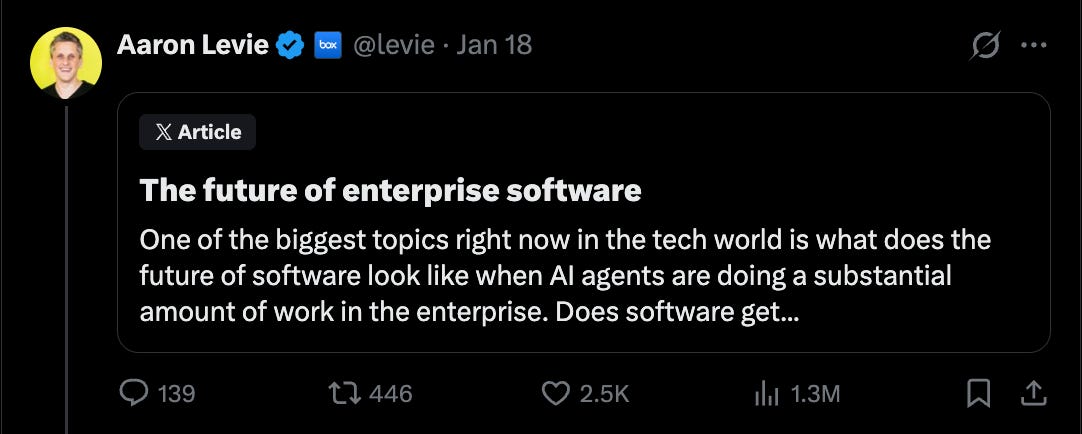
While AI will increase cyber risk by enabling faster vulnerability scanning and generating potentially insecure code, it will also be the solution. AI agents will be needed to review code and defend systems, creating a massive new market for "agentic security" companies.

The increasing use of AI by malicious actors is creating an exponentially expanding threat landscape. Human-only security teams cannot keep pace, creating a forcing function for organizations to adopt autonomous AI agents for defensive purposes just to survive.
The security paradigm is shifting from managing user access to governing autonomous AI agents. These agents act as a new class of "digital employees," creating a massive new attack surface that scales beyond human capacity and requires a workforce management approach to security.