Get your free personalized podcast brief
We scan new podcasts and send you the top 5 insights daily.
SF Compute argues that for a true compute market to exist, it needs an independent operator that handles physical settlement. This means running the data centers to standardize quality and earn Wall Street's trust, much like an electrical grid operator.

Related Insights
AI companies run private compute clusters at low utilization, similar to early industrial factories each having their own inefficient steam generator. This creates massive waste. The solution is a shared, coordinated compute grid that acts as an independent system operator to drive up utilization across the ecosystem.

The AI compute market, worth billions, lacks financial risk-management tools. Silicon Data is creating derivatives like futures contracts, allowing data center providers and AI labs to hedge exposure, enabling them to make bolder, more efficient investment decisions in physical compute.

AMP is creating a software grid to make today's fragmented compute resources (Nvidia, AMD, different clouds) fungible. This is analogous to how standardizing electricity to AC/DC unlocked a national grid, turning stranded pockets of power into an efficient, interoperable system.

The widely discussed GPU supply crunch is only half the problem. There's a severe shortage of suppliers who can operate data centers with the high reliability and SLAs required for mission-critical inference. Out of many providers, only a handful meet the "gold tier" for operational excellence.

The head of AI at Hudson River Trading highlights a practical barrier to creating a financial market for compute. For serious training, the minimum "lot size" is thousands of GPUs, not a small, fungible unit. This makes it difficult to standardize a contract and create liquidity, unlike commodities with smaller, interchangeable units.
Instead of building a vertically integrated cloud, AMP acts as a neutral "Independent System Operator" (ISO) for compute. This model, borrowed from the power grid, focuses on pooling supply and demand across multiple clouds and silicon providers without owning the assets, aiming to make "flops flow like megawatts."
The economic roles in the emerging compute futures market directly parallel the oil market. Compute providers ('NeoClouds') are like oil producers (Shell), needing to hedge revenue volatility. AI companies and other users are like airlines, needing to hedge cost volatility. This classic structure is essential for building a liquid, functional derivatives market.
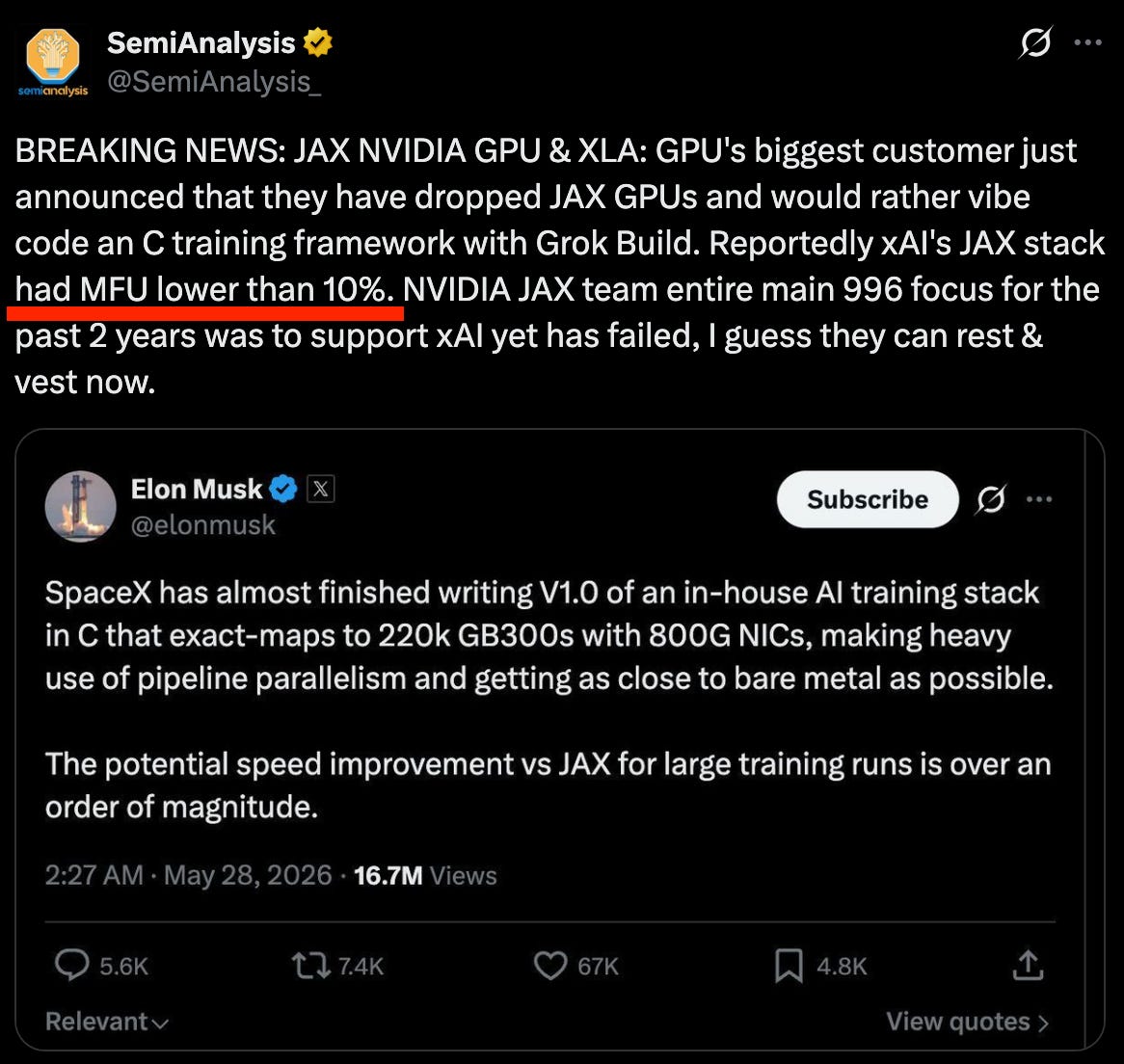
A futures market for GPU compute is not viable yet because the product isn't fungible. The performance of an identical H100 chip varies significantly between cloud providers based on their proprietary software stack and operational excellence, measured by metrics like "goodput" and "MFUs."
Major banks like Goldman Sachs and JPMorgan are exploring compute futures not just for speculation, but as a crucial financial instrument. This allows them and their clients to hedge the multi-billion-dollar risk associated with the massive build-out of data center infrastructure, signaling market maturation.

Creating a true commodity market for AI compute is highly challenging because compute is not uniform. Variations in chips, data center design, and specific customer needs make it difficult to establish a standardized physical delivery product or a trusted index, which are prerequisites for a liquid, tradable market.