Get your free personalized podcast brief
We scan new podcasts and send you the top 5 insights daily.
The podcast's narrative structure highlights extreme societal contradictions by placing interviews with elites, prisoners, and political loyalists side-by-side. This technique suggests that the true nature of American democracy is found not in a single consensus, but in the unresolved tension between these vastly different experiences.

Related Insights
The podcast revisits Alexis de Tocqueville's 1831 journey not as a history lesson, but as an analytical tool. By applying his observations on America as a novel 'idea', the host seeks to measure the extent to which that foundational identity has eroded, questioning whether the nation's core principles and global leadership role still stand.
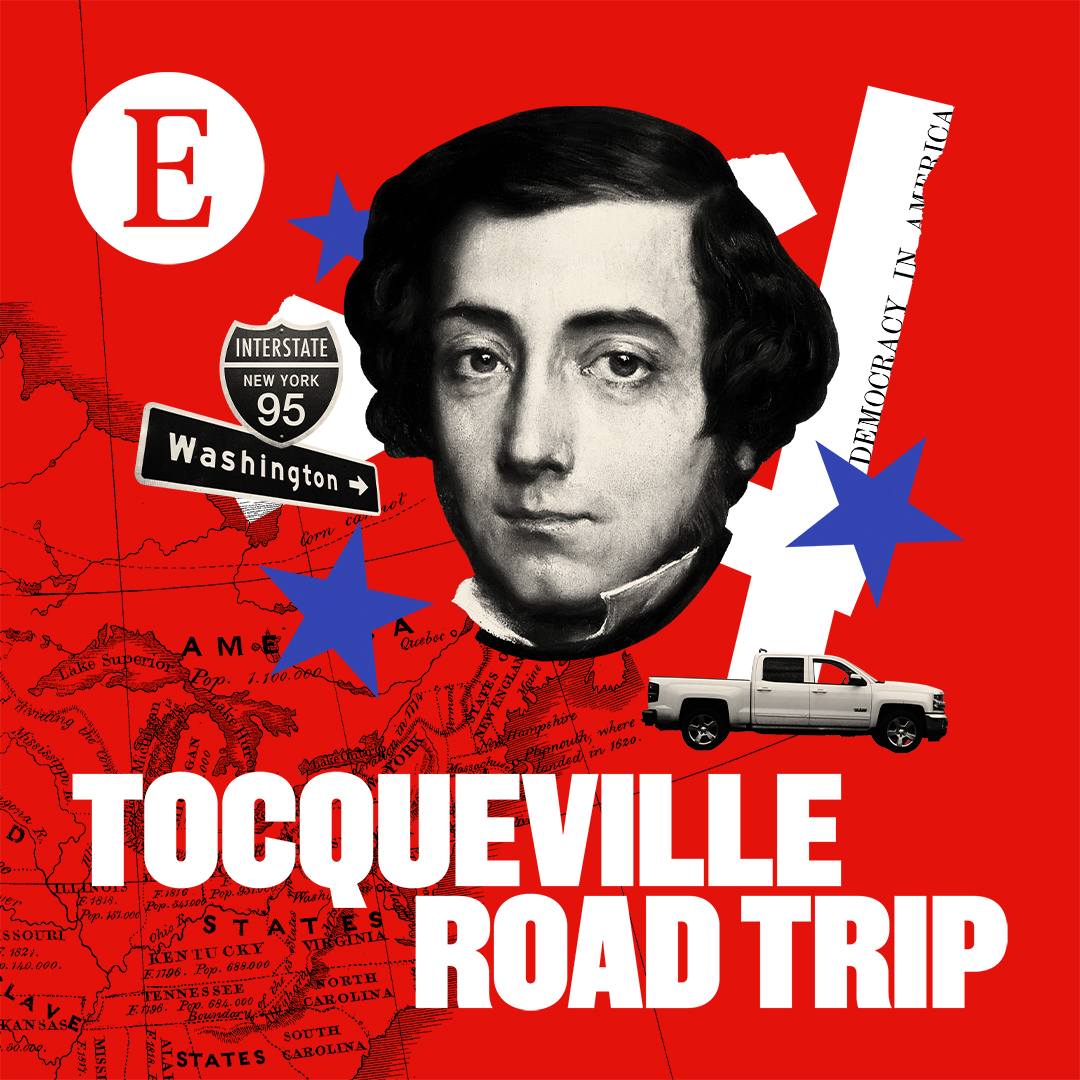
The podcast mirrors Tocqueville’s method of speaking to 'all walks of life,' but with a modern twist. By juxtaposing New York's elite with prisoners, and fervent political supporters with victims of government overreach, it implies that the true state of a nation is revealed not by its mainstream but by the breadth and nature of its most polarized voices.
The lack of a unified national narrative creates profound societal division. America is fractured by two irreconcilable stories: one of colonialist oppression and another of unprecedented prosperity, making a shared identity and collective action impossible.

To grasp America's current state, the podcast host revives Alexis de Tocqueville's 1831 methodology: an extended road trip for in-depth interviews with diverse citizens. This suggests that deep, qualitative immersion is superior to quantitative data for understanding national identity and division.
Stripped of everything, incarcerated individuals in the podcast display a profound belief in self-improvement and second chances, reflecting a core American ideal that many on the outside seem to have lost.
Tocqueville saw America as a powerful 'idea' with the unifying force of a religion. The podcast suggests this civil religion has shattered. Today, the nation is defined by deep divisions where citizens hold opposing, deeply entrenched beliefs—from presidential acolytes to those who see the Constitution as abandoned—indicating a crisis of shared national identity.
The podcast frames contemporary American disillusionment not just as political polarization, but as a crisis of faith in the nation's foundational "idea." This historical lens, borrowed from Tocqueville, recasts the current struggle over national identity as a theological schism within a civil religion.
The podcast highlights a central American paradox by contrasting voices of extreme personal responsibility ("We made choices") with those decrying systemic failure ("The Constitution's been thrown in a dumpster fire"). This suggests a core conflict between America's celebration of individualism and a growing disbelief in the institutions meant to protect individual rights.
The podcast challenges stereotypes by revealing that incarcerated individuals in Sing Sing's reform programs demonstrate a profound sense of responsibility for their past choices. This level of self-reflection is contrasted with what one might find in corporate environments.
The podcast trailer signals its storytelling approach by mixing macro topics like AI and party agendas with tangible, on-the-ground reporting snippets, such as riding in a flying taxi. This method makes complex geopolitical issues relatable and accessible through personal, human-scale stories.