Get your free personalized podcast brief
We scan new podcasts and send you the top 5 insights daily.
The effectiveness of modern daratumab-based therapies has significantly improved patient outcomes. This positive development paradoxically made previous staging systems, founded in eras with less effective treatments, unable to accurately identify the highest-risk patients, necessitating the creation of a new prognostic model for the current era.

Related Insights
The Uromigos score (0-3) provides a rapid expert consensus on new treatments. It bridges the gap between slow, formal guidelines and long, unprioritized lists of approved therapies, offering a more immediate assessment of a drug's place in the standard of care.

The future of medicine isn't about finding a single 'best' modality like CAR-T or gene therapy. Instead, it's about strategic convergence, choosing the right tool—be it a bispecific, ADC, or another biologic—based on the patient's specific disease stage and urgency of treatment.

Voyager CEO Al Sandrock suggests the 30% average efficacy of new Alzheimer's drugs isn't uniform. Instead, some patients may see a complete halt in progression while others see no benefit. He argues the next critical step is predicting these responders, which will determine whether future therapies like anti-tau agents should be added on or used as a replacement.

The former high-risk group (Stage 3b) was traditionally excluded from major clinical trials. The new staging system demonstrates that these patients have better-than-expected outcomes with modern therapy and should be included in future studies. It simultaneously identifies a new ultra-high-risk group (Stage 3c) that requires entirely different trial designs.
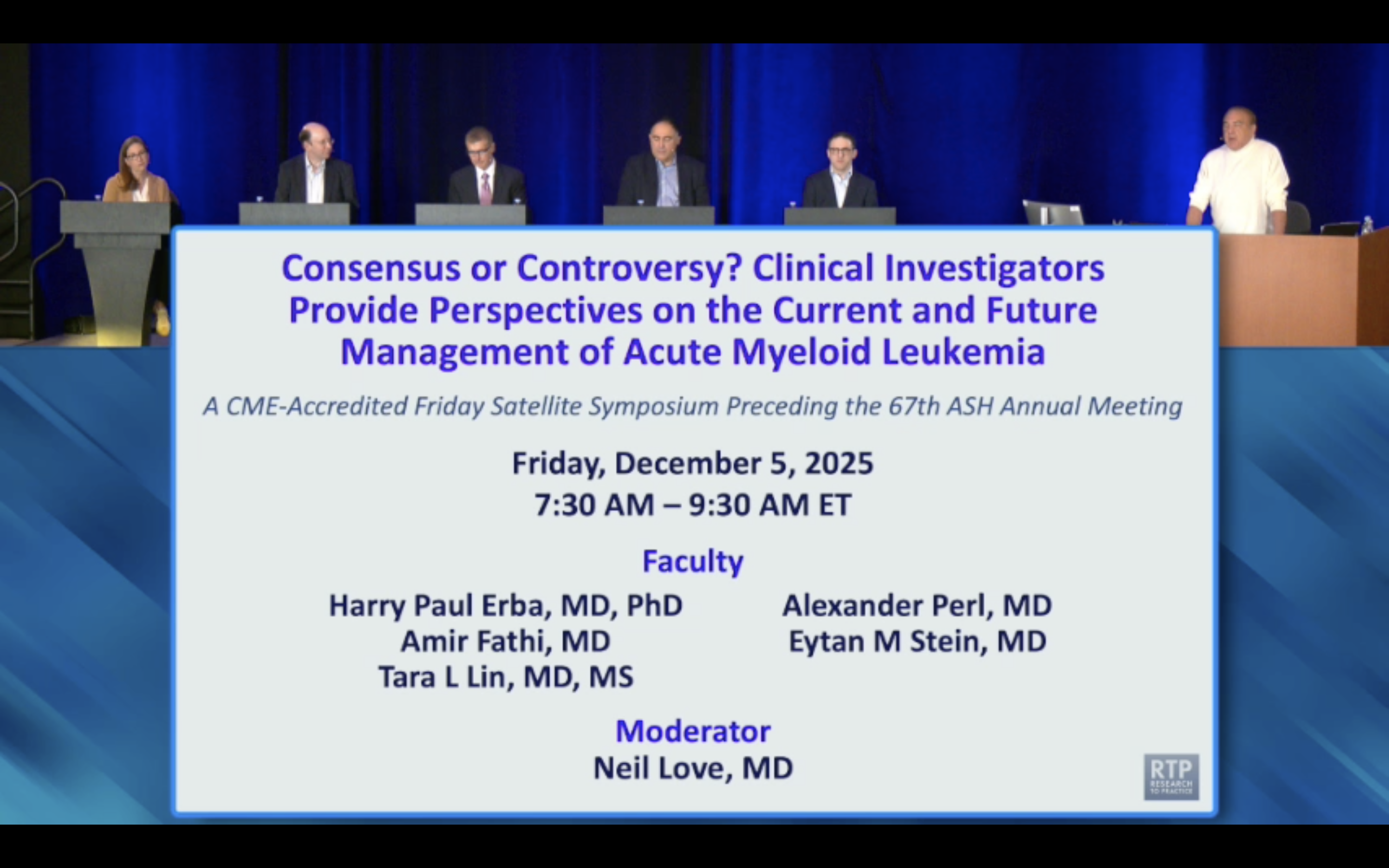
Traditional age cutoffs for AML therapy are becoming obsolete. A comprehensive fitness assessment, not just chronological age, should guide treatment, as some guidelines now classify patients as young as 55 as "older adults," a surprising shift for many clinicians.
The Rampart study's use of the Leibovic score for risk stratification is a key strength. Unlike traditional TNM staging, this score more heavily weights tumor grade, which clinicians find to be a more granular and clinically relevant predictor of recurrence risk than just tumor size.
For the newly defined ultra-high-risk Stage 3c patients, early death is primarily caused by severe organ dysfunction, not the underlying plasma cell malignancy. This indicates a strategic shift is needed for this population, requiring trials that focus on therapies like antifibril antibodies which directly clear amyloid deposits from organs to improve function.
Recent non-inferiority trials affirm that fixed-duration combination therapies are viable alternatives to continuous BTK inhibitors. However, clinicians must look beyond the headline conclusion, as numerical data can show slightly worse progression-free survival for high-risk subgroups within the acceptable non-inferiority margin, complicating treatment decisions.
TP53-mutated AML carries an extremely poor prognosis, significantly worse than other adverse-risk subtypes. When TP53 patients are excluded from analyses, the survival gap between the remaining adverse-risk and intermediate-risk patients narrows considerably, clarifying risk stratification.
The successful KEYNOTE-564 trial intentionally used a pragmatic patient selection model based on universally available pathology data like TNM stage and grade. This approach avoids complex, inconsistently applied nomograms, ensuring broader real-world applicability and potentially smoother trial execution compared to studies relying on more niche scoring systems.